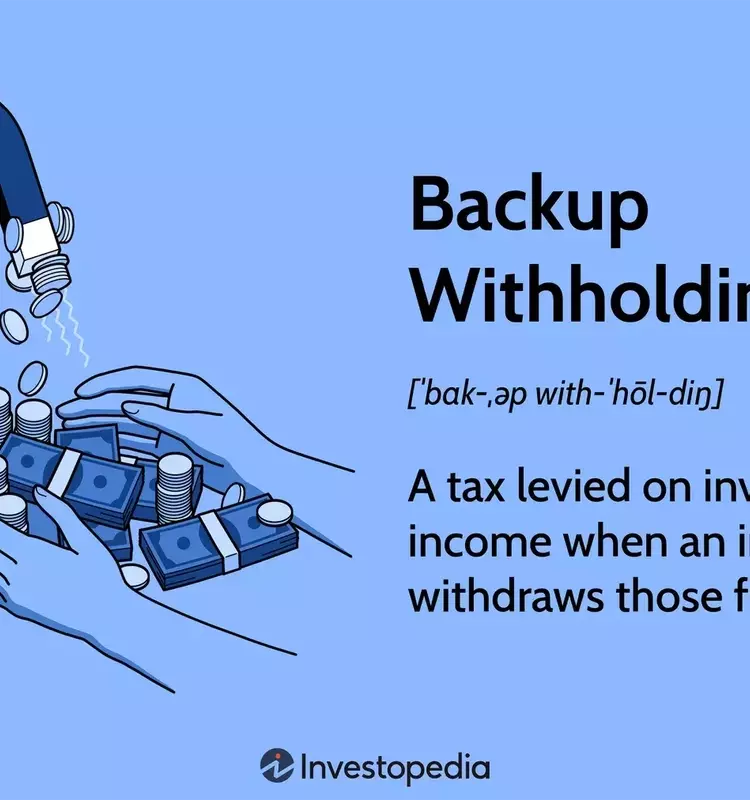
Governments, through agencies like the Internal Revenue Service (IRS) in the U.S. or the Canada Revenue Agency, utilize a system known as backup withholding to guarantee the collection of taxes on specific types of investment income. This measure acts as a safeguard against potential tax shortfalls, particularly when investors might otherwise spend their earnings before their annual tax obligations are due. While seemingly a direct deduction, the withheld funds are ultimately credited towards the investor's total tax bill, potentially resulting in a refund.
The Mechanics of Backup Withholding: How Investment Income is Taxed Proactively
Backup withholding primarily comes into play when investors receive certain forms of income from their assets, such as interest payments, dividends, and distributions. Unlike regular employment income, which is typically subject to ongoing payroll withholding, taxes on investment earnings are usually reconciled at the end of the calendar year during tax season. This temporal gap creates a risk for tax authorities: investors might deplete their investment gains before the tax due date, making collection challenging and costly.
To mitigate this risk, financial institutions and other payers are sometimes mandated to withhold a portion of these earnings at the point of withdrawal or payment. This ensures that a predetermined amount, usually at a rate like 24% for the IRS, is sent directly to the tax-collecting body. For instance, if an investor withdraws $1,000 in dividends, and backup withholding applies, $240 would be sent to the IRS, leaving the investor with $760. This immediate collection provides the government with funds without delay.
Several specific circumstances can trigger backup withholding. A common scenario involves an investor failing to provide a correct Taxpayer Identification Number (TIN), such as a Social Security Number (SSN), to the payer. When there's a discrepancy between the provided information and the records held by the tax authority, or if the investor hasn't properly certified their tax status, backup withholding may be instituted. Furthermore, if an investor consistently underreports interest or dividend income on their tax returns, the IRS may issue a series of notices, eventually leading to mandatory backup withholding on future payments. Other payments that can be subject to this measure include government transfers, rents, royalties, commissions, and even certain gambling winnings that aren't already subject to standard withholding procedures. However, many taxpayers are exempt from this process, particularly those who have accurately provided their TIN/SSN to their financial intermediaries, ensuring their information aligns with tax authority records. Retirement benefits and unemployment compensation are also typically not subject to backup withholding.
The Broader Implications of Proactive Tax Collection
From an investor's perspective, backup withholding can be a double-edged sword. On one hand, it ensures compliance with tax laws and prevents the accumulation of a large, unexpected tax bill at year-end. On the other hand, it can reduce immediate cash flow, potentially limiting an investor's ability to reinvest or use funds for other purposes. However, it's crucial to remember that the amounts withheld are not additional taxes but rather a prepayment of existing tax liabilities. These withheld sums are factored into the annual tax filing, and if an overpayment occurs, the investor will receive a refund. This system underscores the government's commitment to maintaining fiscal stability by ensuring a steady and reliable stream of tax revenue, even from less predictable income sources like investments. It also highlights the importance for investors to maintain accurate and up-to-date tax identification information with their financial institutions to avoid unnecessary withholding.
", "date": "2023-11-20 10:00:0