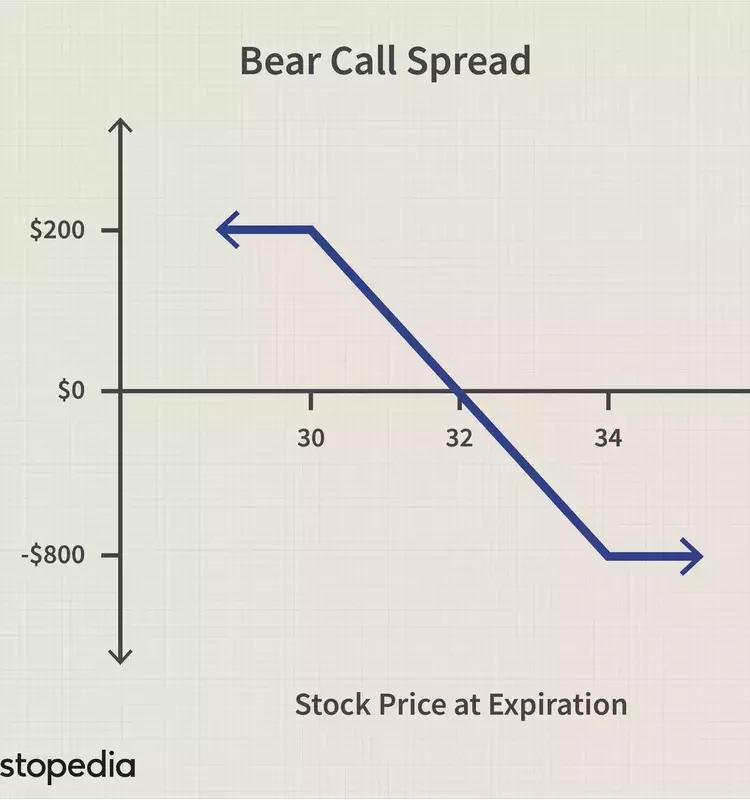
A bear call spread is an options trading strategy that limits both potential profit and risk. It is employed by traders who anticipate a moderate decline in an asset's price. This strategy involves selling a call option at a lower strike price and simultaneously purchasing a call option at a higher strike price, with both options sharing the same expiration date. This structured approach allows investors to cap their potential losses while aiming for a predetermined maximum profit if the underlying asset's value falls below the lower strike price. It's often favored in moderately declining markets, offering a more conservative alternative to direct short selling.
Delving Deeper into Bear Call Spreads
In the dynamic realm of options trading, the bear call spread stands as a sophisticated instrument for investors predicting a mild downturn in an asset's valuation. This strategy, also known as a bear call credit spread, is a carefully constructed trade that combines selling a call option at a specific, lower strike price with buying another call option at a higher strike price. Crucially, both options must pertain to the same underlying asset and share an identical expiration date. This dual-action approach is not merely about speculation; it's a calculated move to mitigate risk while still capitalizing on a bearish market outlook.
For instance, consider an investor observing a stock trading at $30, anticipating a slight dip. This investor might initiate a bear call spread by selling a call option contract with a strike price of $35 for a premium of $2.50 per share (totaling $250 for a standard 100-share contract). Simultaneously, they would purchase another call option contract with a higher strike price of $40 for a premium of $0.50 per share (or $50 for the contract). This transaction results in a net credit of $200 for the investor ($250 received - $50 paid), which represents the maximum potential profit.
The mechanics of this strategy become clear when we consider different scenarios at expiration:
- Asset Price Falls Below $35: If the stock's price at expiration is below $35, both call options expire worthless. The investor retains the initial net credit of $200, realizing the maximum profit.
- Asset Price Between $35 and $40: If the stock settles, for example, at $37, the sold call option (strike $35) would be exercised against the investor, meaning they are obligated to sell shares at $35. However, the purchased call option (strike $40) expires worthless. In this case, the investor would incur a loss if they had to buy shares at the current market price of $37 to fulfill their obligation, subtracting the initial $200 credit.
- Asset Price Above $40: Should the stock price soar above $40, both call options would be exercised. The investor would be compelled to sell shares at $35 (from the sold option) and would exercise their right to buy shares at $40 (from the purchased option). This creates a loss of $500 ($40 - $35 = $5 difference per share, multiplied by 100 shares), which is then offset by the initial $200 net credit, resulting in a maximum net loss of $300.
The breakeven point for this specific example is calculated by adding the net credit received to the strike price of the sold call option. So, $35 (sold call strike) + $2 (net credit per share) = $37. If the stock price is above $37 at expiration, the investor incurs a loss. Conversely, if it is below $37, they make a profit, up to the maximum of $200 if it drops below $35.
This strategy offers a compelling risk-reward balance, making it suitable for those who believe an asset will decline but want to protect themselves from significant upward price movements. It stands in contrast to a bull call spread, which is used when an investor anticipates a moderate price increase.
The bear call spread is a valuable tool in an investor's arsenal, particularly when market conditions suggest a mild downturn. By clearly defining both maximum profit and loss at the outset, it allows for strategic participation in bearish movements without the open-ended risks associated with simpler, more aggressive options strategies.
