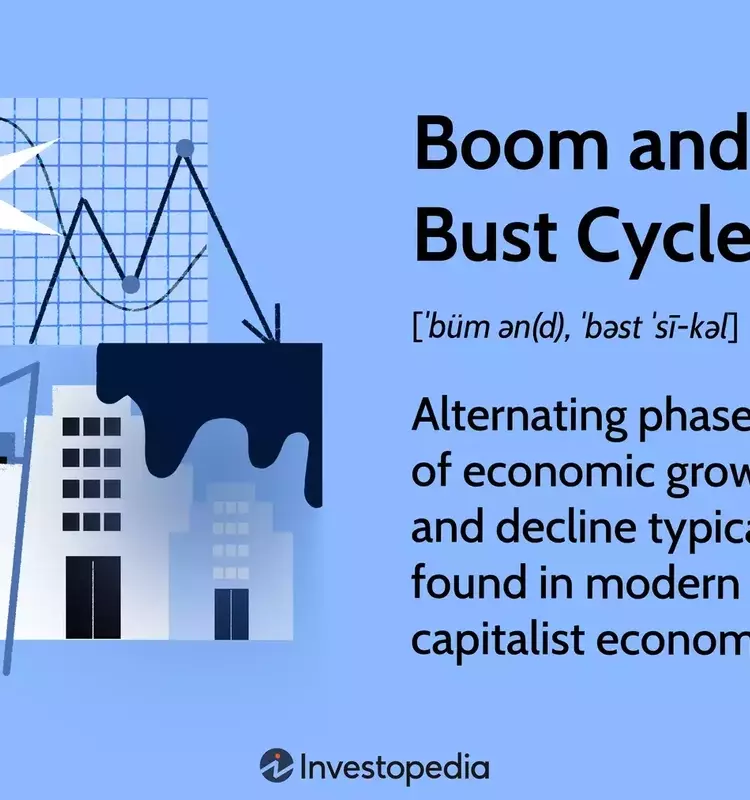
Navigating the Waves: Understanding Economic Cycles
The Rhythmic Flow of Economic Activity
The concept of alternating periods of prosperity and downturns is an informal way to describe the economic cycle. This cyclical pattern of expansion and contraction is a defining characteristic of market-based economies, often referred to as the business cycle.
Prosperity and Decline: How Economic Cycles Unfold
During phases of economic prosperity, known as booms, the economy experiences robust growth, employment opportunities abound, and investments yield strong returns. Conversely, in the subsequent downturns, or busts, the economy contracts, leading to job losses and diminished investment values. These fluctuations vary in duration and intensity.
Central Banks and the Fluctuation of the Economy
Since the mid-20th century, the United States has undergone numerous economic cycles. The persistence of these cycles, rather than continuous steady growth, is largely attributed to how central banks manage the money supply. When a central bank facilitates access to credit by offering low interest rates during a boom, individuals and businesses can readily borrow and invest, for instance, in technology stocks or real estate, driving economic expansion.
The Perils of Excessive Investment and Market Corrections
However, when credit becomes overly accessible and interest rates remain too low, it can lead to excessive investment, a phenomenon known as "malinvestment." This can result in an oversupply of assets, such as housing, eventually leading to a market correction. During these bust periods, asset values plummet, investors incur losses, consumer spending decreases, and companies reduce their workforce. Access to credit tightens as borrowers struggle to meet their obligations. Severe downturns are termed recessions, with extreme cases referred to as depressions.
Beyond Monetary Policy: Psychological and Governmental Influences
A decline in confidence further exacerbates economic downturns. When financial markets experience significant corrections or crashes, investors and consumers become apprehensive. Investors tend to liquidate their holdings and seek refuge in safer assets like bonds or gold, while job-losing consumers prioritize essential purchases, intensifying the economic spiral.
Economic downturns eventually self-correct as asset prices fall to levels that entice new investment. However, this recovery can be prolonged, potentially leading to a depression. Swift intervention through central bank monetary policy and governmental fiscal measures can accelerate the restoration of confidence.
Furthermore, government incentives that reduce the cost of investment can inadvertently contribute to these cycles by encouraging overinvestment in specific areas. For example, tax deductions for mortgage interest can spur increased homeownership, potentially fueling housing bubbles.
Understanding the Drivers of Economic Cycles
Economic cycles are influenced by a multitude of factors, with the cost and availability of capital, alongside future expectations, being particularly significant. When borrowing is easy, businesses are more inclined to invest in equipment and expand their workforce, which boosts employment and consumer spending. Conversely, when borrowing becomes expensive, businesses cut costs, leading to a reduction in economic activity.
The Federal Reserve's Role in Economic Stabilization
Like other central banks, the Federal Reserve endeavors to mitigate economic fluctuations by adjusting interest rates. During periods of high unemployment, the Fed lowers interest rates to encourage businesses to borrow and expand. When inflation escalates, the Fed raises rates to incentivize businesses to scale back operations.
Forecasting Economic Trends: Indicators and Insights
Economists monitor various metrics to predict shifts in economic activity. Changes in producer prices and the production of durable goods serve as crucial leading indicators, as businesses often reduce output in anticipation of a downturn. The monthly jobs report is another vital indicator, reflecting both employer sentiment and consumer purchasing power.
The Ever-Present Economic Pendulum
The boom and bust cycle describes the inherent fluctuations between economic prosperity and depression. During favorable economic conditions, businesses thrive, leading to increased spending and employment. Conversely, a weaker economy makes borrowing more challenging, resulting in higher prices, reduced employment, and consequently, lower consumer spending and diminished corporate profitability. The continuous prediction and moderation of these economic cycles remain a central focus for economists and policymakers worldwide.
