Understanding Business Ecosystems: Collaboration, Competition, and Evolution
Finance

Understanding Business Ecosystems: Collaboration, Competition, and Evolution

authorBy Strive Masiyiwa
DateApr 27, 2026
Read time3 min

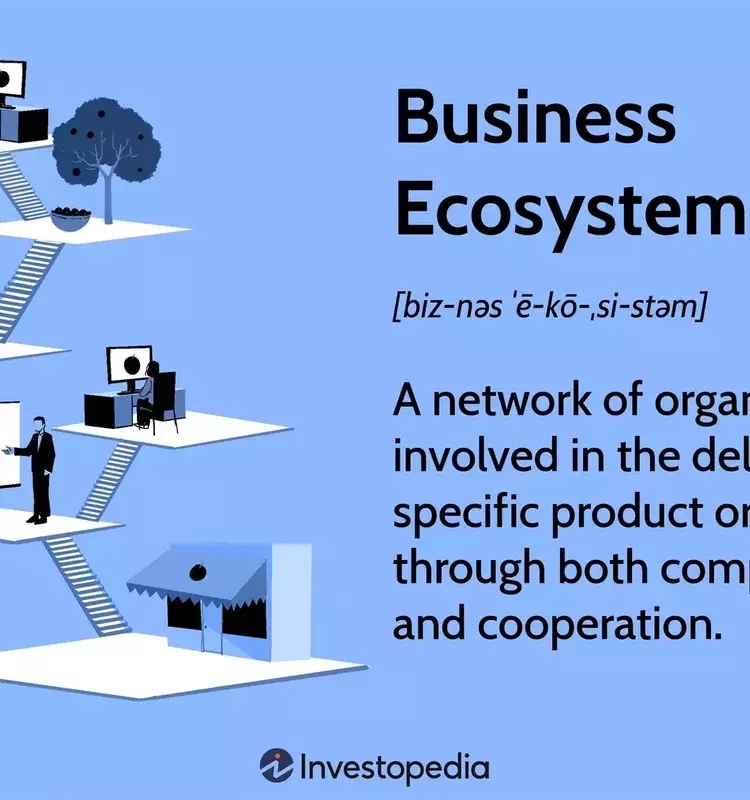
In today's dynamic commercial landscape, the concept of a business ecosystem has become increasingly vital for understanding how enterprises operate and flourish. This intricate network involves various entities, including suppliers, distributors, and even governmental bodies, all engaged in a delicate balance of cooperation and rivalry to bring forth products and services. Much like a natural ecosystem where organisms adapt and interact for survival, businesses within this framework must demonstrate flexibility and responsiveness to continuous market shifts.

The term "ecosystem" was first introduced by British botanist Arthur Tansley in the 1930s to describe the interplay between living organisms and their environment. Business strategist James Moore later adapted this biological analogy in his seminal 1993 Harvard Business Review article, "Predators and Prey: A New Ecology of Competition." Moore posited that companies should be viewed not in isolation but as integral components of a larger business ecosystem, transcending traditional industry boundaries. This perspective is particularly relevant in an era of rapid technological advancement and increasing globalization, where interconnectedness is key to navigating evolving market conditions.

Moore's definition of a business ecosystem highlights an economic community supported by a foundation of interacting organizations and individuals. This community works collectively to create valuable goods and services for its customers, who are also considered part of the ecosystem. Key participants include suppliers, lead producers, competitors, and various other stakeholders. These entities co-evolve their capabilities and roles over time, often aligning their efforts with one or more central companies. While leadership roles may shift, the function of an ecosystem leader is highly valued as it facilitates shared visions, aligned investments, and mutually supportive relationships among members.

The inherent strength of a business ecosystem lies in its ability to create formidable entry barriers for new competitors. Entrants must not only match or surpass existing core products but also contend with the entire independent network of complementary businesses and suppliers. Participation in a robust business ecosystem offers mechanisms to leverage cutting-edge technology, foster excellence in research and competence, and effectively compete in the marketplace. Beyond commercial success, business ecosystems also aim to drive new collaborations to tackle pressing social and environmental challenges, harness creativity and innovation to reduce production costs or reach new customers, accelerate learning processes through shared insights and expertise, and ultimately create novel solutions for fundamental human needs.

In this rapidly changing global economy, it is imperative for companies to either cultivate their own thriving ecosystems or strategically integrate into existing ones by offering distinct advantages. This proactive approach ensures sustained growth and resilience in a world where collaboration and adaptability are paramount.

More Articles
Finance
Janus Henderson MBS ETF: A High-Quality Investment with Attractive Yield
The Janus Henderson Mortgage-Backed Securities ETF (JMBS) offers investors exposure to high-quality, agency mortgage-backed securities with a moderate duration. Its portfolio demonstrates resilience against market downturns and volatility. With an impressive 5.5% dividend yield, JMBS provides a consistent income stream. The fund has also shown strong performance since its inception, consistently outperforming its benchmark.
By Suze OrmanApr 27, 2026
Finance
YieldMax HOOD Option Income Strategy ETF: A Critical Analysis of Its Performance and Investment Strategy
The YieldMax HOOD Option Income Strategy ETF (HOOY) has been underperforming, failing to mirror the total returns of Robinhood (HOOD) stock, especially during market upturns. It exposes investors to significant downside risk while limiting upside potential, making it an unsuitable choice for high-beta stocks. The fund's high distribution rate of 108% largely consists of return of capital, leading to a substantial 40% price drop over the past year. Given its high expense ratio of 0.99% and inherent structural flaws, HOOY is rated a 'Sell.' Investors are advised to consider a direct investment in HOOD stock instead.
By Nouriel RoubiniApr 27, 2026
Finance
Circle Internet Group's USDC: A Promising Investment Despite Regulatory Volatility
This article discusses the investment opportunity in Circle Internet Group, the issuer of the USDC stablecoin, amidst recent regulatory uncertainties. Despite market volatility, USDC has shown resilience, with a year-to-date increase of approximately 20%. The author views a recent 30% price correction as a strategic buying opportunity, reiterating a buy rating. The company's revenue model relies on reserve returns and yield-sharing, with growth in payments and subscriptions identified as key catalysts for future upside. The base case projects significant adjusted EBITDA growth for the current year, driven by the expansion of its payments network.
By Fareed ZakariaApr 27, 2026
Finance
Third Avenue Small-Cap Value Fund Invests in Compass, Inc.
Third Avenue Small-Cap Value Fund has strategically acquired shares in Compass, Inc., a technology-driven real estate brokerage. Despite current industry headwinds like rising mortgage rates and affordability issues impacting transaction volumes, Compass's recent merger with Anywhere Real Estate has positioned it as a dominant global platform. The company anticipates substantial profitability once market conditions stabilize, leveraging its operational efficiency and expanded market presence.
By Robert KiyosakiApr 27, 2026
Finance
Albany International: Limited Upside Ahead of Earnings Report
Albany International (AIN) stock is currently rated as a 'hold' due to its inconsistent financial performance and unattractive valuation. While the company has shown revenue growth, it continues to struggle with profitability, particularly in its Machine Clothing division. The Engineered Composites segment, however, exhibits some strength, driven by recent acquisitions and defense contracts. Management anticipates a decline in Q1 2026 revenue and lower earnings per share, suggesting a cautious outlook for the company's near-term prospects.
By Michele FerreroApr 27, 2026