Unlock the Power of Appreciation: Maximizing Your Investment Returns
Decoding Capital Gains Yield (CGY): A Fundamental Investment Concept
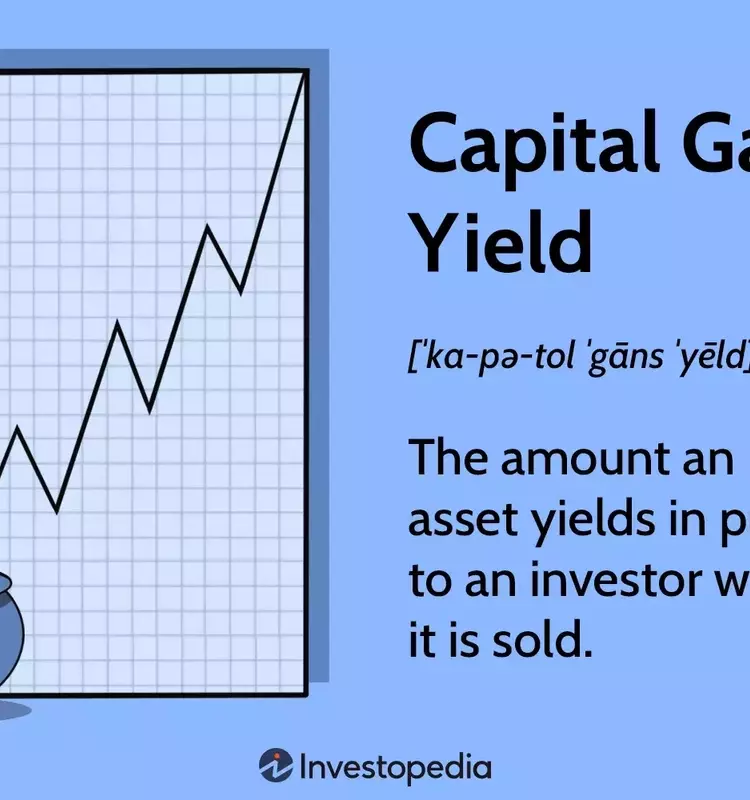
Capital Gains Yield (CGY) quantifies the appreciation in the market value of an investment, such as common stock or bonds. It's determined by dividing the increase in the security's price by its initial purchase price. This metric offers a snapshot of how much an investment's value has grown, but it's essential to remember that it focuses solely on price appreciation, excluding any income generated from dividends or interest.
The Mechanism of Capital Gains Yield: Simplicity in Calculation
Calculating CGY is relatively simple, requiring just two key pieces of information: the original purchase price of the security and its current market price. This direct approach makes it an accessible tool for investors looking to quickly assess the price growth of their assets.
The Significance of Capital Gains Yield in Investment Evaluation
Investors must consider both CGY and the total return yield when assessing an investment. While CGY focuses purely on price appreciation, the total return encompasses both capital gains and any dividends received. For investments that do not generate cash flow, CGY alone represents the total return. It acts as a barometer for predicting the future price movement of a security over time. Conversely, if a stock's value declines, it results in a capital loss. A higher share price at the point of sale indicates a more substantial capital gain, signifying superior stock performance. Furthermore, CGY is intrinsically linked to the Gordon Growth Model, where for consistently growing stocks, it aligns with the constant growth rate.
Practical Applications: Illustrative Examples of Capital Gains Yield
Let's consider practical examples to understand CGY better. If an investor buys shares of company ABC for $200 and later sells them for $220, the CGY is 10% (calculated as ($220-$200)/$200). In the year 2020, Tesla demonstrated an extraordinary CGY of 743%, with its stock price soaring from $83.67 to $705.67. During the same period, Nike recorded a CGY of 46% (from $101.31 to $141.47), and Netflix saw a 67% CGY (from $323.57 to $540.73).
Key Considerations and Nuances of Capital Gains Yield
CGY is inherently unpredictable, as market prices can fluctuate monthly, quarterly, or annually, unlike the fixed schedule of dividend payouts. An investment only generates CGY if its selling price exceeds the original purchase price. It's crucial to distinguish between high-dividend stocks, which might offer lower capital gains due to less reinvestment into the company, and growth stocks, which prioritize reinvesting profits for higher capital appreciation over dividend distribution. Investors often use CGY to gauge price volatility and make informed decisions about potential securities. It's also important to remember that capital gains can incur taxes, though these can often be offset by capital losses or carried over to subsequent tax years.
The Essential Role of Capital Gains Yield in Investor Assessment
Capital gains yield serves as an indispensable metric for investors to ascertain the success of their investments through price appreciation. However, recognizing its limitations is equally vital. CGY specifically excludes income from dividends or interest, meaning it should not be considered a standalone measure of total return. A comprehensive investment analysis requires looking beyond just capital gains to include all forms of return.
Calculating Capital Gains Yield for Fixed-Income Securities: Bonds
The methodology for calculating capital gains yield for bonds mirrors that of stocks. It involves dividing the increase in the bond's price by its original purchase price. For instance, if a bond acquired for $100 appreciates to $120, its capital gains yield is 20%.
Distinguishing Capital Gains Yield from Current Yield in Bonds
While both metrics relate to bonds, capital gains yield focuses on price appreciation, whereas current yield measures the income generated by the bond. Specifically, a bond's current yield is calculated by dividing its annual interest income by its current market price, providing insight into the income component of a bond investment.
Capital Gains Yield vs. Holding Period Return: A Clear Distinction
Capital gains yield, as established, excludes any income generated from the investment, such as interest or dividends. In contrast, the holding period return offers a holistic view of an investment's performance, encompassing both the income earned and the capital appreciation over the entire duration it was held.
