Understanding Consumer Durables: Key Economic Indicators
Finance

Understanding Consumer Durables: Key Economic Indicators

authorBy Robert Kiyosaki
DateJul 17, 2026
Read time2 min
This article explores the concept of consumer durables, their economic significance, and how they differ from nondurable goods, providing a comprehensive overview for better understanding consumer behavior and economic trends.

Long-lasting goods, lasting economic impact.

Defining Consumer Durables: An Overview

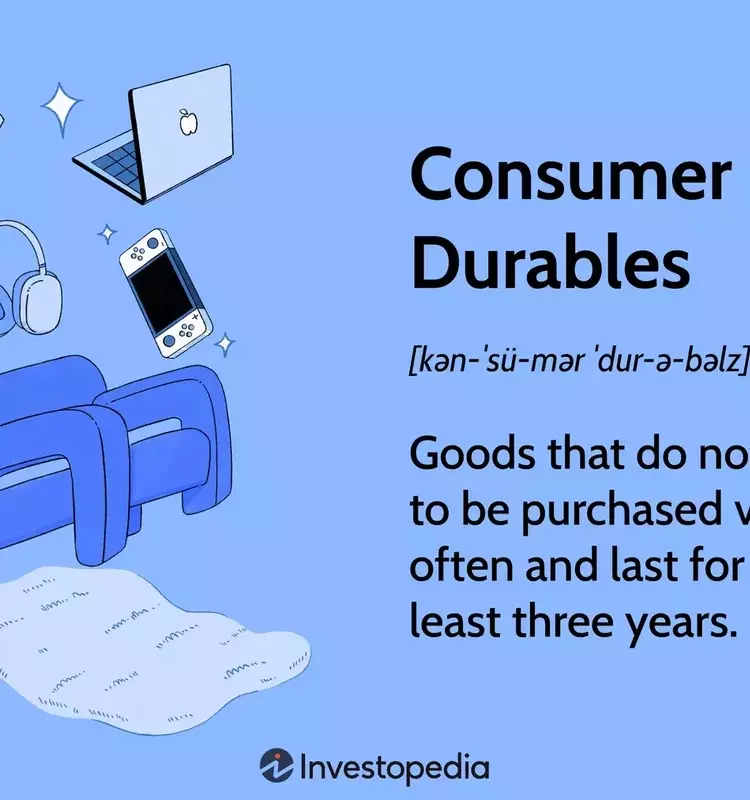
Consumer durables are a category of goods that offer extended utility and are not subject to frequent replacement. These items are characterized by their longevity, typically lasting three years or more, as defined by economic standards. They encompass a wide range of products, including household appliances, electronics, and various types of furnishings.

The Economic Significance of Durable Goods

Durable goods play a crucial role in reflecting an individual's financial stability and the broader economic health. By investing in these long-lasting assets, consumers effectively preserve their wealth over time. This sustained economic value makes durable goods a key focus for investors, business leaders, and economists. Trends in durable goods consumption and new orders are closely watched indicators, often preceding shifts in the gross domestic product (GDP) and signaling the direction of economic growth.

Durable vs. Nondurable Goods: A Fundamental Distinction

The primary differentiator between durable and nondurable goods lies in their lifespan and sustained value. Durable goods are designed to last for a minimum of three years, retaining their economic worth for an extended period. In contrast, nondurable goods are consumed or replaced within a shorter timeframe, typically less than three years. Generally, durables represent a more significant financial commitment, leading to increased purchases during periods of economic prosperity. However, exceptions can occur, such as the unexpected surge in durable goods spending during the COVID-19 pandemic, driven by reduced service consumption and increased disposable income from government aid.

Categorization of Consumer Expenditures

Economic analysis categorizes personal consumption into two main components: goods and services. Goods are further divided into durable and nondurable categories. As of December 2024, total personal consumption expenditures in the U.S. economy reached $16.35 trillion. Of this, goods accounted for $5.61 trillion, with durable goods contributing $2.15 trillion. The growth in this sector was notably propelled by recreational goods, vehicles, and motor vehicles and their associated parts.

Publicly Traded Companies in the Durable Goods Sector

Several publicly listed companies specialize in the production of consumer durables. These include major players like Kimberly-Clark Corp., ABB Ltd., Johnson Controls International PLC, The Clorox Co., Mohawk Industries, and Whirlpool Corp. These companies operate across various subsectors, such as containers and packaging, electrical products, industrial specialties, specialty chemicals, home furnishings, and consumer electronics and appliances.

More Articles
Finance
Active Management Shines: PBDC Outperforms BIZD in BDC ETF Battle
This article evaluates two BDC-focused ETFs, PBDC and BIZD, highlighting the superior performance of actively managed PBDC since its 2022 inception. PBDC boasts higher yields and greater transparency, investing almost entirely in BDCs, unlike BIZD which holds a significant portion in T-Bills. BIZD's recent distribution cut further underscores PBDC's resilience. The analysis concludes that PBDC is the preferred choice for BDC exposure.
By Mariana MazzucatoJul 17, 2026
Finance
monday.com Poised for Strong Growth with Innovative AI-Powered Platform
monday.com is identified as a leader in work management, leveraging AI to enhance employee value and revenue. Its new 'seats + credits' pricing model enables efficient monetization of both human and AI workflows, forecasting over 20% revenue growth and margin improvement. The company offers credible upside with annualized returns of 26% over five years, making it a strong buy despite competitive risks.
By Mariana MazzucatoJul 17, 2026
Finance
Apple Hospitality REIT: A Rally With Limited Further Upside
Apple Hospitality REIT has experienced a remarkable surge of nearly 48% in three months, outperforming most REITs, yet it now appears to be fairly valued. The company's portfolio boasts diversification, a focus on guest rooms, and benefits from a constrained supply of new hotels, ensuring steady operational results. However, growth in Modified Funds From Operations (MFFO) per share remains subdued, with both management and market projections indicating only marginal future gains. This analysis initiates coverage on APLE with a "Hold" rating, reflecting its modest growth prospects and the recent valuation rebound that curtails additional upward potential.
By Suze OrmanJul 17, 2026
Finance
Nasdaq 100 Faces Potential Correction as Tech Stocks Stumble
The Nasdaq 100 has demonstrated significant weakness this week, underperforming other major U.S. equity indices. This dip is attributed to investors re-evaluating highly-valued AI and semiconductor firms, shifting focus towards sustainable earnings rather than growth narratives. Increased volatility in semiconductor stocks indicates broader market risks, with the Nasdaq 100 nearing a critical technical support level. A breach could initiate a multi-week corrective decline.
By Nouriel RoubiniJul 17, 2026
Finance
Identifying High-Yield Retirement Investments with Sustainable Income
Many high-yield investment options present risks of capital erosion and dividend reductions, making them unsuitable for long-term income strategies. While the S&P 500 typically offers an average annual return of 10%, attempting to surpass this consistently through high-coupon investments without asset value decline is challenging. This article introduces two investment selections offering over 12% yield, which are identified as robust choices for maintaining a steady income stream and are currently more attractive for purchase.
By Fareed ZakariaJul 17, 2026