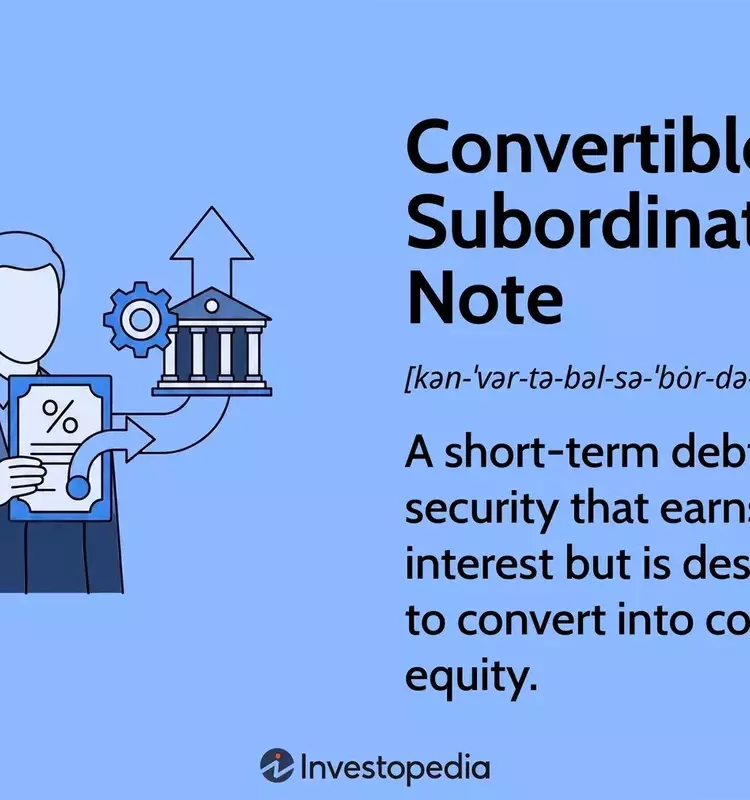
Convertible subordinated notes represent a hybrid financial instrument, functioning as a short-term debt security that offers the unique option for investors to convert them into the issuing company's common stock. While providing a pathway to equity participation, their 'subordinated' nature places them lower in the repayment hierarchy during liquidation compared to other debt obligations, positioning them as a moderate-risk investment.
A convertible subordinated note is essentially a short-term bond issued by a corporation, granting the holder the right to exchange it for common stock of the same company. The defining characteristic of these notes is their convertibility feature, which allows investors to partake in potential stock price appreciation. However, they are also 'subordinated,' meaning that in the unfortunate event of the issuing company's bankruptcy and subsequent asset liquidation, these notes are repaid only after all other, more senior debt obligations have been satisfied. Despite this, they still hold a higher claim to repayment than common stockholders.
The conversion mechanism is a crucial aspect of these notes. Investors can convert their notes into a predetermined number of common shares, calculated based on a set conversion price and the note's par value. For instance, a $1,000 note with a conversion price of $50 would yield 20 shares. This convertibility is often a trade-off for a lower interest rate compared to non-convertible debt, as investors gain the potential for equity-like returns. The value of these notes tends to correlate with the issuing company's stock price, making them susceptible to market volatility. Consequently, they offer the possibility of substantial capital gains but also carry the risk of losses, differing from traditional fixed-income securities that are typically less sensitive to equity market movements.
The conversion process can be initiated either voluntarily by the noteholder or mandatorily by the issuing company. Voluntary conversion typically occurs when the stock price rises significantly, making conversion financially attractive. Noteholders who choose not to convert receive the face value of their notes at maturity. Conversely, companies might force conversion, often by exercising a call privilege, to reduce long-term debt or streamline their balance sheet. This can be incentivized by increasing common stock dividends, making equity ownership more appealing to noteholders.
Convertible subordinated notes are complex financial instruments, offering investors a blend of debt income and equity potential. Their subordinate ranking in the capital structure means they carry more risk than senior debt but less than common stock. The decision to convert, whether voluntary or forced, is influenced by market conditions and the strategic objectives of both the investor and the issuing company. This hybrid nature makes them a unique consideration for investors seeking both income and growth potential, balanced against an understanding of their specific risk profile.
