Understanding the Correlation Coefficient: A Guide to Measuring Relationships Between Variables
Unveiling the Interconnections: Your Guide to Correlation Analysis
Defining the Correlation Coefficient
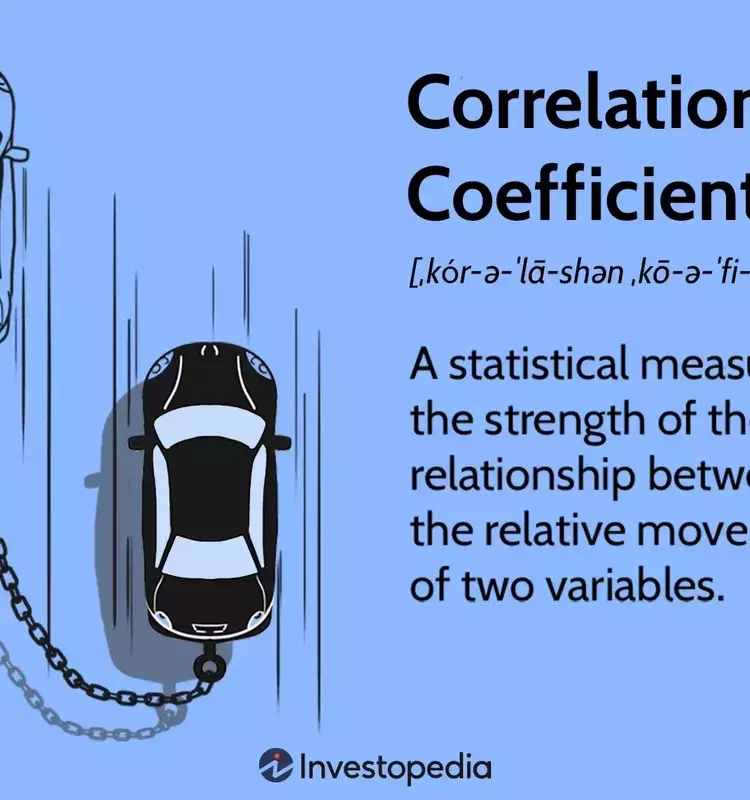
The correlation coefficient serves as a quantitative metric to evaluate both the intensity and the path of a direct association between any two given variables. This measure is crucial for discerning how these variables interact and move in relation to one another. Understanding this relationship is particularly vital in fields like investment, where it assists in the assessment of risks and the construction of optimized financial portfolios.
Exploring the Mechanics of Correlation
Various forms of correlation coefficients exist, each tailored to different data characteristics. Among these, the Pearson coefficient, often referred to as "Pearson's R," is the most widely recognized. It specifically gauges the linear relationship between two variables, indicating both the magnitude and the direction of their association. This coefficient utilizes a statistical formula to determine how closely the data points of two variables align with a straight line, representing the best fit. This line is typically derived through regression analysis, providing a visual and mathematical representation of the data's trend.
Formulating the Correlation Coefficient
To compute the Pearson correlation coefficient, one must first ascertain the standard deviation for each variable, along with their covariance. The coefficient is then derived by dividing the covariance by the product of the two variables' standard deviations. A larger absolute value of the coefficient signifies a stronger correlation, whether positive or negative. A coefficient of 1 or -1 indicates a perfect linear relationship, meaning one variable can be perfectly predicted from the other. Conversely, a value of zero implies no linear relationship exists between the variables.
Applying Correlation in Investment Strategies
In the realm of investments, the correlation coefficient is an invaluable tool for risk evaluation and management. Modern portfolio theory, for instance, emphasizes diversification to mitigate volatility. The correlation coefficient between historical returns of different assets can help investors determine how adding a particular investment will affect the overall diversification and risk profile of their portfolio. Furthermore, quantitative traders often leverage historical correlation data to forecast short-term price movements in securities.
Understanding the Limitations of the Pearson Coefficient
It is important to remember that correlation does not imply causation; the Pearson coefficient cannot establish a cause-and-effect relationship between variables. Moreover, it cannot determine the extent to which one variable's variation is explained by another, a role fulfilled by the coefficient of determination (R-squared). The Pearson coefficient is also unsuitable for analyzing nonlinear relationships or data that does not follow a normal distribution. Its accuracy can also be compromised by outliers, which are data points significantly distant from the general distribution. For such cases, non-parametric methods like Spearman's or Kendall's rank correlation coefficients are more appropriate.
Leveraging Excel for Correlation Coefficient Calculation
Excel offers several straightforward methods for calculating correlation coefficients. For two data series, the built-in CORREL function provides an immediate result. For a more extensive analysis involving multiple datasets, Excel's Data Analysis ToolPak can be enabled through the 'Options' menu. Once activated, this add-in allows users to generate a comprehensive correlation matrix by selecting their data ranges, streamlining the process of analyzing relationships across various financial metrics.
Simplifying Correlation: An Analogy
Consider the relationship between daily temperatures and ice cream sales: as temperatures rise, so do ice cream sales, demonstrating a positive correlation. Conversely, as temperatures climb, heating bill costs decrease, illustrating a negative correlation. However, if we were to compare ice cream sales with the number of people wearing purple shoes, we would likely find no discernible pattern, indicating no correlation. The correlation coefficient quantifies these relationships, making complex data understandable by indicating how closely two phenomena move together, in opposition, or entirely independently.
Distinguishing R from R-squared
While often discussed in conjunction, 'R' and 'R-squared' serve distinct purposes. 'R' denotes the Pearson correlation coefficient, which quantifies the strength and direction of a linear relationship between variables. 'R-squared,' or the coefficient of determination, measures the proportion of variance in the dependent variable that can be predicted from the independent variable(s) in a regression model, essentially indicating how well the model explains the outcome.
Calculating the Correlation Coefficient Explained
The correlation coefficient is computed by taking the covariance between two variables and dividing it by the product of their individual standard deviations. This normalization process ensures the coefficient's value falls within a standardized range, making it universally interpretable regardless of the original data's scale.
Investment Applications of the Correlation Coefficient
In investment, correlation coefficients are vital for portfolio risk assessments and quantitative trading strategies. Portfolio managers frequently monitor the correlations among their holdings to optimize diversification, thereby reducing overall portfolio volatility and risk. By understanding these relationships, investors can make more informed decisions to enhance returns and protect against adverse market movements.
