Understanding the Efficient Frontier in Investment Portfolio Management
Finance

Understanding the Efficient Frontier in Investment Portfolio Management

authorBy Lisa Jing
DateAug 21, 2026
Read time2 min

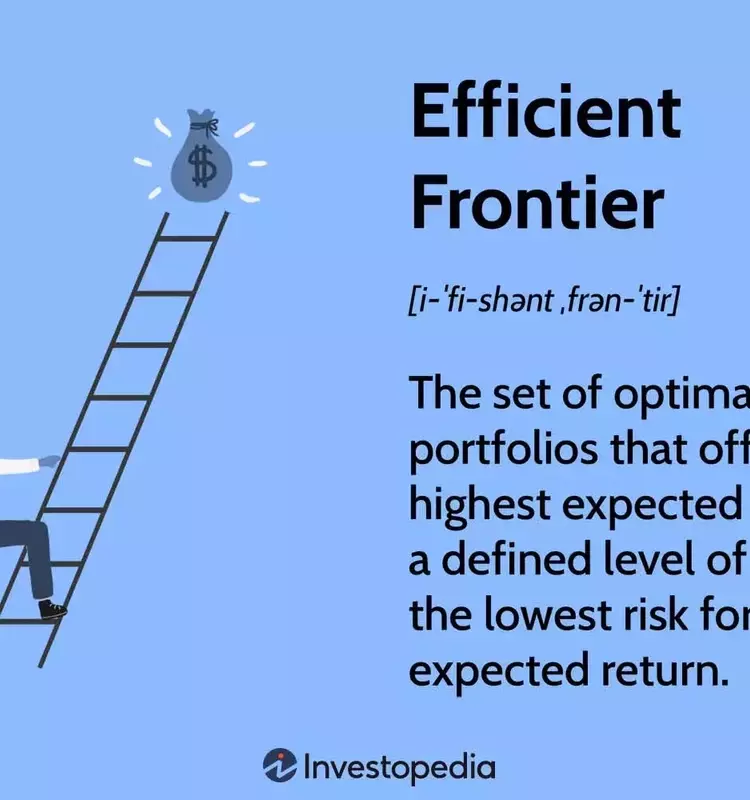
The efficient frontier, a core tenet of modern portfolio theory, identifies optimal investment portfolios. These portfolios are characterized by delivering the maximum potential return for a given degree of risk, or conversely, the minimum risk for a desired level of return. This concept, often visualized as a curve on a graph, serves as a crucial guide for investors aiming to strategically balance potential gains with acceptable risk exposures.

Introduced by Nobel laureate Harry Markowitz in 1952, the efficient frontier is fundamental to modern portfolio theory (MPT). It graphically plots portfolios, using return as the y-axis and risk as the x-axis, typically measured by the compound annual growth rate (CAGR) and annualized standard deviation, respectively. The essence of this theory is to construct portfolios that maximize returns for the assumed risk. An ideal portfolio leverages diversification to achieve a combined standard deviation lower than that of its individual components, particularly when the securities within it are not highly correlated. The inherent curvature of the efficient frontier underscores the power of diversification in enhancing a portfolio's risk/reward profile and demonstrates that the marginal return for each additional unit of risk tends to decrease.

Despite its widespread influence, the efficient frontier theory faces criticisms regarding its underlying assumptions. It presupposes that asset returns follow a normal distribution, a notion that real-world financial markets often contradict due to phenomena like "tail risk" where returns can deviate significantly from the mean, leading to a leptokurtic or heavy-tailed distribution. Moreover, the theory assumes investors are always rational, incapable of influencing market prices, and have unlimited access to borrowing and lending at a risk-free rate. In practice, markets are populated by diverse investor behaviors, some of whom can significantly impact prices, and not all investors have uniform access to capital markets. Investors can choose portfolios along the efficient frontier based on their risk tolerance: those seeking higher returns despite greater risk would lean towards the right side of the curve, while risk-averse individuals would prefer portfolios on the left, which promise lower risk.

The efficient frontier empowers investors to build portfolios that thoughtfully align with their risk appetite and return expectations. By emphasizing the strategic combination of assets, it highlights how a well-diversified portfolio can enhance returns while managing risk effectively. While recognizing its theoretical underpinnings and limitations is essential, the efficient frontier remains an indispensable framework for disciplined and informed investment decision-making, encouraging a balanced and proactive approach to wealth management.

More Articles
Finance
Webull's Stellar Second Quarter: A Deep Dive into Resilience and Growth
Webull Corporation demonstrated exceptional performance in its second quarter, highlighting its resilience amidst market fluctuations and VIX volatility. This strong showing reinforces previous positive outlooks on Webull's discerning customer base and the effective dual-revenue model for Payment for Order Flow (PFOF). However, recent market expansions may lead to disproportionately high valuations, raising questions about long-term value for current investors, especially considering stock-based compensation.
By Mariana MazzucatoAug 21, 2026
Finance
Alibaba's Q1 2027 Performance: A Detailed Analysis
Alibaba Group reported a mixed first quarter in 2027, with revenues slightly exceeding forecasts but profitability falling short of expectations. The company's cash flow and capital allocation issues are particularly concerning, exacerbated by a substantial free cash flow deficit of -RMB44.6 billion, a significant increase from -RMB18.8 billion a year ago. This comes despite a halt in dividends and a near-elimination of share repurchases. Additionally, regulatory and geopolitical uncertainties raise questions about its valuation compared to U.S. technology giants.
By Robert KiyosakiAug 21, 2026
Finance
Enterprise Products Partners: A Strong Buy for Robust Performance and Growth
Enterprise Products Partners (EPD) receives an upgraded "Strong Buy" rating due to its impressive Q2 financial results, attractive valuation, and industry-leading net leverage. The company's Q2 revenue surged by 60.8% year-over-year, driven by increased volumes and margins. EPD's long-term growth is supported by strategic organic investments and positive U.S. production forecasts, offering compelling risk-adjusted returns compared to its peers.
By Nouriel RoubiniAug 21, 2026
Finance
SanDisk's Future: A Five-Year Stock Trajectory Forecast
SanDisk, a prominent player in NAND memory, reported substantial revenue growth driven by increased NAND prices and shipments. The company projects continued robust growth, particularly fueled by the expanding AI sector and secure long-term contracts. This analysis delves into SanDisk's potential stock performance over the next five years, considering current market valuations and growth projections, to assess its investment appeal.
By David RubensteinAug 21, 2026
Finance
Saab AB: A Strong Contender in the Evolving Defense Sector
Saab AB is capitalizing on increased European defense spending and NATO expansion. The company's strategic capacity enhancements, particularly in dynamics like NLAW, are fostering scalable growth and improved margins. Significant naval orders are expected to bolster segment profitability, while the Gripen aircraft continues to attract interest as a cost-effective yet capable option. Saab's impressive sales compound annual growth rate (CAGR) and potential for margin expansion position it favorably, despite a premium valuation compared to its industry peers.
By Suze OrmanAug 21, 2026