Understanding EMEA: A Comprehensive Overview of Europe, Middle East, and Africa as a Business Region
Finance

Understanding EMEA: A Comprehensive Overview of Europe, Middle East, and Africa as a Business Region

authorBy David Rubenstein
DateJul 20, 2026
Read time3 min

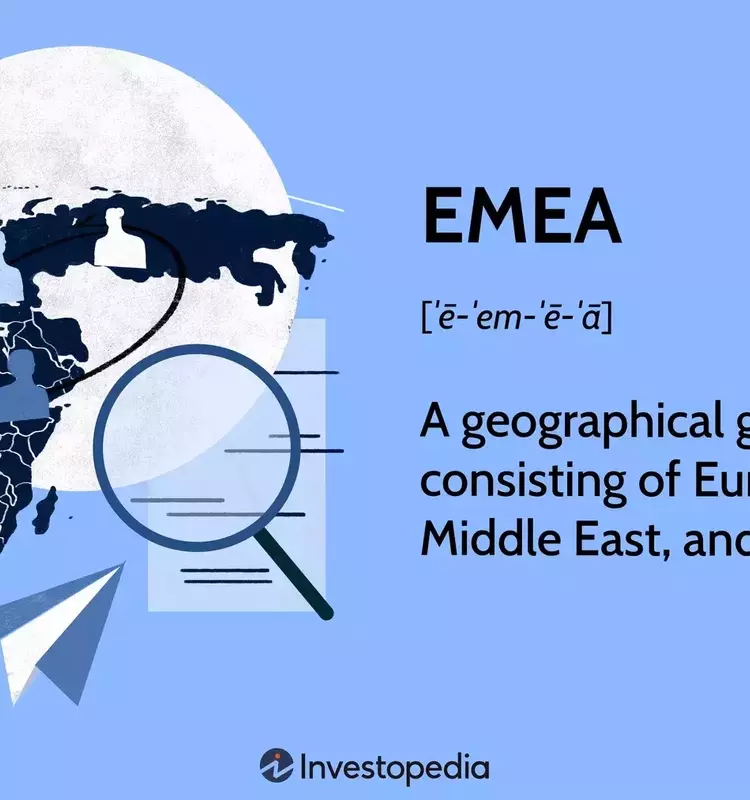
EMEA, which stands for Europe, the Middle East, and Africa, represents a significant geographical categorization extensively employed by multinational corporations. This grouping serves as an organizational framework for businesses to delineate and manage their activities across these diverse continents and their respective regions.

Corporations leverage the EMEA designation to segregate their business functions from other major global territories, such as the Americas and the Asia Pacific region. This segmentation facilitates clearer financial reporting, operational management, and strategic planning. While EMEA is a commonly accepted international business division, its precise geographical boundaries can vary, occasionally excluding or including specific nations like Russia or Kazakhstan, and typically omitting European overseas territories situated on other continents. These distinctions are often tailored to suit the specific operational needs and market focus of individual companies.

The utility of the EMEA region for corporate purposes stems largely from its contiguous time zones, which, despite its vast cultural and political diversity, streamline communication and travel for business operations. This cohesive time zone structure simplifies logistics for companies operating across its varied landscapes. However, the region presents unique challenges due to its wide array of political systems, economic landscapes, linguistic differences—including Arabic, French, Russian, and English—and rich cultural tapestry. These factors necessitate careful consideration for marketing strategies, legal compliance, and product adaptation.

EMEA is frequently further disaggregated or reconfigured to meet more granular corporate requirements. For instance, the inclusion of India might lead to the term EMEIA or EMIA. Businesses might also differentiate between Eastern and Western Europe, using terms like Eastern Europe, Middle East, and Africa (EEMEA) or focusing on the European Union (EU) and European Free Trade Association (EFTA). Additional variations include groupings like SEEMEA (Southeastern Europe, Middle East, and Africa), MENA (Middle East and North Africa), CEE (Central and Eastern Europe), CEMEA (Central Europe, Middle East, and Africa), EUMENA or EMENA (Europe, the Middle East, and North Africa), EMEAC (Europe, the Middle East, Africa, and the Caribbean), EMEACIS (Europe, the Middle East, Africa, and the Commonwealth of Independent States), CEMA (Central and Eastern Europe, the Middle East, and Africa), and NACE (North Atlantic and Central Europe). The Commonwealth of Independent States (CIS) specifically refers to countries surrounding the Caspian and Black Seas. These diverse regional classifications underscore the dynamic and adaptable nature of corporate geographical segmentation.

The EMEA acronym is a universally recognized term that helps standardize business and news reporting across a vast and diverse geographic area. It serves as a practical tool for multinational corporations to manage their operations, report financial results, and structure leadership roles. By understanding this broad region, businesses can better navigate its complexities and harness its opportunities, contributing to global economic integration and progress.

More Articles
Finance
Understanding Head of Household (HOH) Tax Filing Status
The Head of Household (HOH) filing status offers unmarried individuals with dependents significant tax advantages, including a higher standard deduction and more favorable tax rates compared to single filers. To qualify, taxpayers must be unmarried or considered unmarried by the IRS on the last day of the tax year, and provide more than half the financial support and housing costs for a qualifying dependent who resides with them. This status provides a financial boost to eligible taxpayers, reducing their overall tax liability.
By Mariana MazzucatoJul 20, 2026
Finance
India's Edible Oil Market Navigates Geopolitical Tensions and Climate Challenges
India's heavy reliance on edible oil imports is jeopardized by the ongoing Middle East conflict and anticipated weak monsoon rains, leading to price surges and concerns for food security. The nation's ambitious plan to double domestic edible oil production by 2031 faces hurdles like increased input costs and weather risks. CME Group's new edible oil futures offer a hedging solution for market participants amidst this volatility.
By Morgan HouselJul 20, 2026
Finance
Navigating the Bull Market's Trajectory: Key Economic Indicators and Investor Strategies
This article analyzes the current bull market, noting its resilience despite recent fluctuations in the semiconductor sector. It highlights that bull markets typically conclude not due to predictions, but when underlying supportive conditions deteriorate. The piece identifies cooling inflation, a less hawkish Federal Reserve, sustained earnings growth, and broader market leadership as current positive factors. It further suggests that significant earnings shortfalls, negative earnings revisions, tightening liquidity, and restrictive monetary policies are the more reliable harbingers of a market downturn, none of which are currently dominant.
By Robert KiyosakiJul 20, 2026
Finance
Market Dynamics: Tech's Rise, Industrials' Decline, and Looming Earnings
On Monday, major U.S. stock indexes displayed mixed performance, with technology stocks, particularly those in AI, showing strength, while industrial stocks lagged. This divergence was influenced by renewed optimism in AI infrastructure, ongoing concerns about oil disruptions in the Middle East, and the anticipation of a busy week for corporate earnings reports. Investors are keen to assess the viability of significant AI investments as a wave of company results approaches.
By Suze OrmanJul 20, 2026
Finance
Nucor's Market Position and Future Outlook
Nucor Corporation has performed exceptionally well since 2021, benefiting from strong tailwinds in infrastructure development and data center expansion. However, its current valuation appears to fully incorporate these advantages. Upcoming Q2 earnings will be crucial to assess sustained profitability, particularly focusing on sales volume against pricing, and management's Q3 forecasts. Potential challenges include global steel oversupply, rising costs, and possible margin compression, which could impact Nucor's earnings trajectory. This analysis explores the rationale for potentially realizing gains.
By Michele FerreroJul 20, 2026