"Navigate the Future: Mastering Ex-Ante Financial Forecasting"
"Unraveling the Essence of Ex-Ante Analysis: A Forward-Looking Perspective"
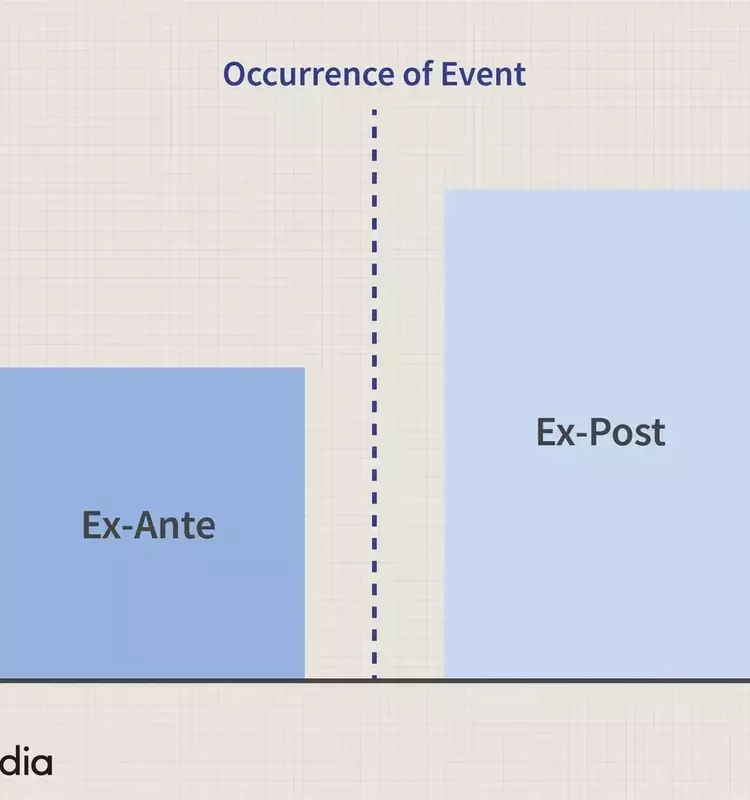
Ex-ante analysis involves predicting future events by analyzing historical data and market trends. This approach helps investors assess potential economic outcomes, essentially looking 'before the event' to inform decisions.
"The Pivotal Role of Forecasting in Ex-Ante Analysis"
Forecasting is central to ex-ante analysis in finance. Any projection made before an event, and prior to all relevant facts becoming known to market participants, falls under this category. Financial professionals regularly employ ex-ante analysis in their research to provide insights into future performance.
These predictions are typically grounded in the historical performance of a company or security. Key areas where this is applied include:
- Buy-side analysts utilize fundamental factors to establish a target price for a stock, subsequently comparing this projection against actual performance.
- Earnings estimates heavily rely on ex-ante analysis, considering the projected performance of a company's business segments and individual products. This also involves modeling cash utilization for capital expenditures, dividends, and share repurchases.
It is important to remember that ex-ante analysis provides expectations rather than certainties, serving as a benchmark for evaluating reported actuals.
"Diverse Methodologies for Conducting Ex-Ante Analysis"
Investors frequently employ aggregate ex-ante earnings-per-share (EPS) analysis, which establishes a baseline for corporate earnings. This method also allows for the identification of analysts whose predictions are particularly accurate, especially when their forecasts significantly deviate from those of their peers.
Analysts also perform ex-ante predictions for anticipated mergers before they materialize. This involves assessing potential cost reductions from consolidating redundant activities and revenue synergies achievable through cross-selling. Post-merger company performance inherently carries significant uncertainty. While the merger is the initial event, ex-ante analysis focuses on forecasting subsequent key events, such as the initial earnings report of the newly formed entity.
It is often challenging to account for all variables in every form of ex-ante analysis. Market behavior can be unpredictable, leading to instances where price targets, despite incorporating numerous fundamental variables, may miss the mark due to external market shocks impacting nearly all stocks.
"Ex-Post Analysis: Understanding Its Interplay with Ex-Ante"
Ex-post, meaning "after the event," is the counterpart to ex-ante analysis. It involves reviewing predictions against actual outcomes once the forecasted event has occurred. This retrospective evaluation is crucial for refining future predictive models.
Analysts and investors leverage historical returns to formulate predictions about the performance of investments and companies. Through this, potential future risks for an investor can be quantified using statistical measures based on an investment's long-term returns.
However, ex-post analyses, while capable of outlining maximum potential losses, do not account for future market volatility, anomalies, or other unforeseen circumstances.
"Assessing the Merits and Limitations of Ex-Ante Analysis"
Ex-ante analyses are valuable tools for investors and companies, allowing them to leverage past performance to anticipate various investment outcomes, both favorable and unfavorable. The use of historical data enhances preparedness for crucial investment decisions among investors, analysts, and companies.
Nevertheless, this analytical method is based purely on forecasts and lacks the certainty of actual results. Consequently, it offers no concrete conclusions and does not factor in unforeseen occurrences such as market fluctuations, shifts in investor sentiment, or other surprising industry news.
"Practical Application of Ex-Ante Analysis"
Consider Company ABC, scheduled to announce its earnings on a specific date. Analysts at a research firm would employ economic and financial data from the company's past and current operations to forecast its earnings per share (EPS). This involves evaluating the broader economic climate and its potential impact on the company's operational costs. Additionally, they might use historical business decisions and earnings reports to project future sales figures.
"Ex-Ante Interest Rates and Merger Evaluations Explained"
An ex-ante interest rate refers to the real interest rate before it is adjusted for inflation and publicly announced by lenders and bond issuers. For merger evaluations, analysts thoroughly compare the revenue streams of the involved entities to ascertain their compatibility. They also forecast potential cost savings through a cost-benefit analysis, determining if a new combined entity would yield efficiencies.
"Defining Ex-Ante Investment"
Ex-ante investment typically denotes a company's projected capital expenditure and intended investment during a specified period, in contrast to ex-post investment, which refers to the actual capital deployed within that period.
"Concluding Thoughts on Ex-Ante Analysis"
Investors and companies employ diverse strategies to inform their investment decisions. A prominent method is ex-ante analysis, which forecasts future outcomes based on historical performance. This approach is widely applied in predicting earnings reports and assessing major events such as corporate mergers.
