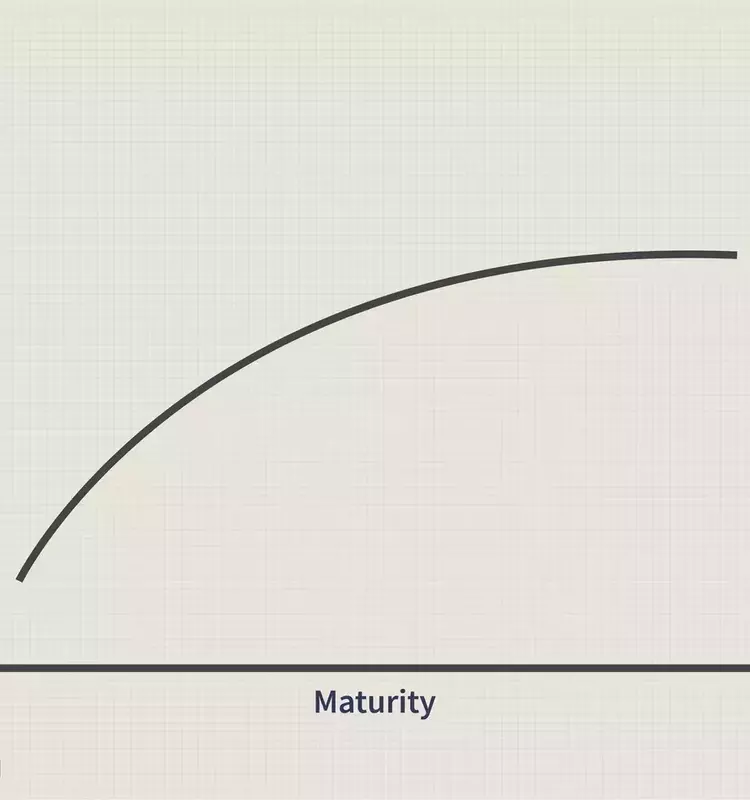
A flat yield curve, characterized by similar interest rates across bonds of varying maturities, often signals economic ambiguity. This scenario influences the cost of borrowing, investment returns, and strategic portfolio decisions for both investors and financial institutions. In such times, some investors utilize approaches like the barbell strategy, blending short and long-term bonds to mitigate risk and optimize returns.
The flattening of the yield curve happens when the yields on short-term and long-term bonds, particularly government securities, converge. This convergence implies that investors receive nearly the same return for both short-duration and long-duration investments. Typically, long-term bonds carry higher yields to compensate investors for the increased risk and opportunity cost associated with tying up capital for extended periods. When this distinction diminishes, it suggests that the market does not anticipate significant economic growth or inflation in the future, thus reducing the premium usually associated with longer-term holdings.
For instance, if a two-year U.S. Treasury bond yields 5% and a 30-year Treasury bond yields 5.1%, the curve is considered flat. This situation often arises when long-term interest rates decrease more rapidly, or short-term rates increase more substantially. Market participants might interpret this as a sign of impending economic deceleration or a belief that the Federal Reserve will soon raise interest rates. For example, the period between 2022 and 2023 saw rapid rate hikes by the Federal Reserve to combat inflation, which contributed to a flattening yield curve as short-term rates climbed more than their long-term counterparts.
Central banks like the Federal Reserve exert significant influence over the economy's borrowing costs through adjustments to the federal funds rate. This rate, which dictates how much banks charge each other for overnight lending, propagates through the financial system, influencing other interest rates. While an increase in the federal funds rate directly boosts short-term rates, its effect on long-term rates can vary. Sometimes, long-term rates follow suit; other times, they remain stable or rise marginally, leading to a flatter curve. This often occurs when the market forecasts a brief period of rate increases followed by cuts, anticipating an economic contraction.
Banks primarily generate profits from the spread between their long-term lending rates and short-term borrowing rates. A flat yield curve compresses this spread, leading to narrower profit margins. Consequently, financial institutions may adopt a more cautious stance on lending, an inclination that intensifies with the prospect of an economic downturn. However, this dynamic is not always straightforward, as many loans feature variable rates tied to short-term benchmarks, and banks typically pay less to savers for deposits.
A normal, or “healthy,” yield curve is characterized by a gradual upward slope, indicating stable economic conditions and expectations of future growth. In this scenario, bonds with longer maturities offer higher yields. For example, a two-year bond might yield 1%, while a 20-year bond yields 3.5%. A steepening curve suggests robust economic expansion, potentially leading to higher inflation and interest rates, whereas a flattening curve signals caution and economic uncertainty.
To navigate a flattening yield curve, investors might consider strategies such as the barbell approach. This strategy involves allocating a portfolio equally between very short-term and very long-term bonds. This allows investors to maintain some liquidity and flexibility to react to bond market fluctuations, while also capturing potentially higher yields from long-term assets. For instance, an investor might split their fixed-income portfolio between U.S. Treasury 10-year notes and two-year notes. However, such portfolios are vulnerable to significant declines if long-term rates experience a sharp increase.
The yield curve serves as a crucial barometer for investor sentiment regarding future interest rates, inflation, and economic growth. Its shape provides insights into the prevailing economic outlook, guiding investment decisions across various asset classes. Normal, flat, or inverted curves each convey distinct messages about market expectations, with an inverted curve historically signaling an impending recession.
In essence, a flat yield curve, where short-term and long-term bond rates are almost identical, typically reflects investor apprehension about the economic future. This situation often results from the Federal Reserve's monetary policy adjustments, particularly when short-term rates climb faster than long-term ones. The implications extend to banks, which face reduced profit margins, and to the broader economy, signaling a potential deceleration. Investors frequently adapt by employing strategies like the barbell approach, balancing short and long-term debt instruments to navigate these evolving market conditions effectively.
