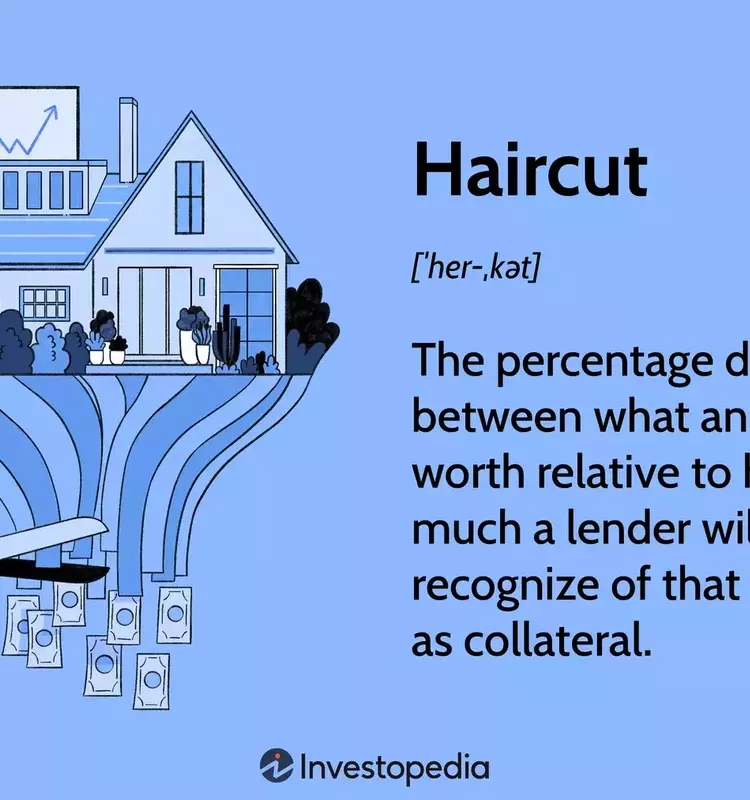
In the financial world, the term “haircut” broadly denotes a reduction in an asset’s perceived value. This concept manifests primarily in two distinct contexts: the valuation of collateral for secured loans and the profit margins earned by market makers. Both applications aim to account for inherent market risks and operational costs, albeit in different ways. Understanding these financial haircuts is crucial for participants in lending, borrowing, and trading, as they directly influence transaction terms and potential returns.
A Closer Look at Financial Haircuts: From Collateral to Trading Floors
In the realm of finance, the concept of a "haircut" describes a reduction in the value of an asset. This term is primarily applied in two scenarios: collateral for loans and market maker operations. When an asset is pledged as collateral for a loan, a haircut is a percentage reduction applied to its market value. For instance, if a borrower pledges $1 million in bonds with a 5% haircut, they can only borrow $950,000. This reduction, a protective measure for lenders, accounts for potential depreciation in the collateral's value before it can be liquidated, especially in cases of borrower default. Factors such as asset volatility, liquidity, price risk, and the borrower’s creditworthiness influence the size of this haircut. Highly volatile or illiquid assets typically incur larger reductions to offset increased risk.
Conversely, in the trading sphere, a haircut also refers to the modest profit gained by a market maker. Market makers facilitate trading by quoting both bid (buy) and ask (sell) prices for securities, creating a spread. They profit by buying at the lower bid price and selling at the higher ask price. For individual traders, this means buying slightly above or selling slightly below the market's midpoint price, effectively taking a small haircut on their transactions. For example, if a stock trades at $50, but the bid is $49.98 and the ask is $50.02, a seller receives $49.98 per share, while a buyer pays $50.02. The $0.04 difference per share represents the market maker's haircut. This mechanism, while seemingly minor per transaction, allows market makers to ensure market liquidity and continuously facilitate trades. A notable historical example, the 1998 Long-Term Capital Management (LTCM) crisis, highlighted the systemic risks associated with insufficient haircuts on repo transactions. The hedge fund's aggressive leverage, enabled by minimal collateral haircuts, nearly triggered a financial meltdown before a central bank-orchestrated bailout.
The concept of a “haircut” in finance reveals a delicate balance between risk management and market efficiency. For borrowers, it highlights the importance of understanding the true value of their collateral in lending agreements. For traders, it underscores the subtle costs of market participation, embedded within bid-ask spreads. Both aspects emphasize the pervasive nature of risk in financial markets and the mechanisms designed to mitigate it. As an observer, one might recognize that these seemingly small adjustments play a critical role in the broader stability of the financial system, influencing everything from the availability of credit to the fairness of trading prices. Being acutely aware of these dynamics can empower individuals and institutions to make more informed decisions in their financial endeavors.
