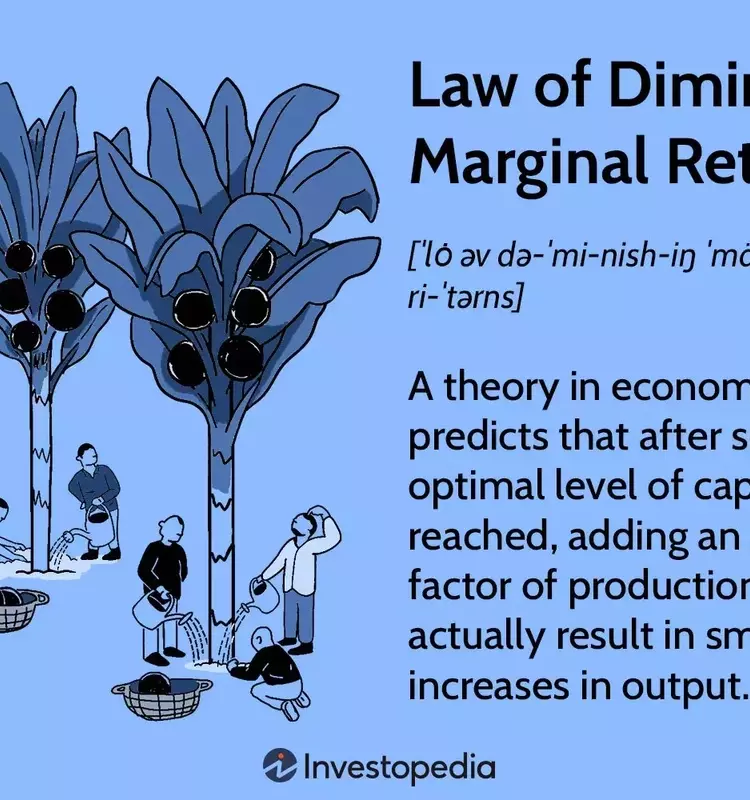
The law of diminishing marginal returns is a fundamental economic principle stating that continually increasing one input factor, while keeping all other inputs constant, eventually results in decreasing efficiency and smaller gains in output for each additional unit of that input. This concept is vital for understanding production limits and optimizing resource allocation in various contexts.
The Core Principle of Diminishing Returns
The law of diminishing marginal returns, also known as the law of diminishing returns or the principle of diminishing marginal productivity, explains that adding increasing quantities of a single production factor, assuming all other factors remain constant (ceteris paribus), will ultimately lead to reduced incremental gains in output per unit. This phenomenon does not imply a decrease in total production but rather a decline in the efficiency of each additional input. For instance, in a factory operating at optimal capacity, introducing more workers without increasing other resources like machinery or space will eventually result in each new worker contributing less to overall output. This is due to factors such as overcrowding, insufficient equipment, or coordination difficulties, leading to a less efficient operational environment. Understanding this principle is crucial for businesses and economists to make informed decisions regarding resource allocation and production planning.
This economic theory is a cornerstone of production analysis, which examines how inputs are transformed into outputs. Businesses frequently apply this law to evaluate the profitability of expanding production. For example, a company might analyze its production process to determine the optimal number of employees. Beyond this point, hiring additional staff would not yield proportional increases in output, thus diminishing the marginal return on labor. This analytical approach helps prevent over-investment in a single input that could lead to reduced overall efficiency. Historical economic thinkers such as Jacques Turgot, Thomas Robert Malthus, and David Ricardo were instrumental in developing this concept. Ricardo, for instance, illustrated how adding more labor and capital to a fixed plot of land would generate increasingly smaller output increases. Malthus integrated this idea into his population theory, suggesting that food production increases arithmetically while populations grow geometrically, implying a natural limit to food supply due to diminishing returns.
Historical Context and Returns to Scale
The concept of diminishing returns has deep roots in economic thought, tracing back to the 18th century with Jacques Turgot's observations. Early economists like David Ricardo and Thomas Robert Malthus further developed this idea, often linking the reduction in output to a decline in the quality of successive inputs. Ricardo's notion of the "intensive margin of cultivation" highlighted that adding more labor and capital to a fixed land area would generate progressively smaller increases in agricultural output. Malthus, in his population theory, used diminishing returns to argue that food supply would struggle to keep pace with population growth, positing that while population increases geometrically, food production only grows arithmetically, inherently limiting food availability.
While diminishing marginal returns focus on increasing a single input in the short run while other inputs remain fixed, the concept of returns to scale examines the impact of changing all production variables proportionally in the long run. When a company doubles all its inputs and experiences less than a doubling of its output, it faces decreasing returns to scale. Conversely, if doubling all inputs leads to exactly double the output, it achieves constant returns to scale. Economies of scale, a related but distinct concept, occur when a proportional increase in all inputs results in a more than proportional increase in output, leading to greater efficiency and lower per-unit costs. This distinction is critical for businesses planning long-term growth and expansion, as it helps determine the optimal scale of operations. Neoclassical economists extended this understanding by positing that assuming identical units of labor, diminishing returns arise from disruptions in the overall production process when extra labor is introduced to a fixed amount of capital.
