Market Capitulation: The Turning Point in Downtrends
What Does Capitulation Mean in Financial Markets?
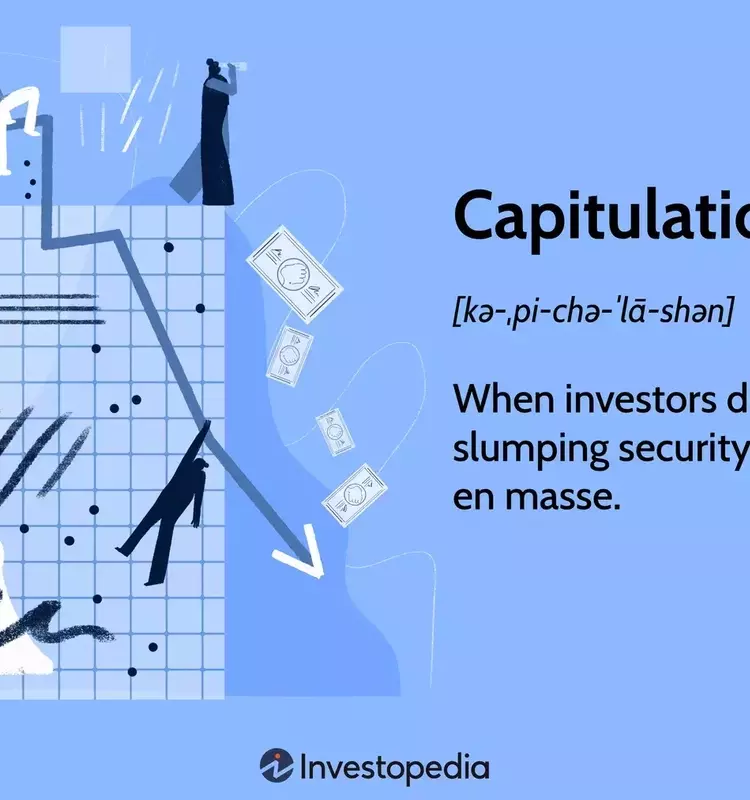
In financial markets, capitulation signifies an intense phase of panic selling by investors during a significant market decline. This widespread anxiety among investors fuels a rapid acceleration in price drops. Historically, such periods of extreme selling often precede a renewed investor interest in the affected assets, initiating a reversal in the prevailing market trend.
The Dynamics of Market Capitulation
Capitulation typically emerges after a substantial price drop, even when some investors maintain a bullish outlook. As the market continues its descent, selling activity intensifies, leading to a cascade effect where more investors offload their holdings to mitigate further losses. This dynamic results in even sharper price declines.
Identifying Capitulation Through Market Indicators
The surge in trading volume during these periods is often seen as a cleansing process, flushing out less confident investors. Their positions are subsequently taken up by individuals with a higher tolerance for risk, who perceive the depressed prices as attractive entry points. Market participants actively monitor for unusually high trading volumes coinciding with steep price depreciation as key indicators of capitulation. The ultimate confirmation of capitulation, however, is the subsequent price rally that occurs once the panic selling has exhausted itself.
Investor Decisions During Market Sell-Offs
The term "capitulation" refers to a surrender. In financial contexts, it denotes the moment when a substantial number of investors relinquish their hope of recovering recent losses, especially as market declines gain momentum. Consider a scenario where an investor holds a stock that has fallen significantly, first by 30%, then another 20%, despite seemingly strong underlying fundamentals. If this stock then plummets an additional 15% within a single trading day, leading the investor to sell, this act would embody capitulation. This selling decision often reflects a collective realization among investors that their positions might continue to deteriorate.
The Challenge of Real-Time Identification and the Aftermath
It's crucial to acknowledge that definitive identification of capitulation is only possible in hindsight, once a market rebound has clearly materialized. While collective selling during a capitulation might indicate a bottom, it doesn't preclude future price drops if new market stressors emerge. Bear markets can frequently feature multiple episodes of high-volume selling, leading to premature declarations of capitulation. True confirmation always follows a clear price recovery.
Technical Analysis Techniques for Spotting Capitulation
Market capitulation often precedes significant shifts in the price trajectories of securities and financial instruments. Technical analysts employ various charting tools, such as candlestick patterns, to detect these turning points. A notable pattern is the "hammer candle," which forms when a security's price plunges significantly below its opening level but then recovers substantially by the close. When accompanied by elevated trading volume, this pattern suggests that selling pressure has reached its peak, signaling a potential reversal. Conversely, a "shooting star candle," where prices rally sharply but then retreat to close near the opening level, often indicates the exhaustion of a buying spree and a potential market top.
A Glimpse into Market Capitulation: The Tesla Case
Although difficult to discern in real-time, market capitulation becomes evident in retrospect, marked by a substantial price recovery. A compelling example is the trajectory of Tesla (TSLA) stock following its peak of $414 in October 2021. Over the ensuing fifteen months, TSLA experienced alternating periods of sharp declines and brief recoveries, eventually bottoming out at $101 by early 2023, representing a loss of over 75%. However, the stock then rebounded with remarkable speed, surging to $208 within six weeks, accompanied by daily trading volumes exceeding $1 billion. This final, dramatic price drop, followed by a vigorous recovery, illustrates a clear period of capitulation where distressed sellers exited the market, paving the way for new investors to enter.
How Market Participants Detect Capitulation
Traders and financial analysts leverage a range of sentiment and technical indicators to gauge when buying or selling pressure for an asset might be nearing exhaustion. Tools such as the Relative Strength Index (RSI), Fibonacci ratios, various candlestick patterns, and the Moving Average Convergence-Divergence (MACD) are frequently utilized. However, none of these methods offer an infallible prediction. The only truly accurate way to confirm capitulation is through retrospective analysis, once a clear price rebound has occurred.
The Duration of Capitulation Phases
There are no fixed parameters defining the length of a capitulation period, as market recovery times can vary widely across different assets and economic conditions. For instance, the Great Recession of 2008 spanned 18 months, yet the broader economy required several additional years to achieve a full recovery. This variability underscores the unpredictable nature of market cycles.
Assessing the Impact of Capitulation on Investors
Capitulation is not inherently good or bad; its impact depends entirely on an investor's market position. For investors holding a long position, capitulation can be advantageous during a bullish market, as short sellers are compelled to cover their positions. Conversely, in a bearish capitulation, astute speculators can seize the opportunity to acquire undervalued shares as other traders exit the market. This dynamic highlights the dual nature of capitulation, offering both risks and potential rewards.
The Essence of Market Capitulation
Market capitulation describes a phase of sustained price depreciation that compels investors to divest their holdings, thereby locking in losses rather than witnessing further erosion of their asset values. This often signifies the final stage of an asset bubble, where inflated prices eventually collapse. Crucially, capitulation frequently marks a turning point, after which the asset's value may begin to appreciate once more.
