Merkle trees are a cornerstone of modern blockchain technology, ingeniously designed to bolster data security and verification efficiency. This data structure condenses vast amounts of transactional information into a singular cryptographic fingerprint known as the Merkle root. This summary hash acts as an unalterable seal, confirming the integrity of all underlying data. The power of Merkle trees lies in their ability to enable rapid validation of specific transactions within a blockchain, obviating the necessity for users to download and process the entire chain—a task that would otherwise be prohibitively time-consuming due to the sheer volume of data. Moreover, these trees play a crucial role in linking blocks within the chain; any unauthorized modification to data instantly alters its hash, triggering a rejection by the network's consensus mechanisms and thus preserving the blockchain's immutability. Beyond their application in cryptocurrencies like Bitcoin, the adaptability of Merkle trees makes them invaluable for any data management system demanding high levels of security and operational swiftness.
The Intricate Architecture and Impact of Merkle Trees in Blockchain
In the dynamic realm of blockchain technology, Merkle trees stand as a testament to cryptographic ingenuity, providing an elegant solution for managing and verifying vast datasets. Conceived by Ralph Merkle in his seminal 1987 paper, these data structures, also known as "binary hash trees," transform digital information into a compressed, secure format. At their core, Merkle trees process data through a hashing algorithm, converting it into a fixed-length alphanumeric sequence—a hash. This one-way transformation ensures that identical inputs always yield identical outputs, but critically, the original data cannot be reconstructed from the hash alone. This mechanism forms the bedrock of data integrity.
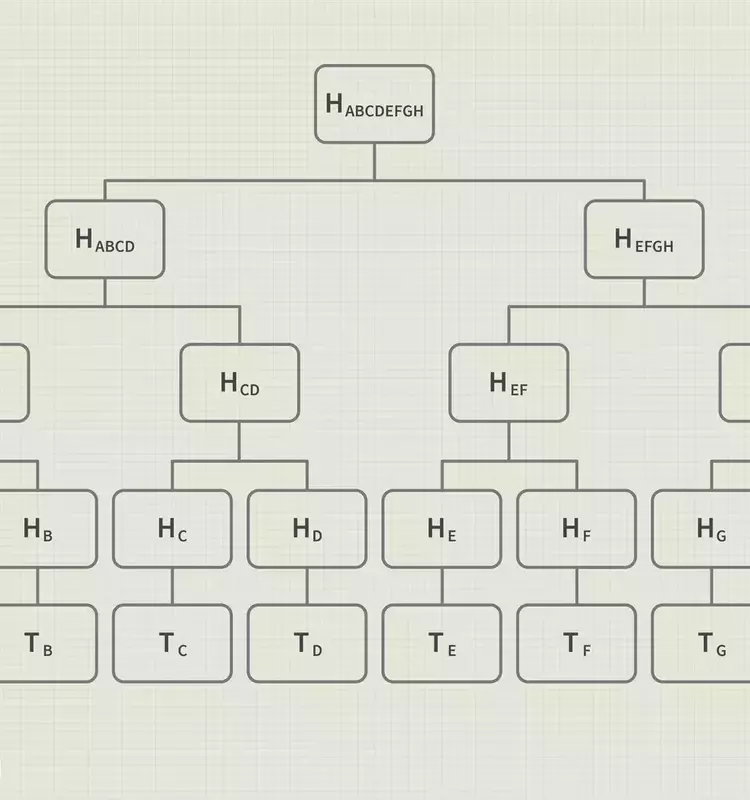
The application of Merkle trees in blockchain networks, most notably Bitcoin, revolutionized transaction verification. Instead of hashing all transactions at once, Bitcoin's protocol hashes each individual transaction. These transaction hashes, forming the 'leaves' of the tree, are then paired and re-hashed iteratively, climbing up the tree structure. If an odd number of transactions exists, one is duplicated to maintain the binary pairing. This process culminates in a single 'Merkle root' hash, representing all transactions within a given block. For instance, in Bitcoin block #854,046, a specific Merkle root hash was generated, unique to its contained transactions.
This Merkle root is not merely an identifier; it is a critical component in forming the block hash—the unique fingerprint of an entire block. By combining the Merkle root with other block metadata, such as software version, the hash of the preceding block, timestamp, difficulty target, and a random 'nonce,' a new, distinct block hash is forged. This block hash then acts as a linkage in the chain, appearing in subsequent blocks and cementing the chronological and secure connection between them. The speed at which modern computing systems can perform these complex hashing operations—in mere milliseconds—underscores the efficiency of Merkle trees in validating large data volumes.
A profound benefit of Merkle trees for cryptocurrencies is the ability to verify individual transactions without necessitating the download of the entire blockchain. For a user to confirm a specific transaction, say TD, they only need the Merkle root (HABCDEFGH) and a select few intermediate hashes (e.g., HC, HAB, HEFGH). With these minimal pieces of information, the integrity of TD can be cryptographically proven against the Merkle root. Any tampering with TD would inevitably alter its hash, causing a ripple effect up the tree and changing the Merkle root, thereby invalidating the entire block. This immutable linking and efficient verification are fundamental to the security and scalability of blockchain networks.
A Glimpse into the Future of Secure Data Management
The ingenuity of Merkle trees extends far beyond their current applications in blockchain. Their fundamental principle of efficient, tamper-proof data verification holds immense potential for various sectors. Imagine their use in supply chain management, where every step of a product's journey, from raw material to consumer, could be immutably recorded and verifiable with minimal data transfer. In digital forensics, Merkle trees could offer an irrefutable method for verifying the integrity of collected evidence. Furthermore, in cloud storage, they could enable users to quickly and securely audit the integrity of their stored files without downloading entire datasets. The core strength of Merkle trees—their ability to compress vast amounts of data into a single, verifiable hash—positions them as a pivotal technology for a future increasingly reliant on secure, transparent, and efficient data management across all industries. The ongoing evolution of this concept promises to unlock new frontiers in trust and data authenticity, reinforcing the fabric of our digital world.
