Understanding Negative Gap in Finance
Finance

Understanding Negative Gap in Finance

authorBy David Rubenstein
DateJul 17, 2026
Read time2 min

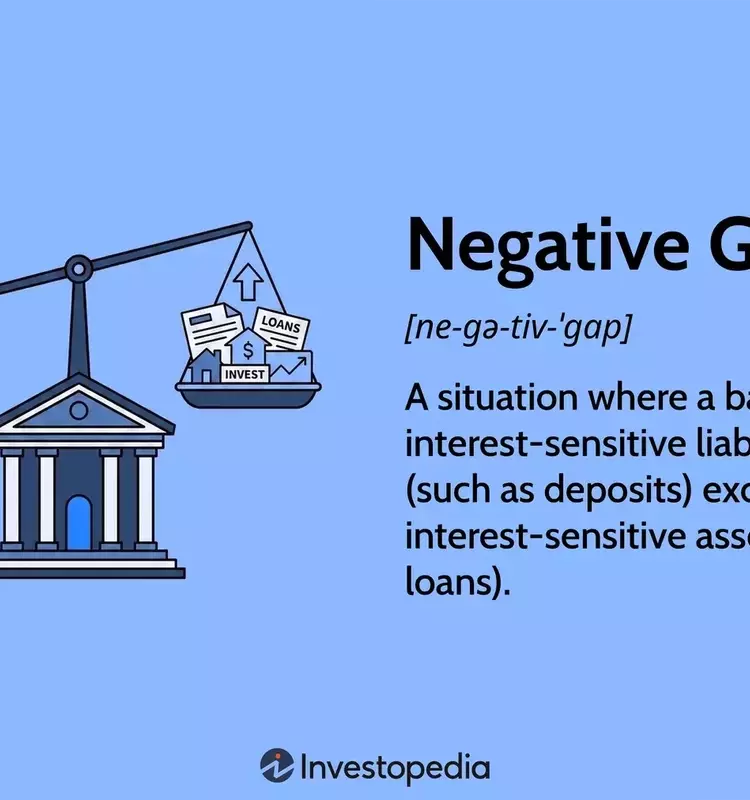
A negative gap signifies a financial scenario where an institution's liabilities, which are sensitive to interest rate fluctuations, surpass its interest-sensitive assets. This situation, while not inherently detrimental, highlights a financial entity's exposure to interest rate shifts. It forms a crucial part of asset-liability management, a strategy employed by financial institutions to oversee the timing of cash inflows and outflows to ensure sufficient liquidity and solvency.

The Dynamics of a Negative Gap in Financial Institutions

In the intricate world of finance, a "negative gap" emerges when a financial institution's interest-sensitive liabilities outstrip its interest-sensitive assets. This metric, often analyzed in conjunction with 'gap analysis,' serves as a barometer for the institution's vulnerability to changes in interest rates. When interest rates fall, the institution's liabilities can be repriced at lower rates, potentially leading to an increase in net income. Conversely, a rise in interest rates would necessitate repricing liabilities at higher rates, which could subsequently diminish the institution's income. This delicate balance underscores the importance of a robust asset-liability management framework. This framework, a cornerstone of sound financial practice, meticulously aligns the maturity of assets with the timing of liabilities. Its primary objective is to guarantee that future financial commitments can be met by incoming cash flows, safeguarding the institution's liquidity and financial health. While achieving a 'zero duration gap'—a state of perfect insulation from interest rate shifts—is an aspiration, its practical attainment remains elusive due to the inherent complexities of diverse asset and liability durations and unpredictable customer behaviors.

From a financial analyst's perspective, comprehending the nuances of a negative gap is not merely an academic exercise; it's a vital tool for strategic decision-making. It highlights the inherent risks and opportunities that interest rate fluctuations present to a financial institution's profitability and stability. By diligently managing this gap, institutions can not only mitigate potential losses but also strategically position themselves to capitalize on favorable market movements, thereby enhancing their overall financial resilience.

More Articles
Finance
Understanding Jobless Claims: Economic Indicator and Market Impact
Jobless claims, reported weekly by the U.S. Department of Labor, measure individuals applying for unemployment insurance. This vital economic indicator, categorized into initial (first-time filers) and continued claims (ongoing beneficiaries), reflects the health of the employment situation and broader economy. Fluctuations in these claims can significantly influence financial markets, with economists often focusing on the four-week moving average due to weekly volatility. A rise in claims often signals a weakening economy, while a decrease suggests improvement.
By Robert KiyosakiJul 17, 2026
Finance
ImmunityBio: ANKTIVA's Commercial Momentum Supports A Buy
ImmunityBio's ANKTIVA, an approved immunotherapy for NMIBC, is driving significant revenue growth and market share. The company's pipeline is robust, with trials targeting NSCLC, glioblastoma, HIV, and other high-value indications. Despite a recent 40% pullback, the strong balance sheet and ANKTIVA's efficacy offer a compelling risk-reward profile.
By Mariana MazzucatoJul 17, 2026
Finance
Tech Sector Pullback Gains Momentum
Chip stocks are once again at the forefront of market news as the global technology sector experiences a significant downturn. The primary drivers remain unchanged: investors are cashing in on profits and exiting the sector due to increasing concerns. Meanwhile, oil prices are nearing their intraweek peak, and Netflix continues to face challenges, with its shares declining.
By Robert KiyosakiJul 17, 2026
Finance
Understanding the Dynamics of Labor Force Participation
The labor force participation rate is a critical economic indicator, reflecting the percentage of the working-age population that is either employed or actively seeking employment. This metric, often viewed alongside the unemployment rate, offers a more comprehensive understanding of an economy's labor market health. It fluctuates due to various social, economic, and demographic influences, impacting both short-term trends and long-term structural changes in the workforce.
By Morgan HouselJul 17, 2026
Finance
Illinois Tool Works: Valued Adequately, Awaiting Stronger Organic Growth
Illinois Tool Works currently holds a "Hold" rating, with its valuation closely aligned to its probability-weighted fair value of $270.74, against a share price of $271.41. While revenue increased by 4.6%, organic growth stood at a mere 0.4%, with the majority of gains attributed to foreign exchange fluctuations, raising concerns about sustained performance. Operating margin improved by 60 basis points to 25.4%, but this was largely due to reduced restructuring costs, as gross margin remained relatively flat, limiting operational upside. Growth is concentrated in a few cyclical sectors, with four out of seven segments experiencing organic contraction. The second-quarter organic revenue performance will be a critical factor for any potential change in the rating.
By Strive MasiyiwaJul 17, 2026