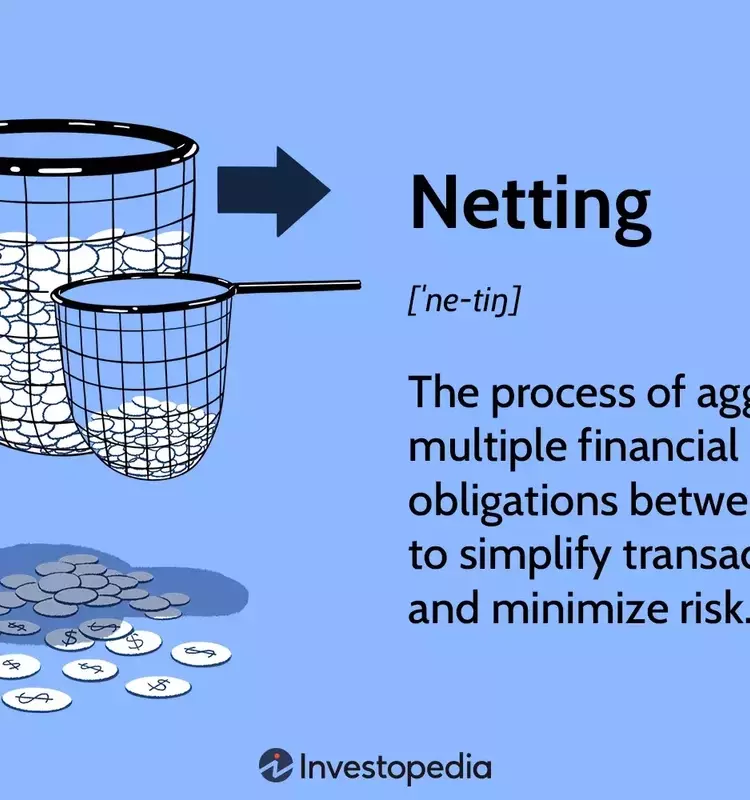
Netting, a fundamental principle in finance, involves consolidating various financial obligations or payments between multiple parties into a single, overall amount. This practice significantly mitigates risks associated with financial contracts and optimizes processing efficiency. This report delves into the mechanics of netting, its diverse applications, and its overarching benefits in the contemporary financial landscape.
Detailed Report: Unveiling the Mechanism of Financial Netting
Netting serves as an essential method for de-risking financial agreements by coalescing numerous financial commitments to ascertain a singular, consolidated obligation. Its utility spans across diverse financial sectors, encompassing securities trading, foreign exchange markets, and inter-company transactions, thereby curbing settlement, credit, and other associated financial hazards.
In the realm of trading, netting empowers investors to counterbalance gains in one position against losses in another, thereby presenting a net exposure. For instance, an investor holding a short position of 40 shares and a long position of 100 shares in the same asset effectively maintains a net long position of 60 shares.
Furthermore, netting finds application during corporate insolvency proceedings. In such scenarios, outstanding balances between a bankrupt entity and its counterparts are offset. This “set-off” mechanism allows a company to subtract any funds owed to the defaulting entity from its own liabilities, with the resulting net sum being pertinent to bankruptcy claims.
Businesses also leverage netting to streamline invoicing from third-party suppliers. A large conglomerate with several divisions sourcing materials from a single vendor, who in turn utilizes the conglomerate's transport services, can employ netting to determine the final amount owed. This reduces multiple invoices to a single payment from the party with the outstanding balance. This streamlined approach is also beneficial for inter-subsidiary fund transfers.
The concept of netting manifests in several distinct forms:
- Close-Out Netting: This occurs post-default, where existing contracts are terminated, and a singular aggregate value is calculated for one party to settle with the other.
- Settlement Netting (Payment Netting): This method aggregates all payments due between parties, resulting in a single net payment. A prior agreement is typically required to ensure only the net difference is exchanged.
- Netting by Novation: This process cancels original offsetting contracts and replaces them with a new agreement for the net aggregate amount. Unlike settlement netting, it creates a new contractual obligation.
- Multilateral Netting: Involving more than two parties, this often necessitates a central clearinghouse or exchange. Within a multi-subsidiary company, a central corporate entity can consolidate and net inter-subsidiary payments and currencies, making a single net payment to the respective beneficiaries.
The primary advantage of netting lies in its ability to conserve significant time and resources by drastically reducing the volume of transactions. For financial institutions engaged in cross-border transfers, it minimizes foreign exchange transactions and enables the consolidation of currency deals into larger trades, yielding better pricing. Enhanced predictability in settlements, stemming from netting, also allows companies to forecast their cash flows with greater accuracy.
A practical illustration of netting can be observed in swap markets. Consider two investors in a swap agreement: Investor A is owed $100,000 by Investor B, while Investor B is owed $25,000 by Investor A. Instead of two separate payments, netting simplifies this to Investor B paying Investor A a net amount of $75,000. However, it's crucial to note that currency swaps, involving notional amounts in different currencies, are typically settled in full for each currency without netting.
Netting stands as a cornerstone of modern financial efficiency, enabling simplified transactions, reduced operational costs, and enhanced risk management across a spectrum of financial activities. Its multifaceted applications underscore its importance in fostering a more organized and predictable global financial environment.
The application of netting in financial transactions offers a profound lesson in efficiency and risk management. By simplifying complex webs of mutual obligations into singular, manageable figures, it not only reduces operational burdens but also strengthens the stability of financial contracts. This practice highlights the continuous evolution of financial mechanisms designed to streamline global commerce and foster greater trust among market participants. As financial landscapes grow increasingly intricate, the principles of netting serve as a testament to the power of simplification in achieving clarity and security.
