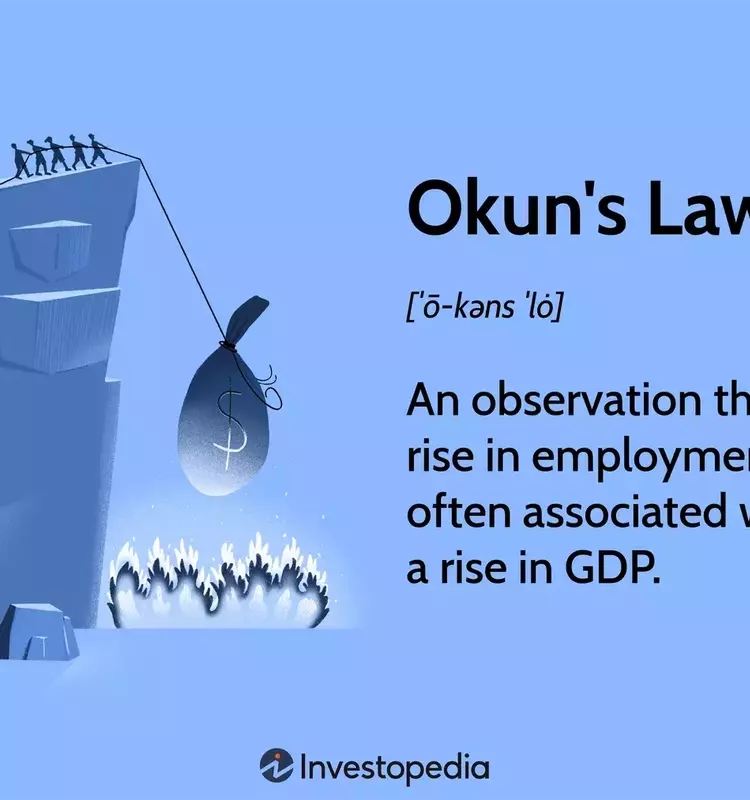
Okun's Law, a concept introduced by economist Arthur Okun, describes an empirically observed inverse relationship between a country's economic output, measured by Gross Domestic Product (GDP), and its unemployment rate. Essentially, as unemployment rises, GDP tends to fall, and vice versa. This principle suggests that a one-percentage-point increase in the unemployment rate often correlates with a two to three-percentage-point decrease in GDP. While not a rigid law, it provides a valuable framework for understanding the dynamic interplay between employment levels and a nation's economic health.
Arthur Okun, an influential economist and Yale professor, served on President John Kennedy's and President Lyndon B. Johnson's Councils of Economic Advisors. His pioneering work in the 1960s laid the foundation for understanding how employment fluctuations impact economic production. As a proponent of Keynesian economics, Okun advocated for using fiscal policies to manage inflation and stimulate job growth. His core insight was that a reduction in unemployment generally leads to an increase in a country's output. The Federal Reserve Bank of St. Louis later articulated this by stating that Okun's Law helps quantify the potential GDP loss when the unemployment rate exceeds its natural level.
The underlying logic of Okun's Law is straightforward: an economy's productive capacity is directly tied to its labor force. More people employed in the production process typically result in higher output. Okun's initial formulation suggested a three-percentage-point decrease in GDP from its long-run potential for every one-percentage-point increase in unemployment. Conversely, a three-percentage-point increase in GDP from its potential level was linked to a one-percentage-point decrease in unemployment. Potential GDP refers to the maximum sustainable output an economy can achieve when all resources are fully utilized.
Despite its utility, Okun's Law is often considered a "rule of thumb" rather than a precise economic law. Its empirical nature means it's based on observation rather than theoretical derivation, and other factors, such as capacity utilization and work hours, also influence economic output. These additional variables contribute to why the relationship between changes in output and unemployment is not always a perfect one-to-one correspondence. Okun himself noted that a three-percentage-point increase in GDP could be attributed to various factors, including increases in labor force participation, hours worked, and labor productivity, with the remaining portion affecting the unemployment rate.
The accuracy of Okun's Law forecasts can vary across different countries and time periods. For instance, industrialized nations with less flexible labor markets than the United States, such as France and Germany, might experience a smaller impact on unemployment from the same percentage change in GNP. A 2007 review by the Federal Reserve Bank of Kansas City largely supported the law's accuracy, albeit noting periods of instability where unemployment deviated from predictions. This led to the conclusion that while the law isn't an exact relationship, it effectively indicates that economic slowdowns typically coincide with rising unemployment. Subsequent analyses, even following significant economic events like the Great Recession, have shown that the law generally holds, suggesting its enduring relevance despite cyclical variations.
The inherent challenges and limitations of Okun's Law stem from its empirical foundation and the multitude of factors influencing economic activity. While economists generally agree on the existence of a relationship between productivity and employment, the exact magnitude remains a subject of debate. The presence of numerous other variables affecting productivity and employment rates makes it difficult to generate precise forecasts using Okun's Law alone. Consequently, some economists view it as having limited forecasting power due to what the Federal Reserve Bank of Cleveland termed "rolling instability" in its predictive accuracy. This instability, consistent across various formulations of the law, reinforces the idea that if a rule has many exceptions, its utility as a strict rule is diminished.
