Understanding Proof of Funds: A Comprehensive Guide
Finance

Understanding Proof of Funds: A Comprehensive Guide

authorBy Fareed Zakaria
DateJul 20, 2026
Read time3 min

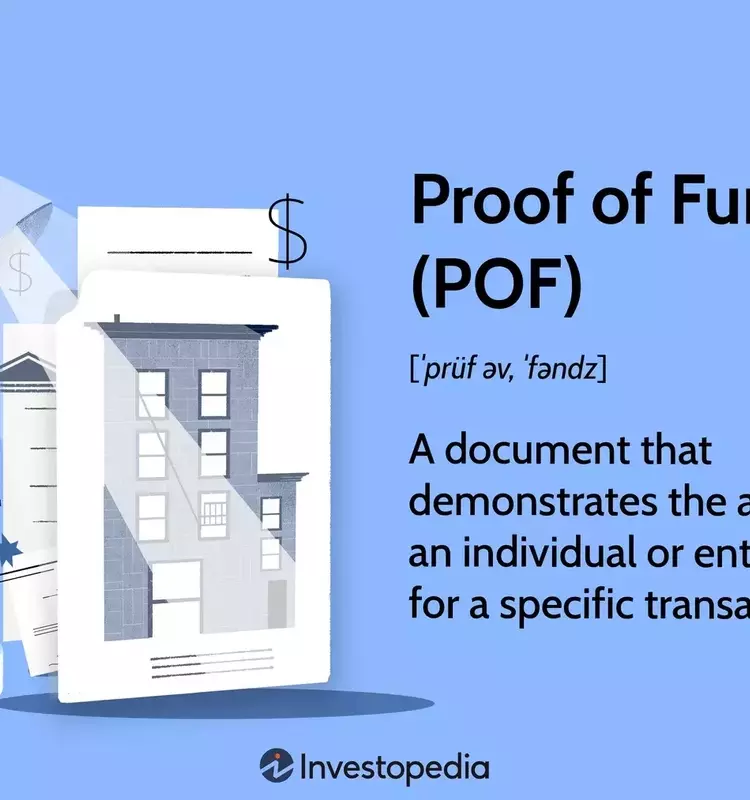
Proof of Funds (POF) serves as a critical document in demonstrating an individual's or entity's readily available financial resources for significant purchases. This verification reassures sellers and lenders of a buyer's capability to fulfill their financial commitments. Typically, a POF document originates from reputable financial institutions like banks and must explicitly state the bank's name, the available balance, and be authenticated with an authorized signature. It's imperative that the assets declared are liquid, meaning easily convertible to cash, as non-liquid assets such as certain retirement accounts often do not qualify. Sellers and lenders scrutinize these documents to confirm that the necessary funds for down payments and closing costs are not merely hypothetical but tangible and accessible.

The importance of Proof of Funds spans various financial transactions, establishing credibility and mitigating risks. For instance, in real estate, it confirms a buyer can meet the purchase price and associated costs. In loan applications, it assures lenders of the borrower's capacity for initial payments. POF is also vital in investment opportunities, immigration processes, business transactions like mergers, and even contract bidding, where it verifies financial strength. When preparing a POF, specific details must be included: the bank's name and address, official bank statements, account balances, and an authorized signature. For funds spread across multiple accounts, consolidating them or providing individual proofs is necessary. Given the sensitive nature of the information, safeguarding POF documents and only sharing them with trusted parties is crucial to prevent fraudulent activities.

While both Proof of Funds and Proof of Deposit relate to financial verification, they serve distinct purposes. Proof of Deposit, typically used in commercial banking, confirms that funds have been transferred into an account and details their origin, often by comparing check and deposit slip amounts. This is particularly relevant for mortgage applications, where lenders assess the source of deposits to ensure the borrower's ability to manage the loan. Alongside these, a pre-approval letter from a lender is essential for home purchases, signifying that a mortgage can be secured. These comprehensive financial documents collectively ensure transparency, build trust, and facilitate smooth transactions in various high-value dealings.

Proof of Funds documents are indispensable tools in the financial world, offering assurance and clarity in large-scale transactions. By meticulously preparing and verifying these documents, individuals and entities can confidently navigate complex financial landscapes, demonstrating their solvency and commitment to fulfilling their obligations. This practice underpins the integrity of financial exchanges, fostering a secure environment for significant investments and purchases, and promoting a culture of accountability and trustworthiness.

More Articles
Finance
Ariel Investments: Navigating Small-Cap Value in a Rebounding Market
Ariel Small Cap Value Tax-Exempt Composite performed in line with the Russell 2000 Value Index in Q2, posting a +17.19% gross return, while the broader Russell 2000 Index saw a +21.49% gain. U.S. equities experienced significant growth, driven by easing geopolitical tensions, lower oil prices, and strong corporate earnings, with technology and AI-related sectors leading the charge. Despite global economic moderation and ongoing geopolitical risks, the market showed resilience, highlighting the dynamic nature of small-cap investments.
By Michele FerreroJul 20, 2026
Finance
Abercrombie & Fitch: Navigating Challenges with Robust Fundamentals
Abercrombie & Fitch faces hurdles in the EMEA region and with its Hollister brand, compounded by prolonged US-Iran tensions potentially delaying recovery. Despite mixed guidance for FQ2'26/FY2026, strong demand in APAC/Americas offers mitigation. The stock's current valuation of 9.17x P/E, combined with solid free cash flow, a net cash position, and aggressive share repurchases, presents a compelling value proposition. While risks exist from elevated short interest and insider selling, ANF remains an attractive option for contrarian and swing traders.
By Mariana MazzucatoJul 20, 2026
Finance
4D Molecular Therapeutics: Advancing Gene Therapy for Wet-AMD and DME
4D Molecular Therapeutics is pushing forward its 4D-150 gene therapy for Wet-AMD and Diabetic Macular Edema (DME) into pivotal trials. The therapy has shown a significant reduction in injection burden and maintained visual acuity over two years. With strong financials and upcoming data readouts in 2026 and 2027, the company is well-positioned for future growth in the biotechnology sector.
By David RubensteinJul 20, 2026
Finance
Understanding Home Improvement Costs for Tax Purposes
Homeowners often face various expenses when preparing to sell their property. This article clarifies the distinction between "fixing-up expenses" and "capital improvements" as defined by the IRS, detailing how each impacts a home's cost basis and potential tax implications during a sale. It also discusses the home sale tax exclusion and its criteria.
By Michele FerreroJul 20, 2026
Finance
Tortoise AI Infrastructure ETF: A Balanced Approach to AI Investment
The Tortoise AI Infrastructure ETF (TCAI) offers a balanced investment strategy in artificial intelligence infrastructure, blending digital and physical assets to achieve robust risk-adjusted returns. Approximately 50% of its portfolio is allocated to physical infrastructure, which helps reduce market volatility and mitigate potential downturns. While the ETF's risk management and diversified exposure make it a strong 'Hold', current valuation concerns prevent a 'Buy' rating, despite its ability to cushion against multiple compression.
By Strive MasiyiwaJul 20, 2026