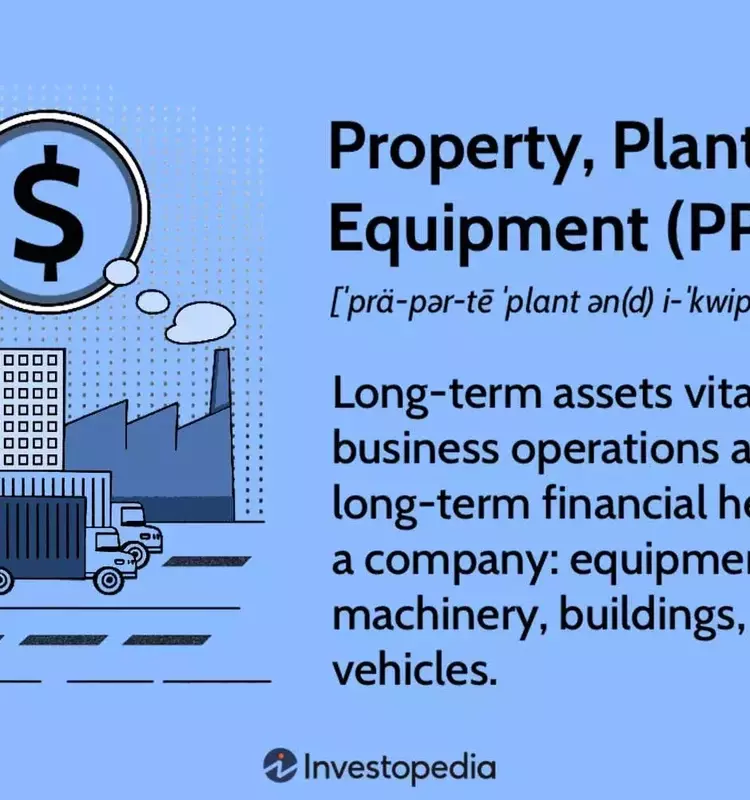
Understanding Property, Plant, and Equipment (PP&E) in Business Finance
Finance

Understanding Property, Plant, and Equipment (PP&E) in Business Finance

authorBy Robert Kiyosaki
DateMay 11, 2026
Read time2 min

Property, Plant, and Equipment (PP&E) are fundamental to a company's operational infrastructure. These assets, which include physical items like buildings, machinery, and land, are classified as long-term tangible assets. Unlike current assets that can be easily converted to cash, PP&E's value is realized through its sustained use in business operations rather than its immediate sale. This characteristic highlights their role in demonstrating a company's long-term financial commitment and stability. Businesses invest in such assets with a vision for future growth and continued functionality, underscoring their confidence in their sustained operations.

The valuation of PP&E on a company's financial statements involves a specific calculation: the gross value of these assets is combined with capital expenditures, and then accumulated depreciation is subtracted. This adjusted figure, known as net PP&E, provides a more accurate representation of the assets' current worth. For instance, if a company owns a building worth $1,000,000 that has depreciated by $600,000, and it acquires another building for $1,000,000 with a combined depreciation of $30,000, the net PP&E would be $1,370,000. It is crucial to note that while most PP&E depreciates over time, land is a unique exception as its value generally appreciates, and it is recorded at market value. This aspect of PP&E calculation offers valuable insights into a company's financial health, as significant PP&E holdings often reflect robust operational capacity and a solid asset base.

Ultimately, PP&E assets serve as a barometer for a company's long-term viability and its willingness to invest in its future. These assets, though not readily liquid, play a pivotal role in securing financing and reflecting a company's operational strength. Understanding PP&E means recognizing that these tangible assets are indispensable for ongoing business activities and represent a strategic investment in persistent success. When assessing a company's financial outlook, PP&E data should always be considered alongside other critical financial metrics to gain a comprehensive understanding of its overall economic standing and potential.

More Articles
Finance
Micron's AI Opportunity: Navigating Cyclical Risks and Future Growth
Micron Technology (MU) is benefiting from strong AI-driven memory demand, but the company remains susceptible to market cycles. Despite impressive recent results and a positive short-term outlook due to industry bottlenecks, long-term risks include potential oversupply from capacity expansions and scrutiny of hyperscaler ROI. Investors should balance the AI tailwind with the inherent cyclicality of the semiconductor industry.
By Fareed ZakariaMay 11, 2026
Finance
Diversifying Investments for Stability and Growth
This article explores strategies for balancing risk and reward in investment portfolios, focusing on low-risk options suitable for diverse financial goals. It outlines 11 secure investment types, including preferred stocks, high-yield savings accounts, and Treasury securities, emphasizing their role in capital preservation and steady returns, especially during uncertain market conditions. The guide also highlights the importance of diversification and understanding individual risk tolerance to build a resilient investment strategy.
By Mariana MazzucatoMay 11, 2026
Finance
Understanding Financial Consolidation and Its Diverse Applications
This article explores the concept of consolidation across various financial and business contexts. It delves into financial accounting, where consolidation integrates the financial data of subsidiaries with a parent company. Additionally, it examines business consolidation through mergers and acquisitions, consumer debt management, and market consolidation in technical analysis. The article highlights how this process streamlines operations, fosters strategic growth, and simplifies financial management.
By Robert KiyosakiMay 11, 2026
Finance
US Bond Yields Surge: Economic Implications and Future Outlook
US long-term bond yields, particularly the 30-year bond, have recently surpassed 5%, indicating significant economic shifts. This rise is attributed to diminished Federal Reserve control, escalating refinancing costs, and persistent fiscal deficits. The article explores the far-reaching consequences for fiscal sustainability, household and corporate debt, and the broader economic landscape, suggesting a prolonged period of elevated interest rates.
By Robert KiyosakiMay 11, 2026
Finance
RingCentral's AI-Powered Evolution and Market Opportunity
RingCentral is rapidly transforming its market position through advanced AI-driven contact center solutions. This strategic shift is moving the company from a traditional provider to a leader in applied AI. The introduction of new AI products has significantly boosted attach rates and accelerated growth, with a notable 5.2% year-over-year revenue increase in Q1 and expanding profit margins. Key partnerships with major businesses like Cox and Spectrum, coupled with substantial investment in research and development, are expanding RingCentral's total addressable market to an impressive $150 billion, fostering continuous product innovation.
By Robert KiyosakiMay 11, 2026