Understanding SEC Form S-4: Mergers, Acquisitions, and Stock Offerings
Finance

Understanding SEC Form S-4: Mergers, Acquisitions, and Stock Offerings

authorBy Lisa Jing
DateApr 29, 2026
Read time2 min

SEC Form S-4 is an essential filing for publicly traded companies involved in significant corporate transactions such as mergers, acquisitions, or offers to exchange securities instead of cash. This document serves to register pertinent information with the U.S. Securities and Exchange Commission, ensuring that all material details are transparently disclosed to investors and the public. The form outlines various aspects of the transaction, including its terms, associated risk factors, and pro-forma financial statements, which are crucial for evaluating the transaction's impact. Moreover, Form S-4 plays a vital role in hostile takeover scenarios, demanding full disclosure to protect investor interests and maintain market fairness.

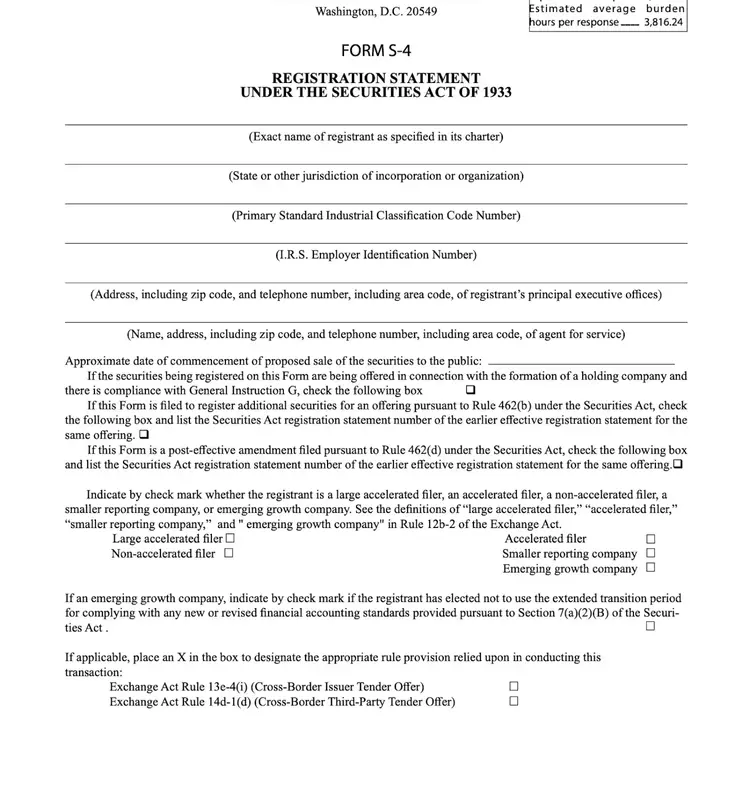
The operational framework of SEC Form S-4 is rooted in the Securities Exchange Act of 1933, which mandates its submission for companies engaged in specific corporate activities. The SEC meticulously reviews each submission to verify the legality and adherence to regulatory standards of the proposed transaction. Key information required in the filing includes a detailed description of the transaction, potential risks, various financial ratios, and pro-forma financial data. Companies must also provide specifics about any material contracts related to the acquired entity, disclosures for underwriters, and interests of involved experts and legal counsel. Additionally, the form requires fundamental corporate information such as the registered name, jurisdiction of incorporation, employer identification number, and details of principal executive officers, along with the proposed sale date and the company's filing status. This rigorous disclosure process applies to all types of mergers, including conglomerate, congeneric, market extension, horizontal, and vertical mergers, each characterized by distinct strategic motivations like market expansion, efficiency gains, or supply chain optimization.

In conclusion, SEC Form S-4 is a cornerstone of regulatory oversight for major corporate actions by public companies. It mandates the disclosure of all significant information related to mergers, acquisitions, and stock exchanges, thereby promoting transparency and legal adherence under the Securities Exchange Act of 1933. This robust framework safeguards investor confidence and ensures market integrity during periods of substantial corporate change. By requiring comprehensive details on transaction terms, financial implications, and potential risks, the form facilitates informed decision-making and helps to prevent illicit practices, fostering a more stable and trustworthy financial environment.

More Articles
Finance
AMD Poised to Lead in Agentic AI Over Intel
This analysis upgrades AMD to a Buy and Intel to a Hold, recognizing the shifting landscape of CPU demand within AI infrastructure. Both companies are set to benefit from the growing need for AI inference, yet AMD, with its superior product offerings and focused R&D, is better positioned. Additionally, AMD's lower P/E ratio, compared to Intel's, indicates a more attractive valuation despite both having reasonable PEG ratios.
By Mariana MazzucatoApr 29, 2026
Finance
Global Equity Markets: First Quarter Performance and Key Drivers
Non-U.S. equity markets experienced varied performance in the first quarter, influenced by rising oil prices and concerns surrounding AI's disruptive potential, particularly after a strong previous year. Value stocks maintained their lead over growth stocks. Several sectors, including consumer discretionary, industrials, and communication services, negatively impacted overall absolute returns. The dynamic economic landscape and AI uncertainty have led to significant stock-specific dispersion.
By Strive MasiyiwaApr 29, 2026
Finance
Understanding Earnings Before Interest, Depreciation, and Amortization (EBIDA)
EBIDA (Earnings Before Interest, Depreciation, and Amortization) is a financial metric that assesses a company's profitability by adding back interest expenses, depreciation, and amortization to net income. Unlike EBITDA, EBIDA includes tax expenses, making it a more conservative measure. It is particularly useful for analyzing non-profit organizations and comparing companies within the same industry, though it is less commonly used in general financial analysis due to its exclusion from GAAP and potential to misrepresent profitability.
By Lisa JingApr 29, 2026
Finance
Understanding the Cost of Carry in Financial Investments
The cost of carry represents the expenses associated with maintaining an investment, including financing, storage, and opportunity costs. This concept is vital for investors to accurately assess net returns and is particularly influential in the pricing of derivative instruments. Its variability across markets can lead to arbitrage opportunities.
By Fareed ZakariaApr 29, 2026
Finance
AI's Hidden Investment Gem: Unpacking MLP ETFs
The Alerian MLP ETF (AMLP) offers a compelling 7.63% yield, positioning itself as a strategic investment in the evolving energy landscape driven by AI demand. Its portfolio consists of midstream energy companies with stable, fee-based cash flows, providing resilience against commodity price fluctuations. With strong distribution coverage and a history of dividend growth, AMLP presents an attractive option for income and capital appreciation, simplifying tax complexities for investors.
By Morgan HouselApr 29, 2026