Understanding Shareholder Value Added (SVA): A Key Financial Metric
Finance

Understanding Shareholder Value Added (SVA): A Key Financial Metric

authorBy David Rubenstein
DateApr 27, 2026
Read time2 min

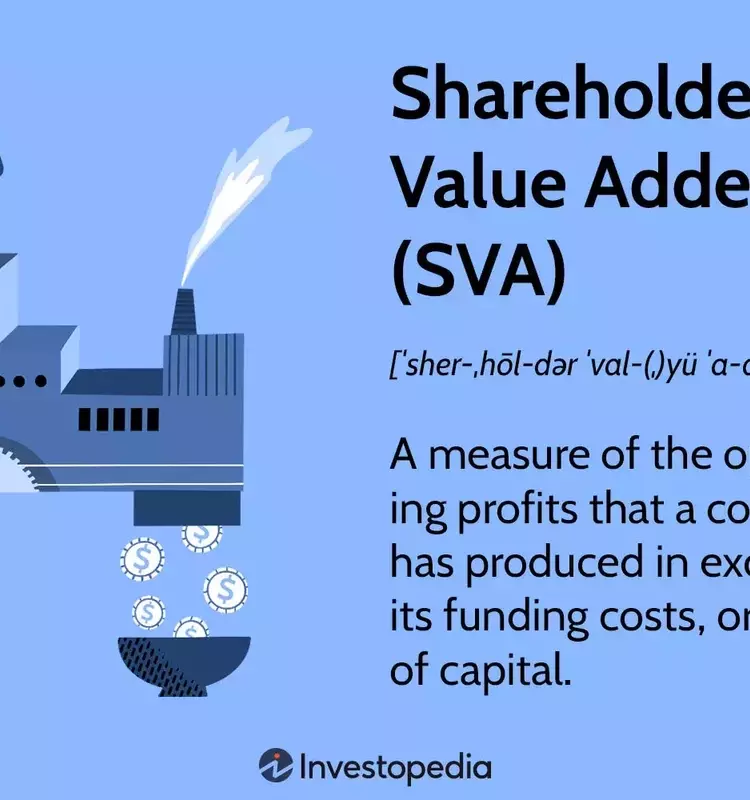
Shareholder Value Added (SVA) serves as a vital financial indicator, representing the economic profit a company achieves after covering its total capital expenses. This metric offers profound insights into how effectively management is enhancing the company's economic standing.

At its core, SVA is derived by taking the Net Operating Profit After Tax (NOPAT) and deducting the company's funding costs. It's a key tool for evaluating management's effectiveness in generating returns that surpass the cost of capital. While widely utilized in assessing publicly traded entities, its application to private companies presents complexities due to the challenges in accurately determining their cost of equity.

The concept of SVA gained prominence in the 1980s amidst concerns over corporate leadership prioritizing personal gains over shareholder interests. Today, while still relevant, its focus on short-term returns has drawn criticism. Critics argue that an overemphasis on SVA can deter long-term growth investments, such as those in technology and innovation, which may initially incur losses but promise substantial future benefits. For investors, particularly value investors, SVA offers a snapshot of a company's immediate profitability. However, it is essential to balance this perspective with a view of long-term growth and reinvestment strategies, ensuring that companies do not sacrifice future prosperity for present gains. Thoughtful consideration of SVA alongside other strategic objectives is crucial for sustainable business success.

The pursuit of maximizing Shareholder Value Added underscores a commitment to robust financial health and astute management. By prioritizing efficient capital utilization and transparent profitability, companies not only enhance their appeal to investors but also lay a solid foundation for enduring growth and innovation. This strategic focus encourages decisions that benefit all stakeholders, fostering a dynamic and responsible corporate environment.

More Articles
Finance
Understanding the FFO to Total Debt Ratio
The Funds From Operations (FFO) to Total Debt Ratio is a key financial metric used to evaluate a company's ability to cover its debt obligations. This ratio is particularly significant for Real Estate Investment Trusts (REITs), as it adjusts net income for non-cash expenses like depreciation, providing a clearer picture of operational cash flow. A higher ratio indicates lower credit risk and a stronger financial position, while a lower ratio suggests higher leverage and potential financial strain. This article explores its calculation, implications, limitations, and importance in financial analysis.
By Robert KiyosakiApr 27, 2026
Finance
Atlassian's Potential Surge: AI Integration and Robust Fundamentals
Atlassian Corporation (TEAM) is poised for significant growth, with a 'Strong Buy' rating and a price target of at least $100 by late 2026. The company exhibits robust fundamentals, including 23% year-over-year revenue growth and accelerating cloud adoption. AI integration is viewed as a catalyst, not a threat, with strong product uptake, particularly for Rovo, and rising enterprise Annual Recurring Revenue (ARR). While GAAP profitability and market sentiment remain key risks, recent insider buying and an attractive valuation suggest substantial upside potential.
By Strive MasiyiwaApr 27, 2026
Finance
Navigating Persistent Inflation: A Strategic Approach to Investment Amidst Global Pressures
Amidst persistent inflation, exacerbated by geopolitical tensions, central banks face a delicate balancing act. This article explores the implications for monetary policy and investment strategies, advocating for equities over government bonds. It highlights the S&P 500's resilience despite oil price surges, attributing it to growing confidence in AI's economic impact. The piece concludes by anticipating stable policy rates from major central banks, grappling with growth-inflation trade-offs.
By Strive MasiyiwaApr 27, 2026
Finance
Unpacking AMZA: A High-Yield MLP ETF in a Dynamic Energy Market
The InfraCap MLP ETF (AMZA) is gaining traction with its impressive 8.95% distribution yield, powered by active management, strategic leverage, and covered call options. Despite its concentrated portfolio and potential for short-term energy market volatility, AMZA's long-term investment appeal is underpinned by the robust demand for natural gas driven by AI and the critical role of energy infrastructure.
By Mariana MazzucatoApr 27, 2026
Finance
Reams Asset Management's 2026 Investment Forecast
Reams Asset Management's 2026 outlook predicts moderate U.S. GDP growth of 2.0% and stable CPI at 2.9%, slightly above the Federal Reserve's target. The firm anticipates a politically influenced Fed may lead to premature rate cuts, creating market volatility. Key themes include the uncertain impact of AI investment, ongoing consumer spending resilience, and significant issuance in corporate and securitized markets. Reams emphasizes disciplined security selection amid potential shifts in interest rates and global economic conditions.
By Morgan HouselApr 27, 2026