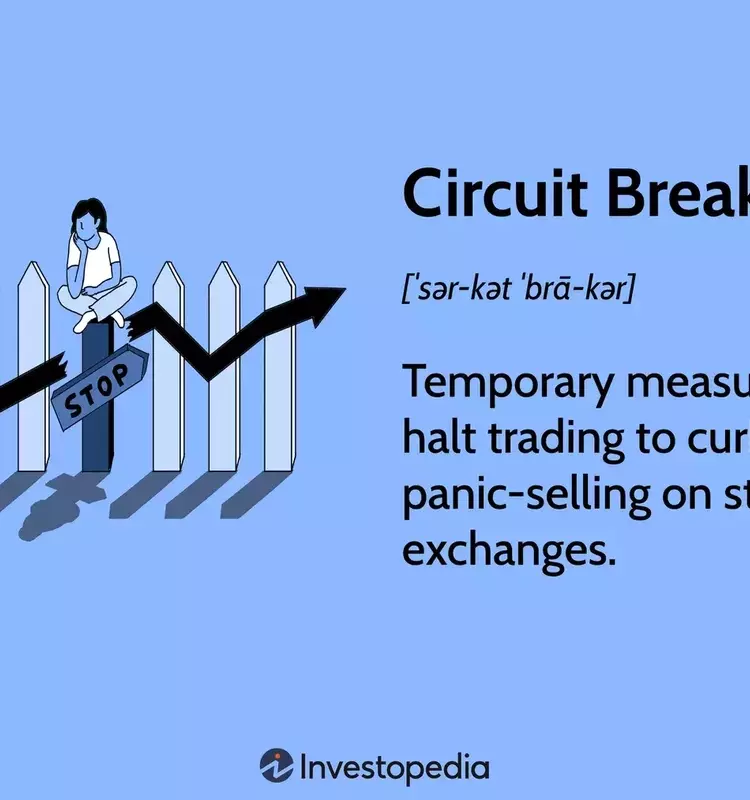
In the unpredictable world of financial markets, moments of extreme volatility can trigger widespread panic and significant losses. To counteract such scenarios, exchanges employ a crucial emergency measure: circuit breakers. These automated systems temporarily halt trading when market prices or individual security values drop below predefined thresholds, serving as a vital safety net against market meltdowns. Understanding how these safeguards operate is essential for anyone engaged with financial markets.
Imagine a situation where a major index like the S&P 500 experiences a rapid decline. As the market falls by 3% then 6%, commentators might use terms like “crash” or “freefall.” This is precisely when circuit breakers come into play. Once a specific decline threshold is met, trading automatically pauses. This pause provides a much-needed cooling-off period, allowing investors to reassess the situation and preventing panic-driven selling from spiraling out of control. The mechanism for market-wide circuit breakers involves three levels, with each level corresponding to a specific percentage drop in the S&P 500 index. A 7% decline triggers a 15-minute halt (Level 1), a 13% drop initiates another 15-minute halt (Level 2), and a 20% fall results in trading being suspended for the remainder of the day (Level 3). These rules ensure that extreme volatility does not destabilize the entire market.
Beyond market-wide circuit breakers, individual securities also have their own protection mechanisms, known as limit up-limit down (LULD) circuit breakers. Unlike their market-wide counterparts, LULD mechanisms are activated by significant price movements in either direction, whether up or down, for specific stocks or exchange-traded products (ETPs). The permissible price fluctuation band depends on the security, and these bands can double in the last 25 minutes of a trading day to accommodate heightened volatility. If a security's price moves outside its designated band for 15 seconds, trading is halted for five minutes, with the possibility of extension up to 10 minutes. These specific measures aim to prevent sudden, dramatic price swings in individual assets.
The concept of circuit breakers was first introduced following the catastrophic Black Monday crash on October 19, 1987, when the Dow Jones Industrial Average (DJIA) plummeted nearly 23% in a single day. Another significant event, the "flash crash" of May 6, 2010, which saw the DJIA drop almost 1,000 points in 10 minutes, further highlighted the need for robust automated safeguards and led to updates in the system. While circuit breakers have largely achieved their goal of preventing market-wide collapses, some economists and market analysts raise concerns about their potential unintended consequences, such as the "magnet effect," where the mere existence of a circuit breaker might encourage selling as the market approaches the trigger point. Other criticisms include interference with natural price discovery, where pauses in trading could prevent markets from quickly finding their true equilibrium. Despite these debates, circuit breakers remain a fundamental component of market regulation, continuously evolving to balance stability with market efficiency.
Circuit breakers serve as crucial emergency measures in financial markets. They are triggered by significant price movements, typically downward, for either a stock index or an individual security. These mechanisms provide a pause in trading, allowing investors to process information and mitigate the cascade of panic selling. Although market-wide circuit breakers are rarely activated, individual security circuit breakers are more frequently triggered, offering tailored protection against rapid, unwarranted price fluctuations.
