Understanding Sweet Crude Oil: Characteristics, Classification, and Market Significance
Finance

Understanding Sweet Crude Oil: Characteristics, Classification, and Market Significance

authorBy Morgan Housel
DateJul 17, 2026
Read time2 min

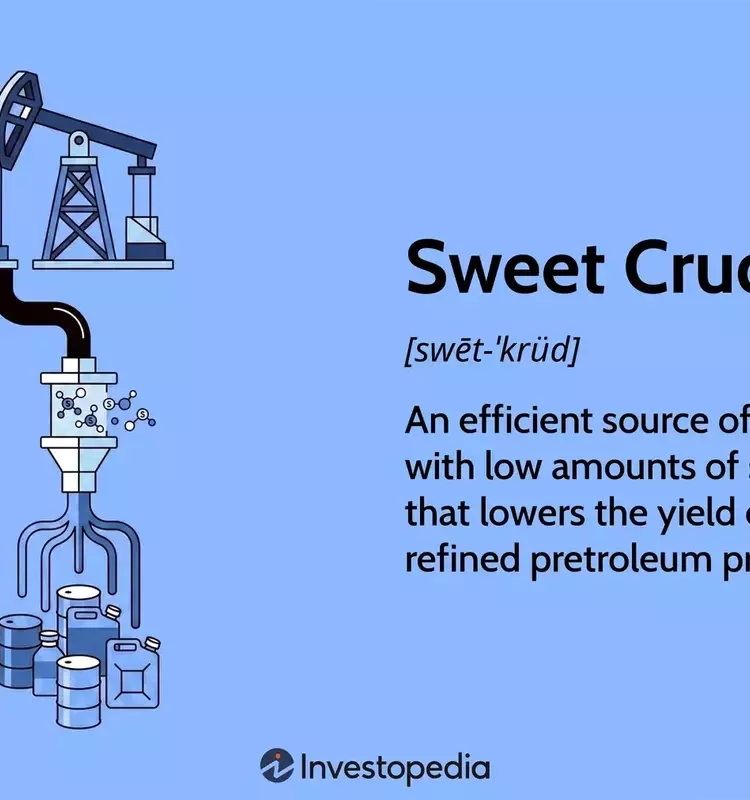
Sweet crude oil, a highly prized commodity in the energy sector, is distinguished by its remarkably low sulfur levels. This characteristic makes it a more efficient and desirable raw material for producing a variety of refined petroleum products, including gasoline, diesel, and plastics, as sulfur impurities can diminish the yield of these end products.

Crude oil is primarily composed of hydrogen and carbon, making up approximately 85% and 12% of its chemical structure, respectively. The remaining elements are trace amounts of sulfur, oxygen, nitrogen, and helium. The specific composition of these trace elements significantly influences the crude oil refining process, particularly regarding the quantity of residual byproducts generated. Refining crude with minimal sulfur content is considerably simpler and more cost-effective. To standardize this high-quality oil, the New York Mercantile Exchange (NYMEX) defines sweet crude as having a sulfur content no greater than 0.42%.

Historically, before advanced analytical techniques were available, oil prospectors would assess sulfur content through taste and smell. A faintly sweet taste and a pleasant aroma indicated low sulfur, while a sour taste coupled with a rotten egg smell pointed to high sulfur levels. This traditional method gave rise to the terms "sweet crude" and "sour crude" to describe oil types.

Beyond sulfur content, crude oil quality is also determined by its density, measured using the American Petroleum Institute (API) Gravity scale. This inverted scale classifies oil as "light" if its API Gravity is above 10 (meaning it floats on water) or "heavy" if it's below 10 (meaning it sinks). While not all light crude is sweet, most heavy crude tends to be sour, often containing significant amounts of sulfur and metals like nickel. Light crude is favored because its lower density facilitates easier refining, distillation, and transportation.

The most coveted type of crude oil combines both low sulfur content and low density, known as light sweet crude. This combination ensures maximum efficiency in refining, minimal residue, and ease of handling and transport. West Texas Intermediate (WTI) crude oil stands out as a prime example of light sweet crude. It is renowned for being lighter and sweeter than other major benchmarks, such as Brent crude and Dubai crude. Its prominence in North America is partly due to its domestic production and refining, as well as its active trading on commodity futures markets like NYMEX.

More Articles
Finance
Understanding Financial Offsets: A Comprehensive Guide
This article explores the concept of financial offsets, a strategy used to balance risk or obligations by taking an opposing position. It delves into how offsets function across various financial contexts, including derivatives, futures contracts, accounting, and banking. The article also provides insights into how businesses utilize offsets to mitigate losses and stabilize profitability, highlighting their significance in risk management.
By Morgan HouselJul 17, 2026
Finance
Second Quarter 2026 Investment Letter
The RAM Smid composite notably outperformed the Russell 2500 Value Total Return index in Q2 2026, gaining 20.06% against the index's 18.50%. This outperformance continues year-to-date, with RAM Smid up 31.15% compared to 24.16% for the index. The U.S. economy, despite geopolitical tensions, shows resilience, driving investors towards undervalued small and mid-cap sectors. The letter also highlights key portfolio adjustments and individual stock performances, emphasizing a disciplined, long-term investment philosophy.
By David RubensteinJul 17, 2026
Finance
ASML: Navigating AI's Momentum with Prudent Investment
ASML maintains its position as a key enabler of AI due to its lithography technology leadership. The company is set to benefit from increased foundry competition, a booming memory sector, and higher demand for upgrades and services. While these industry tailwinds support long-term growth, the stock's current premium valuation and overbought status suggest a cautious approach. A potential price correction to around $1,550 might offer a safer entry point for investors.
By Robert KiyosakiJul 17, 2026
Finance
Understanding Novation in Contract Law
Novation is a legal process where an existing contract is replaced by a new one, involving the substitution of one of the original parties with a new party, with the explicit consent of all involved. This mechanism effectively transfers both the benefits and the obligations of the original contract to the new party, thereby nullifying the initial agreement. It's distinct from an assignment, which only transfers rights while retaining original liabilities.
By Robert KiyosakiJul 17, 2026
Finance
Oracle: Evaluating Valuation Amidst AI Growth and Dividend Sustainability
This article evaluates Oracle's current market position, highlighting its role in the AI sector and its cloud segment growth. Despite a significant share price drop due to elevated capital expenditures and declining free cash flow, the company's dividend sustainability and long-term growth prospects are scrutinized. Investors are advised to consider near-term risks alongside the attractive forward P/E ratio.
By Mariana MazzucatoJul 17, 2026