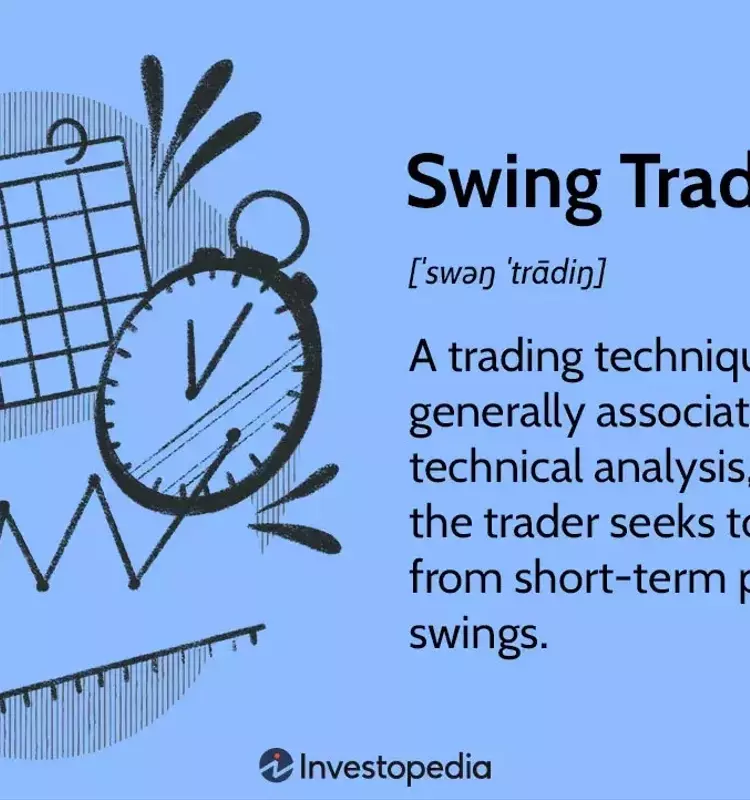
Understanding Swing Trading: Strategies, Examples, Advantages, and Disadvantages
Finance

Understanding Swing Trading: Strategies, Examples, Advantages, and Disadvantages

authorBy Lisa Jing
DateJun 23, 2026
Read time2 min

Swing trading is a method of speculating on financial markets that involves holding positions for a duration ranging from a few days to several weeks. This approach seeks to capitalize on price movements within an overarching trend, rather than the rapid, intraday fluctuations targeted by day traders. Swing traders primarily utilize technical analysis to identify potential entry and exit points, looking for instances where a countertrend movement concludes and the primary market direction reasserts itself.

This trading style emphasizes the cyclical nature of market prices, which rarely move in a perfectly linear fashion. Instead, prices tend to oscillate, creating higher highs and higher lows in an upward trend, or lower highs and lower lows in a downward trend. These oscillations are a natural consequence of continuous shifts in market sentiment and the assimilation of new information. Common technical tools employed include moving averages, momentum indicators such as the Relative Strength Index (RSI) and Moving Average Convergence Divergence (MACD), and the identification of support and resistance levels. Successful swing traders predefine profit targets and stop-loss levels, meticulously evaluating the risk-reward ratio before initiating any trade.

Swing trading offers a balanced approach, positioned between the high-frequency demands of day trading and the long-term commitment of investment strategies. While it provides greater flexibility than day trading by not requiring constant market monitoring, it does expose traders to overnight and weekend market risks. Mastery of this discipline requires not only technical proficiency but also emotional discipline, ensuring adherence to predefined strategies regardless of short-term market fluctuations stemming from hope, fear, or greed.

Swing trading exemplifies a strategic approach to market engagement, bridging the gap between rapid-fire day trading and prolonged investment horizons. By carefully analyzing market dynamics and adhering to a disciplined strategy, traders can effectively navigate the inherent ebbs and flows of financial markets, striving for consistent gains. This methodology underscores the importance of informed decision-making and emotional fortitude in the pursuit of trading success.

More Articles
Finance
Lightwave Logic: A Risky Bet on the Future of Optical Communications
Lightwave Logic is a company developing advanced electro-optic polymers to improve optical modulators, crucial for high-speed, low-power data transfer in AI data centers. Despite its innovative technology and progress with potential customers, the company remains pre-revenue, with minimal projected net sales for 2025 and significant R&D expenses. This analysis rates LWLG as a Hold, suggesting its current valuation already factors in a high likelihood of commercial success, while actual financial proof is still pending. Key risks include market delays, intense competition, and potential stock dilution, though major commercial breakthroughs could also occur.
By Michele FerreroJun 23, 2026
Finance
Nike's Q4 Earnings: An Opportunity for Long-Term Investors?
As Nike (NKE) approaches its fiscal Q4 earnings release, its stock is trading near 52-week and historical lows. This decline is largely attributed to ongoing challenges in the Chinese market, a crucial region for the company outside of North America. This article examines whether the current suppressed stock price presents an attractive entry point for investors with a long-term perspective, suggesting that market expectations might be overly pessimistic.
By Suze OrmanJun 22, 2026
Finance
SpaceX Faces Potential 50% Downside Despite IPO Success
Space Exploration Technologies (SpaceX) recently debuted on the public market with a $2.4 trillion valuation, propelling Elon Musk to trillionaire status. However, a closer look at the company's financials reveals increasing losses. Key concerns include a speculative $60 billion bid for Cursor, the competitive disadvantage of its AI Grok against industry leaders like OpenAI, and the limited market for space exploration revenue, which Starlink's success cannot fully offset against significant AI development costs.
By Lisa JingJun 22, 2026
Finance
Nebius Stock Faces Significant Risks Due to Funding Shortfall and Market Shifts
Nebius (NBIS) stock maintains a Sell rating as its valuation deviates from underlying financial realities. The company faces a substantial funding gap, requiring billions in external capital by 2028, coupled with ongoing stock dilution from convertible debt. The neocloud business model is under threat as major players invest in proprietary AI hardware, potentially squeezing future profit margins. Despite recent acquisitions aimed at enhancing its AI capabilities, high capital expenditures, negative free cash flow, and low EBIT margins highlight persistent structural vulnerabilities.
By Robert KiyosakiJun 22, 2026
Finance
Hormel Foods: A Dividend King Worth Reconsidering
Hormel Foods (HRL) presents a compelling investment case with its conservative valuation and attractive dividend yield, making it suitable for patient investors despite current sector challenges. The company has demonstrated consistent organic top-line growth for six consecutive quarters, with strong performance in its Foodservice and International segments. Management remains committed to long-term growth targets, supported by robust cash flow and a solid balance sheet. While consumer weakness, cost inflation, and private-label competition pose risks, Hormel's adaptability and financial stability reinforce its investment appeal.
By Morgan HouselJun 22, 2026