Understanding the T-REX 2X Long MSTR Daily Target ETF: Risks and Suitability
Finance

Understanding the T-REX 2X Long MSTR Daily Target ETF: Risks and Suitability

authorBy Mariana Mazzucato
DateApr 27, 2026
Read time2 min

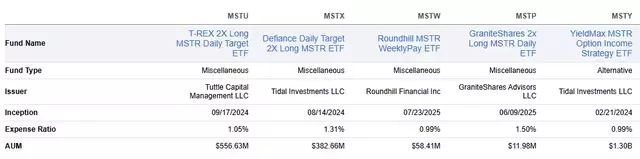
The T-REX 2X Long MSTR Daily Target ETF (MSTU) functions as a leveraged exchange-traded fund, engineered to deliver twice the daily performance of MicroStrategy Inc. (MSTR) shares. Given that MSTR's valuation is closely linked to its Bitcoin holdings, investing in MSTU essentially amplifies exposure to Bitcoin's volatile price movements. This ETF, characterized by its daily reset total return swaps, is ideally suited for active traders aiming to magnify short-term gains, but it poses considerable risks for those contemplating long-term investment. With over $557 million in assets and significant daily trading volume, MSTU boasts robust liquidity, facilitating entry and exit for its target audience of seasoned traders. Nevertheless, the average bid/ask spread of 0.22% represents an additional transaction cost that can impact overall returns.

MSTU's operational framework, particularly its use of daily-reset total return swaps, introduces a complex dynamic where performance compounds over time. This means that holding the ETF for more than a single trading day can either significantly boost profits or dramatically deepen losses, particularly if the underlying MSTR stock moves consistently in one direction. For example, a scenario involving consecutive daily declines in MSTR's value could lead to irreversible capital erosion in MSTU due to this compounding effect. Furthermore, MSTR itself employs financial leverage through debt and preferred shares to acquire Bitcoin, making MSTU an amplified bet on an already leveraged asset. These inherent risks, coupled with the potential for net asset value (NAV) decay, underscore why MSTU is fundamentally unsuitable for long-term investors and requires stringent risk management protocols, including disciplined selling strategies, from its users.

Engaging with MSTU demands a profound understanding of its intricate risks and a disciplined trading approach. The ETF's structure and its indirect exposure to Bitcoin through a leveraged company like MSTR mean that even experienced traders must exercise extreme caution. Success with MSTU hinges on meticulous risk assessment, clear entry and exit strategies, and a steadfast commitment to protecting initial capital. This investment vehicle is not a path to passive wealth accumulation but a finely tuned instrument for short-term speculation, where every decision carries amplified consequences. Embracing such tools requires not just financial acumen, but a resilient mindset focused on continuous learning and adaptation to market realities, emphasizing that informed and cautious engagement is paramount in the dynamic world of leveraged ETFs.

More Articles
Finance
Intel's Strategic Rebirth: AI-Driven Growth and Market Dynamics
Intel Corporation has demonstrated a notable resurgence, with its first-quarter 2026 earnings showcasing a remarkable 40% surge in AI-related revenue, indicating robust demand outstripping current supply. Despite these gains, the company's valuation appears elevated, and its stock faces potential volatility. Investors holding lower-priced shares are advised to maintain their positions, while new investments should target market corrections.
By Robert KiyosakiApr 27, 2026
Finance
Alphabet Inc. Poised for All-Time Highs Ahead of Q1 Earnings
Alphabet Inc. is expected to reach new heights following its Q1 earnings report on April 29th. Analysts predict a strong quarter with revenue growing 19% year-over-year to $107 billion, driven by robust performance in its Cloud and AI segments. Despite potential near-term margin compression from ongoing investments, the company's valuation remains appealing due to its consistent growth, multiple expansion avenues, and history of exceeding earnings expectations.
By Fareed ZakariaApr 27, 2026
Finance
Understanding the Schumer Box: Your Guide to Credit Card Transparency
The Schumer box is a standardized table in credit card agreements that clearly outlines key terms, rates, and fees. Introduced through the Truth in Lending Act, it simplifies the comparison of credit card offers by presenting essential financial information like APRs, annual fees, and interest calculation methods in an accessible format, empowering consumers to make well-informed decisions.
By Fareed ZakariaApr 27, 2026
Finance
Edison International Faces Financial Headwinds and Increased Risk
Edison International (EIX) has been downgraded to 'Hold' with a reduced price target of $55 per share due to heightened financial risks. The company confronts a substantial $41 billion capital expenditure plan, over $36 billion in debt, persistent negative free cash flow, and considerable exposure to California's complex regulatory environment. Despite an appealing dividend yield exceeding 5%, its sustainability is questionable given the financial strain. The risk-reward balance remains unfavorable without a significant discount, as concerns over growth and profitability persist.
By Fareed ZakariaApr 27, 2026
Finance
U.S. Navy's Record Nuclear Shipbuilding Budget
The U.S. Navy's fiscal year 2027 shipbuilding request, totaling $65.8 billion, represents a historic high, with over $25 billion allocated to nuclear-powered platforms. This significant investment aims to bolster the Naval Nuclear Propulsion Program, ensuring sustained revenue for companies involved in the nuclear value chain. Firms within the VettaFi Nuclear Renaissance Index (NUKZX), with their established government contracts, are poised to benefit substantially from this increased funding.
By Robert KiyosakiApr 27, 2026