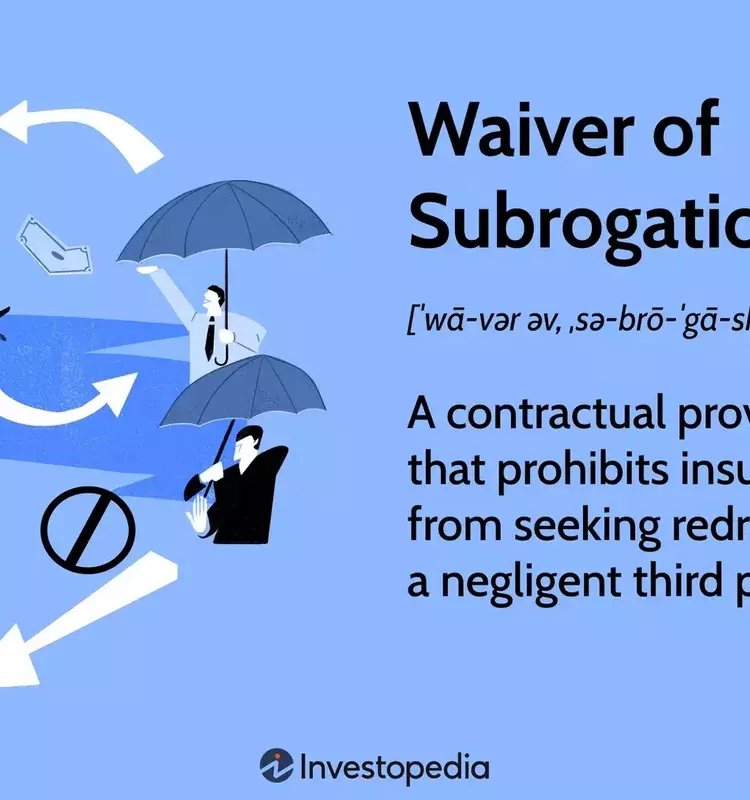
A waiver of subrogation is a specific clause within an insurance agreement that restricts the insurance provider's ability to pursue a third party for recompense following a payout for covered damages. This provision is frequently incorporated into various contractual arrangements, including those found in construction, property leases, and automotive insurance policies, primarily to mitigate the occurrence of prolonged and costly legal conflicts. By including such a waiver, the objective is to streamline the claims process and foster more stable relationships among the involved parties. Insurance companies typically levy an additional charge for this clause, reflecting the elevated risk they assume by relinquishing their right to seek recovery from a negligent third party.
The Essence of Subrogation Waivers
A subrogation waiver functions as a critical contractual element that prohibits an insurer from pursuing a third party to recoup funds paid out for damages covered by an insurance policy. This mechanism is especially prevalent in business agreements such as construction contracts and rental leases, where the aim is to circumvent potential legal entanglements and preserve ongoing professional relationships. When subrogation rights are waived, the insurance company agrees to absorb the financial impact of a loss without attempting to recover costs from another party, even if that party was at fault. This arrangement requires careful consideration from all involved, as it fundamentally alters the flow of financial responsibility following an insured event. The implication of this waiver is that the insurer assumes a higher level of risk, which is often reflected in an increased premium or a specific fee for the waiver endorsement. This trade-off is often deemed acceptable by policyholders who prioritize avoiding disputes and maintaining cooperative relationships over potentially lengthy and contentious legal battles.
Understanding how subrogation waivers operate is key to grasping their significance in various contractual contexts. Ordinarily, the principle of subrogation empowers an insurance company to step into the shoes of its policyholder after settling a claim, thereby gaining the right to sue any third party responsible for the loss. However, when a waiver of subrogation is in effect, this right is explicitly relinquished. This means that once the insurer pays out a claim to its insured, it cannot then turn around and seek reimbursement from another party whose negligence might have caused the damage. This absence of recourse shifts the burden of the loss entirely to the insurer, justifying the additional fees often associated with such waivers. For instance, in a construction project, if a subcontractor's error causes damage that the main contractor's insurer covers, a waiver of subrogation would prevent the insurer from suing the subcontractor. This pre-empts potential disputes that could strain professional relationships and cause project delays, illustrating the waiver's role in fostering stability and cooperation within complex contractual networks.
Applications and Implications of Subrogation Waivers
Waivers of subrogation are integral components across diverse contractual landscapes, notably within construction agreements, lease arrangements for landlords and tenants, and even certain auto insurance scenarios. In construction, these clauses are designed to ensure that project owners cannot sue contractors or subcontractors for insured damages, thereby promoting a smoother workflow and preventing costly delays that could arise from litigation. Similarly, in landlord-tenant relationships, these waivers protect both parties from legal actions by the other's insurer after a covered loss, helping to sustain amicable relations and avoid significant legal expenses. The presence of such a waiver means that, once an insurance claim is paid for an incident, the matter is considered closed without further pursuit of fault-based recovery from involved third parties. This strategic legal tool offers a mechanism for risk management that prioritizes continuity and relationship preservation over the traditional pursuit of indemnification through subrogation.
The practical implications of implementing a waiver of subrogation are significant, touching upon financial aspects and interpersonal dynamics in contractual relationships. For the insurer, accepting a waiver of subrogation typically entails an increased financial exposure, as they forgo the opportunity to recoup losses from a negligent third party. This heightened risk often translates into an extra charge levied on the policyholder's premium. For policyholders, particularly in sectors like construction or real estate, this additional cost is often seen as a worthwhile investment. It shields them from potential lawsuits, minimizes disruptions to projects, and preserves valuable business relationships that might otherwise be jeopardized by adversarial legal proceedings. For example, in a leased property, if a tenant's guest is injured due to a landlord's oversight and the tenant's insurer pays the claim, a waiver prevents the insurer from suing the landlord. This protects both the landlord from liability and the tenant from potential eviction or strained relations, illustrating how waivers of subrogation facilitate smoother operations and foster mutual trust among contracting parties, despite the initial increase in insurance expenditure.
