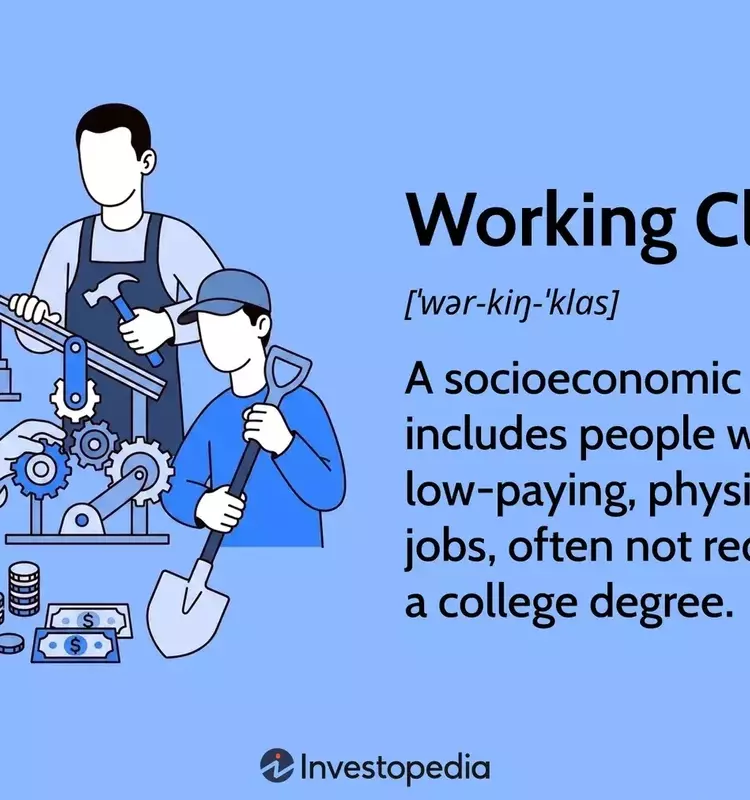
The term 'working class' carries diverse meanings depending on the context, but it generally refers to individuals engaged in employment that typically involves manual labor or service roles, often outside traditional office environments. Such occupations frequently do not necessitate a university degree. While some working-class individuals may experience financial precarity, living from paycheck to paycheck with minimal savings, others, like nuclear power plant operators or boilermakers, earn salaries comparable to many middle-class professions.
The Evolving Landscape of the Working Class
In modern socioeconomic discourse, the 'working class' broadly denotes a group often characterized by occupations demanding minimal specialized training or higher education, frequently resulting in lower remuneration. A 2022 Gallup poll indicated that 35% of respondents identified as working class, alongside 11% categorizing themselves as lower class. This contrasts with 38% identifying as middle class, 14% as upper-middle class, and 2% as upper class. Economists in the United States commonly define the working class as adults lacking a college degree, with many also overlapping with the middle class. Sociologists like Dennis Gilbert consider this group to be those within the 25th to 55th percentile of income distribution.
Historically, the concept of the working class has seen significant shifts. In feudal Europe, a broad 'laboring class' encompassed individuals from diverse trades—lawyers, craftspeople, and peasants alike—who were distinct from the aristocracy or religious elite. Similar social stratifications existed in other pre-industrial societies globally. Karl Marx famously described the working class as the 'proletariat,' asserting their fundamental role in generating society's wealth through their labor. Marxists and socialists extend this definition to anyone who must sell their labor or skills to earn a living, including both manual and 'white-collar' workers, thereby excluding only those whose income is derived from business ownership or the exploitation of others' labor.
The nature of working-class jobs has undergone a dramatic transformation. The decline of manufacturing and industrial sectors has led to a shift towards service-oriented roles. Today, typical working-class jobs include clerical positions, roles in the food industry, retail sales, manual labor, and certain low-level white-collar professions. These roles often offer less than $15 per hour and may not include health benefits. Furthermore, the demographic composition of the working class in America has become increasingly diverse. White Americans now constitute approximately 59% of this group, a notable decrease from 88% in the 1940s, with Black Americans making up 14% and Hispanic Americans 21%.
The concept of the working class continues to evolve, reflecting changes in economic structures, labor markets, and societal perceptions of status and income. Understanding these dynamics is crucial for comprehending broader socioeconomic trends and their impact on individuals and communities.
The evolving definition and composition of the working class offer profound insights into the transformations within modern economies and societies. It highlights the importance of adapting educational and social support systems to meet the changing needs of this significant demographic. Moreover, it encourages a deeper examination of income inequality and access to benefits, prompting discussions on policies that could foster greater economic stability and mobility for all workers, regardless of their specific occupational titles or educational backgrounds.
