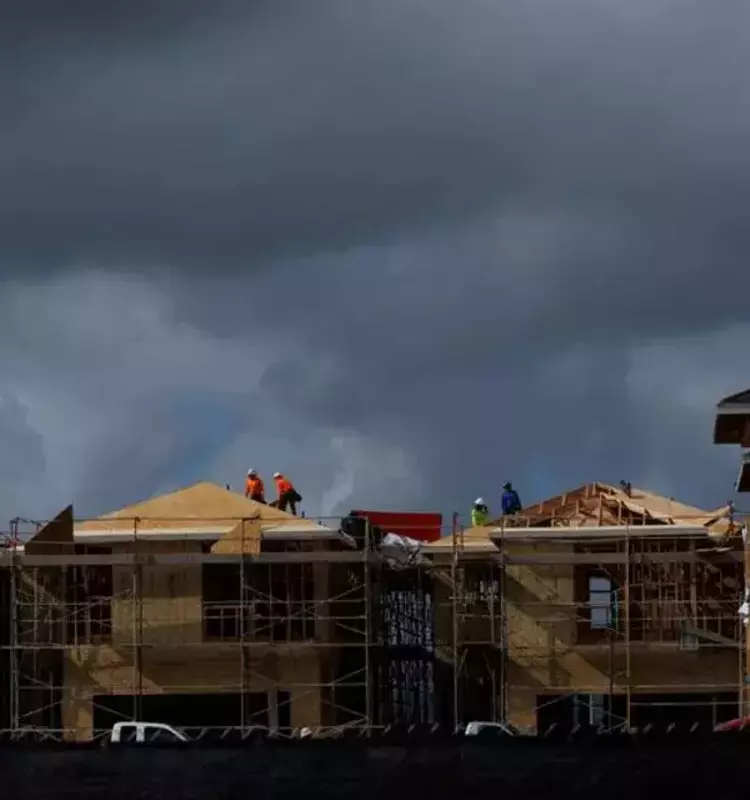
The American housing market is currently experiencing a notable slowdown, with single-family home construction reaching its lowest point in eight months. This decline, fueled by surging mortgage rates and material expenses, has contributed to a broader economic deceleration. Concurrently, the nation faces a significant increase in import prices, primarily due to costlier fuel and essential capital goods, further complicating the economic landscape.
Details on the Recent Economic Shifts
In May, the construction of single-family homes in the United States registered a substantial decrease, falling to its lowest level since September of the previous year. This downturn is largely attributed to elevated mortgage rates and the rising cost of building materials. The Commerce Department reported on Tuesday, June 16, 2026, that overall homebuilding activity, including both single-family and multi-family units, has reached a six-year low. This contraction in residential investment, observed over five consecutive quarters, signals a challenging period for the housing sector.
Economists, including Sal Guatieri of BMO Capital Markets, suggest that the housing market's woes are likely to persist, given the current high mortgage rates, existing housing inventory, and a noticeable dip in builder confidence, as indicated by a recent National Association of Home Builders survey. The increase in mortgage rates is linked to geopolitical tensions, specifically the U.S.-backed conflict with Iran, which has driven up oil prices and subsequently, Treasury yields. Data from Freddie Mac reveals a more than 50 basis point increase in the 30-year fixed-mortgage rate since the conflict began in late February. However, recent agreements between Washington and Tehran to end the conflict and reopen the Strait of Hormuz offer a glimmer of hope, potentially alleviating some import tariff pressures that previously impacted building material costs.
While single-family building permits saw a slight increase of 0.6% in May, multi-family housing starts plunged by 41.6%. Overall, housing starts decreased by 15.4% last month. Separately, the Labor Department's Bureau of Labor Statistics reported a 1.9% rise in import prices in May, following a 2.0% jump in April. This increase, largely driven by more expensive fuels and capital goods, highlights persistent inflationary pressures. Despite a recent pullback in Brent crude prices, import prices have been consistently rising since January, with a 6.7% year-over-year increase in May, marking the largest surge since August 2022. This mirrors strong readings in consumer and producer prices, although economists remain optimistic that inflation may have peaked in May due to falling oil prices.
The Federal Reserve is currently holding a two-day policy meeting, and while interest rates are expected to remain stable, the high inflation and labor market stability suggest a potential shift away from an easing bias. This delicate balance reflects the complex economic challenges facing the nation.
The current economic climate, marked by a struggling housing market and rising inflation, offers a critical lesson in interconnectedness. The interplay between geopolitical events, energy markets, and domestic economic indicators profoundly influences everyday life, from housing affordability to the cost of goods. This situation underscores the importance of resilient economic policies and international cooperation to mitigate external shocks. For individuals, it highlights the need for financial prudence in times of economic uncertainty, particularly regarding major investments like housing. As the Federal Reserve navigates these choppy waters, its decisions will undoubtedly shape the economic landscape for years to come, emphasizing the continuous need for careful observation and adaptive strategies from policymakers and citizens alike.
