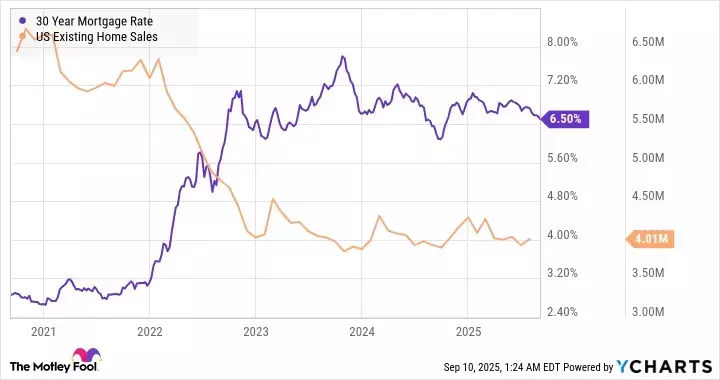
Whirlpool Corporation is currently grappling with a difficult market landscape, marked by elevated interest rates that are stifling the housing sector and fierce competition from Asian manufacturers. These factors have compelled the company to revise its financial forecasts downwards. However, the ongoing trade dynamics, particularly the implementation of tariffs, could present a significant long-term advantage for Whirlpool, bolstering its market position in North America.
Whirlpool Navigates Market Challenges Amidst Evolving Tariff Landscape
As of September 13, 2025, Whirlpool Corporation, a leading appliance manufacturer, finds itself in a precarious market position. Analyst Lee Samaha highlights that the company's stock, currently trading at an attractive valuation with a substantial dividend yield of 3.8%, appears to be a 'deep value' opportunity. Yet, this appeal is tempered by significant near-term headwinds. The persistently high interest rates are dampening the U.S. housing market, consequently reducing demand for major domestic appliances, which typically boast higher profit margins. Simultaneously, Asian competitors are aggressively pushing products into the market in anticipation of impending tariff actions, creating an intensely promotional and competitive environment.
These challenging conditions prompted Whirlpool's management to significantly cut its full-year earnings guidance, from a previous range of $10 to between $6 and $8 per share, and its free cash flow estimate from $500-$600 million to $400 million. There's a real possibility of further downward revisions if market conditions don't improve. However, despite this grim short-term outlook, there's a silver lining. The strategic implications of U.S. trade policies, particularly tariffs, could dramatically reshape the competitive landscape in Whirlpool's favor.
Whirlpool's strong manufacturing base in the United States—with 80% of its major domestic appliance sales in the U.S. being produced domestically and utilizing U.S. steel—positions it uniquely to benefit from the current administration's protectionist trade policies. Tariffs on imports from countries like China (up to 61%) and Vietnam (25%), announced in the second quarter earnings call, are set to significantly increase the cost for foreign competitors. While some rivals maintain U.S. manufacturing presence, it is considerably less than Whirlpool's. As Asian companies deplete their pre-tariff inventory, the full impact of these tariffs is expected to be felt, potentially shifting market share towards domestic producers like Whirlpool. Furthermore, any future interest rate reductions by the Federal Reserve could revitalize the housing market, providing an additional boost to demand for appliances.
Whirlpool's current challenges are undeniable, and investors might face continued volatility. However, the unfolding trade policies, coupled with the potential for a more favorable economic climate by 2026, suggest a strong rebound for the company. For investors willing to tolerate some immediate risk, Whirlpool could represent a strategic long-term acquisition, poised to capitalize on a strengthening domestic competitive edge.
This analysis suggests that while Whirlpool is currently navigating a period of significant headwinds, particularly from a weak housing market and intense competition, its robust U.S. manufacturing footprint positions it as a potential long-term beneficiary of evolving trade policies. The imposition of substantial tariffs on foreign competitors could eventually create a more favorable operating environment, strengthening Whirlpool's competitive advantage in North America. For forward-thinking investors, this situation could present a compelling "deep value" opportunity, despite the immediate uncertainties. The lesson here is that sometimes, short-term pain can precede significant long-term strategic gains, especially when geopolitical and economic factors align to favor domestic industries.