Why the Vanguard Information Technology ETF Remains a Top Performer Despite Volatility
Stocks

Why the Vanguard Information Technology ETF Remains a Top Performer Despite Volatility

DateOct 06, 2025
Read time2 min

In an unpredictable market, while many investors seek stability, focusing solely on 'safe' options might lead to missed opportunities. The Vanguard Information Technology Fund (VGT), despite its perceived risk due to volatility, has consistently delivered superior returns across various timeframes. This analysis delves into why this particular ETF stands out, even when the broader economic landscape appears uncertain, and why a long-term perspective is crucial for maximizing its potential.

Vanguard Information Technology Fund: A Deeper Dive into Its Enduring Performance

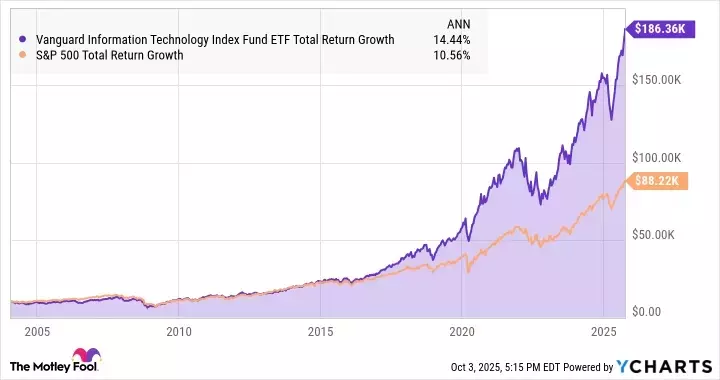
Anders Bylund, an analyst specializing in media and technology, highlights that as of October 6, 2025, the Vanguard Information Technology Fund (VGT) has been the top performer among all Vanguard ETFs over the past one, three, and ten years. This remarkable consistency underscores its strength. Despite the inherent volatility often associated with technology stocks, VGT has demonstrated a powerful ability to rebound from market corrections, offering significant long-term wealth creation opportunities. For instance, those who maintained their investments through the 2022 inflation-driven market downturn saw substantial gains by October 2025, significantly outperforming the S&P 500. This pattern of falling harder but recovering stronger has been observed across multiple major market crises, including the 2008 subprime mortgage crisis and the 2020 pandemic crash. With an expense ratio of just 0.10%, VGT provides an exceptionally cost-effective entry point into some of America's most dynamic and innovative technology companies.

However, Bylund cautions that this ETF is not suitable for everyone. Investors needing their capital within a three-year window or those prone to panic-selling during steep declines might find VGT too risky. Its beta value of 1.25, compared to the S&P 500's 1.0, confirms its higher volatility. Furthermore, VGT's average price-to-earnings (P/E) ratio of 39.0, significantly higher than the S&P 500's 27.7, suggests that its holdings are valued more richly, reflecting higher growth expectations. As of October 3, 2025, VGT traded at $755.39 per share. For those who can commit to a five-year-plus investment horizon and understand that market fluctuations are part of the journey, VGT offers an unparalleled pathway to participate in the growth of the technology sector.

This analysis reveals that while the immediate market climate might appear daunting, a long-term investment strategy in robust, albeit volatile, funds like VGT can lead to substantial rewards. The lesson here is clear: courage and patience are paramount. Short-term fears should not overshadow the potential for significant long-term growth, especially when history consistently demonstrates the resilience and superior returns of such targeted investments.

More Articles
Navigating the S&P 500: Opportunities Amidst High Valuations
The S&P 500 continues its upward trend, demonstrating resilience with a 14% year-to-date increase. While it has historically been a robust wealth builder, its current high valuation, reflected in a nearly 38 P/E ratio and elevated CAPE ratio, suggests a potential for future corrections. Investors can gain AI exposure through S&P 500 ETFs, which hold major tech giants like Nvidia and Microsoft. Long-term investors are advised to stay invested, but those needing near-term liquidity should consider safer alternatives.
Oct 06, 2025
Lucid Group Faces a Challenging Road Ahead as Federal Subsidies Disappear
The electric vehicle industry, including Lucid Group, is bracing for a difficult period in 2026 due to the cessation of federal tax credits and regulatory incentives. An industry expert, Adam Jonas of Morgan Stanley, anticipates a significant impact on EV demand and profitability as these crucial subsidies, which previously lowered vehicle prices and boosted manufacturers' earnings, are eliminated. This shift will particularly affect companies like Lucid as they navigate a more cost-conscious market and plan for future lower-priced models.
Oct 06, 2025
Social Security COLA: Seniors Face Persistent Inflation Challenges
The upcoming 2026 Social Security cost-of-living adjustment (COLA) is projected to be around 2.7% or 2.8%. While this marks the fifth consecutive year of significant COLA increases, historical data and current economic trends suggest that these adjustments may still fall short of covering the rising costs of essential goods and services for seniors, leading to a continued decline in purchasing power.
Oct 06, 2025
Roth vs. Traditional IRA: Which is Right for Your Retirement Planning?
Choosing between a Roth IRA and a Traditional IRA depends on individual circumstances. Roth IRAs offer tax-free withdrawals in retirement and no required minimum distributions, appealing to those expecting higher tax brackets later in life or needing flexibility. Traditional IRAs provide immediate tax deductions, beneficial for those in higher tax brackets during working years, with taxes paid upon withdrawal in retirement. The optimal choice hinges on income levels, anticipated future tax rates, and desired withdrawal flexibility.
Oct 06, 2025
The Buffett Indicator: A Warning Sign for Today's Stock Market Investors
Warren Buffett's favored valuation metric, the "Buffett indicator," has reached an unprecedented 216%, signaling a potentially overvalued stock market. This indicator, which compares total market capitalization to U.S. GDP, suggests investors should exercise caution, echoing Buffett's past warnings during periods of market exuberance.
Oct 06, 2025