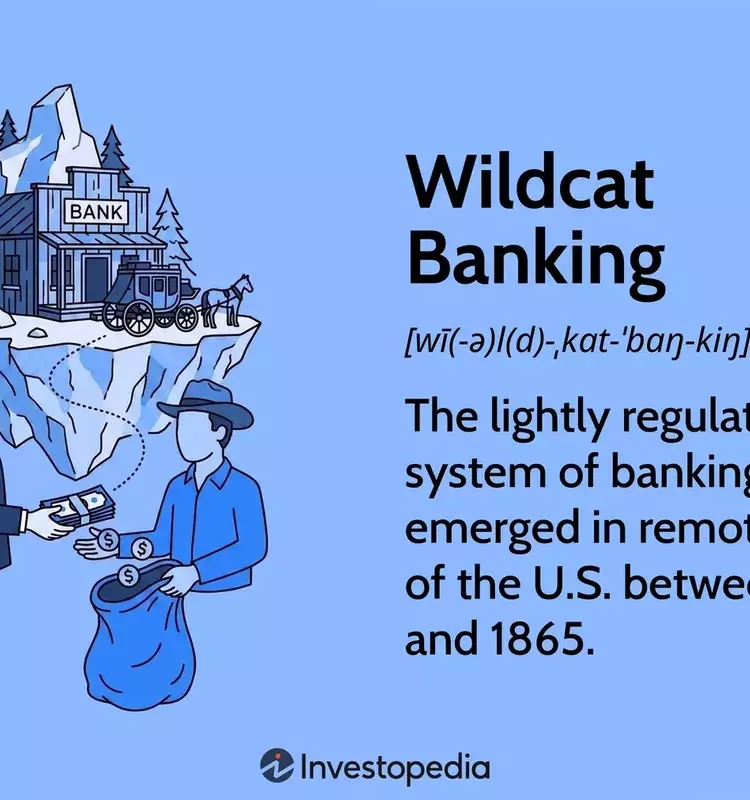
From 1837 to 1865, the United States witnessed a unique financial phenomenon known as wildcat banking. This period was marked by the proliferation of banks, particularly in isolated regions, operating under minimal federal scrutiny. The lack of stringent national regulations allowed individual states to charter and oversee these institutions, leading to a diverse and often volatile banking landscape. The term 'wildcat banking' itself carries connotations of risk and unreliability, stemming from various anecdotal origins, including the establishment of banks in areas frequented by wild animals or the issuance of currency featuring a wildcat image. This era of decentralized banking ultimately paved the way for significant reforms with the introduction of federal oversight.
The era of wildcat banking concluded with the passage of the National Bank Act of 1863. This landmark legislation aimed to bring uniformity and stability to the American financial system by establishing federal regulations, creating the United States National Banking System, and introducing a national currency backed by the U.S. Treasury. This shift marked a crucial turning point, moving away from a fragmented state-regulated system towards a more cohesive and federally controlled banking structure, thereby mitigating the risks associated with the previously unregulated environment.
The Genesis and Characteristics of Wildcat Banking
During the mid-19th century in the United States, a distinctive phase of banking, known as wildcat banking, emerged. This period, spanning from 1837 to 1865, saw the establishment of numerous banks in remote and often inaccessible locations. These institutions operated largely without federal oversight, a characteristic that defined the 'Free Banking Era.' Instead, their operations were governed by state laws, resulting in a patchwork of regulations that varied significantly across different states. This decentralized regulatory environment allowed for considerable autonomy in banking practices but also introduced inherent risks due to the absence of a unified national framework.
The term 'wildcat banking' itself has intriguing origins, purportedly arising from the 1830s in Michigan. One theory suggests that bankers strategically set up their operations in desolate areas, far from established towns, where wild animals like wildcats roamed, making it difficult for note-holders to redeem their currency. Another popular account attributes the term to a particular bank that issued banknotes adorned with an image of a wildcat. Regardless of its precise etymology, the term came to symbolize speculative and precarious financial ventures. These banks were often perceived as unstable and susceptible to failure, a depiction frequently reinforced in popular culture, such as Western films, where wildcat bankers were sometimes portrayed as deceptive figures who would mislead depositors with false displays of wealth in their vaults, using a thin layer of cash over worthless goods to feign solvency.
The Currency System and Regulatory Evolution
Prior to the National Bank Act of 1863, wildcat banks possessed the authority to issue their own banknotes, a practice that was subsequently outlawed by the new federal legislation. A significant challenge for holders of these banknotes was the difficulty in redemption, as many of these remote banks were the sole locations where their currency could be exchanged. This geographical isolation provided an unfair advantage to less scrupulous bankers, who could effectively minimize redemptions. The value and legitimacy of these privately issued currencies varied wildly, with some banks backing their notes with precious metals (specie), while others relied on more questionable collateral such as bonds or mortgages. This inconsistency led to fluctuating exchange rates, with different notes trading at varying discounts to their stated face values. To navigate this complex financial landscape, bankers and currency traders relied on published lists that helped them distinguish genuine notes from forgeries and assess the true worth of the diverse wildcat currencies in circulation.
In the pre-Federal Reserve era, before its establishment in 1913, banks played a crucial role in extending credit by issuing their own notes to customers seeking loans. Borrowers would receive banknotes, typically backed by government bonds or specie, which represented a claim on the bank's assets. During the Free Banking Era, many states mandated that these notes be secured by state bonds, a measure intended to provide some level of security. However, the lack of standardized federal oversight meant that the quality of these backing assets, and thus the stability of the issued currency, was inconsistent. This fragmented system, with its inherent risks and varying levels of security, highlighted the urgent need for a more unified and federally regulated banking structure, which eventually materialized with the National Bank Act and later the Federal Reserve System.
