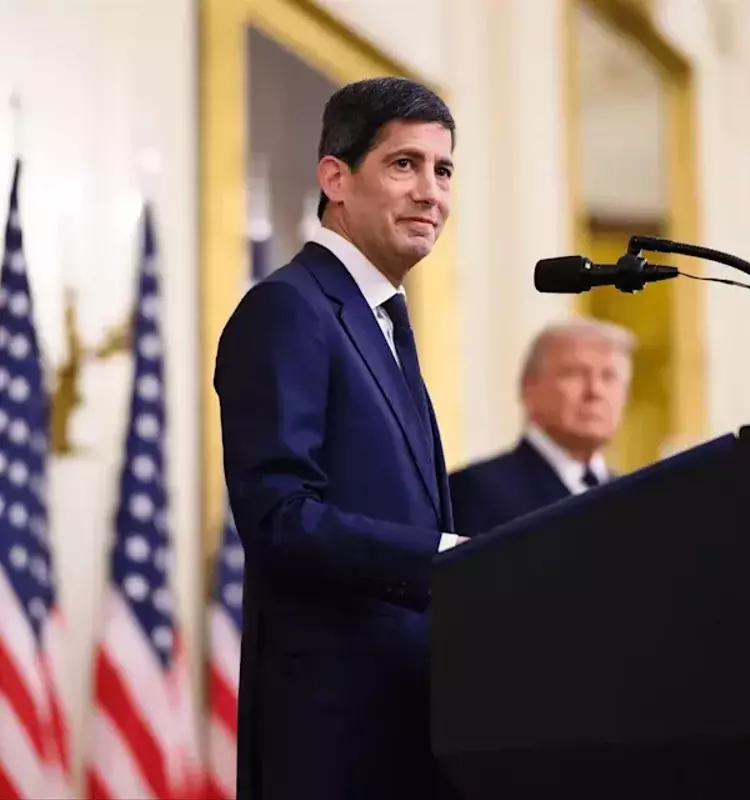
The financial world is currently grappling with a significant disconnect between the Federal Reserve's hinted policy direction and prevailing market sentiment. While the new Fed Chair, Kevin Warsh, has alluded to a future of interest rate reductions, bond markets are actively pricing in a scenario of hikes. This creates a challenging environment for investors as inflation remains elevated and consumer confidence has seen a notable dip, suggesting a complex economic landscape for the remainder of 2026.
Federal Reserve's Contrasting Stances on Monetary Policy Unsettle Markets
On Tuesday, June 16, 2026, financial markets observed a curious divergence as the newly appointed Federal Reserve Chair, Kevin Warsh, delivered remarks that suggested an inclination towards easing monetary policy through rate cuts during his confirmation hearings. This dovish tone, however, stands in stark contrast to the bond market's current trajectory, which is increasingly anticipating future rate increases. Senior economics reporter Steve Liesman, in a segment on CNBC, highlighted this unusual schism between the central bank's signals and investor expectations, creating a critical point of focus for those navigating the financial landscape in the latter half of 2026.
Warsh is advocating for a shift in the Fed's communication strategy, aiming for a less intrusive presence in daily market activities. This departure from previous practices of extensive forward guidance could lead to increased market surprises and heighten the importance of each Federal Open Market Committee (FOMC) decision. Furthermore, Warsh has expressed concerns regarding the accuracy of current inflation metrics, proposing a reliance on 'trimmed averages' that exclude outlier data. Yet, critics, including Liesman, point out that this method previously failed to capture the onset of pandemic-era inflation, potentially leaving the Fed unprepared for future economic shifts.
The underlying economic conditions paint a complex picture. The Federal Reserve's preferred core Personal Consumption Expenditures (PCE) gauge reached its 90.9th percentile in April 2026, while the Consumer Price Index (CPI) showed an increase from 321.435 in June 2025 to 333.979 by May 2026. Overall inflation has surged past the Fed's 2% target, exceeding 4%. Simultaneously, the bond market's actions reveal skepticism about imminent rate cuts. The federal funds target has remained at 3.75% since December 11, 2025, despite earlier cuts. The 10-year Treasury yield is currently elevated at 4.48%, marking its 94th percentile over the past year, and the 2s/10s spread has narrowed significantly, indicating that traders doubt substantial rate reductions will materialize soon. Compounding these concerns, consumer sentiment has plummeted to 49.8 in April 2026 from a high of 61.7 in July 2025, even with a healthy unemployment rate of 4.3%.
From an analytical perspective, this scenario underscores the inherent difficulties in predicting the future course of monetary policy when official rhetoric and market actions diverge. The new Fed Chair's approach, characterized by less transparency and a distinct method for measuring inflation, introduces a layer of uncertainty. For market participants, it highlights the importance of scrutinizing economic data and being prepared for a less predictable central bank. The elevated long-bond yields and falling consumer confidence signal a market that is bracing for prolonged higher interest rates, potentially challenging household budgets and corporate borrowing costs. Investors should remain vigilant, acknowledging that the path to rate adjustments may be more challenging and less straightforward than initially implied by the new Fed leadership.
