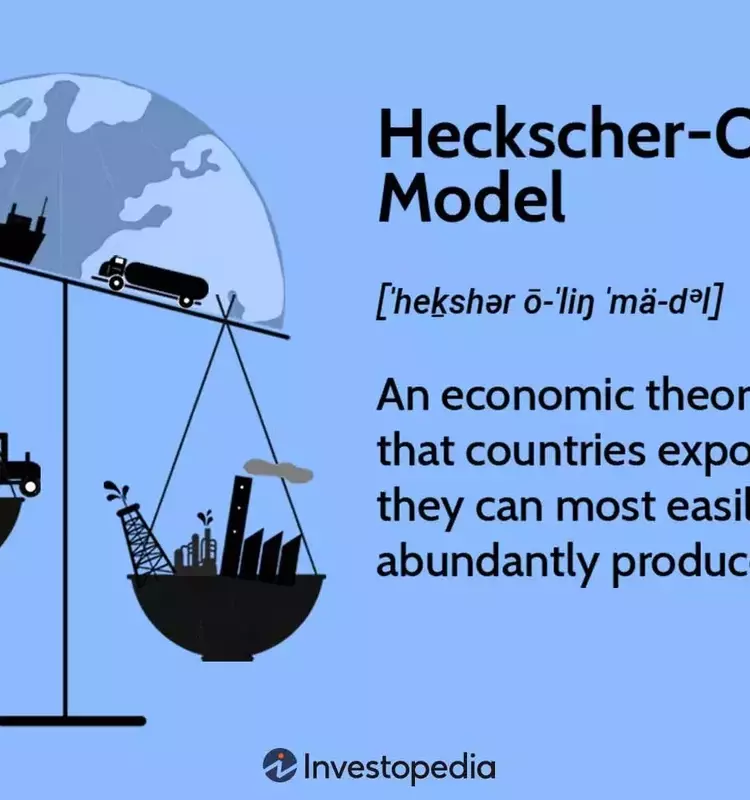
The Heckscher-Ohlin model stands as a fundamental concept in economic theory, illustrating how countries engage in international trade by leveraging their unique factor endowments. This model provides a systematic approach to understanding global trade patterns, emphasizing that nations tend to specialize in and export products that utilize their most abundant and cost-effective resources, while importing goods that would be more expensive to produce domestically due to resource scarcity. It posits that such specialization leads to increased global efficiency and welfare for all participating countries, fostering a mutually beneficial exchange of goods and production factors like labor and capital across borders.
Understanding the Heckscher-Ohlin Theory
The Heckscher-Ohlin model, a cornerstone of international trade theory, proposes that a nation's trade patterns are primarily determined by its relative abundance of various production factors. This theory, initially developed by Swedish economists Eli Heckscher and Bertil Ohlin, and later expanded upon by Paul Samuelson, posits that countries will naturally gravitate towards producing and exporting goods that intensively utilize the resources they possess in abundance. Conversely, they will import goods whose production demands resources that are scarce within their borders. This framework extends beyond tangible commodities to include factors such as labor, capital, and land, suggesting that even variations in labor costs can dictate a country's specialization in labor-intensive or capital-intensive goods.
At its core, the Heckscher-Ohlin model offers a mathematical explanation for achieving trade equilibrium where resource endowments differ between nations. It asserts that international trade serves as a mechanism to redistribute bundles of factors like land, labor, and capital from areas where they are plentiful to regions where they are scarce. For instance, a country with an abundance of low-cost labor would ideally focus on manufacturing labor-intensive products, gaining a competitive edge in global markets. This specialization allows for the efficient allocation of resources on a global scale, leading to increased output and economic benefits for all trading partners. The model's enduring relevance lies in its ability to illuminate the intricate relationship between a country's internal resource structure and its external trade dynamics.
Real-World Applications and Global Benefits
The Heckscher-Ohlin model's theoretical underpinnings are vividly illustrated through practical examples in the global economy, where nations frequently optimize their trade strategies based on their unique resource advantages. Consider, for instance, a country rich in petroleum reserves but lacking iron ore; according to the model, it would naturally export oil while importing iron ore. This principle also extends to other critical factors of production, such as human capital and agricultural land. A nation with fertile land and a developed agricultural sector would likely export food products, while one with a highly skilled workforce might focus on technology-intensive exports, underscoring how diverse factor endowments drive international commerce.
Furthermore, the model highlights the profound global benefits derived from such specialized international trade. By enabling countries to focus on producing goods where they have a comparative advantage due to abundant resources, overall global production efficiency increases. This specialization not only leads to a more efficient allocation of resources worldwide but also allows consumers access to a wider variety of goods at lower prices. The dynamic interplay of exporting abundant resources and importing scarce ones creates a virtuous cycle that enhances economic growth and fosters interdependence among nations. Ultimately, the Heckscher-Ohlin model provides a compelling argument for the economic rationale behind international trade, demonstrating how it can lead to prosperity and improved welfare on a global scale.
