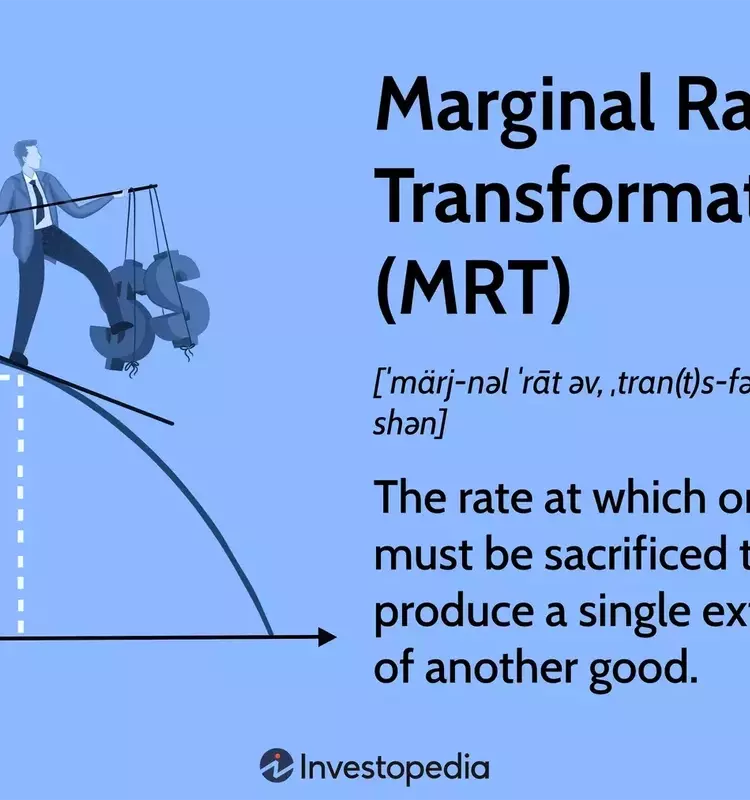
The Marginal Rate of Transformation (MRT) stands as a cornerstone concept in economics, providing a clear lens through which to view the inherent trade-offs in the production landscape. It systematically quantifies how much of one good must be relinquished to acquire an additional unit of another, all while maintaining a fixed level of resources and technology. This metric is not merely an academic construct but a vital tool for businesses and policymakers, illuminating the opportunity costs embedded in every production decision and guiding the path toward optimal resource allocation.
Understanding the Dynamics of Production Trade-offs
In the vibrant realm of economic theory, the Marginal Rate of Transformation (MRT) is a fundamental indicator used to analyze the opportunity costs associated with production. Specifically, it reveals the quantity of one good (let’s call it Good Y) that must be forgone to produce an extra unit of another good (Good X). This crucial economic tool is deeply intertwined with the Production Possibility Frontier (PPF), a graphical representation illustrating the maximum output combinations of two goods that an economy can achieve with its available resources and technology. The MRT is, in essence, the absolute value of the PPF’s slope at any given point, signifying the varying trade-offs as production shifts between goods.
Consider a baker who can produce both cakes and loaves of bread. If sacrificing one cake allows for the production of three additional loaves of bread, the MRT is 3:1. Similarly, if a cake costs $3 to produce and reducing bread production saves $1, the MRT is also 3 ($3/$1). This highlights the direct relationship between cost and the rate of transformation. Another relatable scenario involves a diligent student allocating study time between two subjects. The MRT, in this context, would be the increase in performance in one subject achieved by reducing study time for another, represented by the slope of their academic production possibility frontier.
As an economy moves along its PPF, the MRT typically increases, reflecting the law of diminishing returns. This means that as more of one good is produced, the opportunity cost (in terms of the other good) rises. For instance, redirecting increasingly specialized resources from bread-making to cake-making becomes progressively less efficient, requiring the sacrifice of more bread for each additional cake. While the MRT focuses on the supply-side dynamics of production trade-offs, it is distinct from the Marginal Rate of Substitution (MRS), which pertains to consumer demand and satisfaction. The MRS measures how much of one good a consumer is willing to give up for an additional unit of another good while maintaining the same level of utility. For optimal economic efficiency, where resources are allocated to maximize societal welfare, the MRT should ideally align with the MRS.
Strategic Economic Insights and Future Directions
The Marginal Rate of Transformation (MRT) offers profound insights into the economic choices faced by producers and, by extension, society. By precisely quantifying the sacrifices required to shift production, it underscores the critical importance of efficient resource deployment. This understanding empowers businesses to make informed decisions about their production mixes, ensuring they are operating at the most advantageous point on their production possibility frontier given their technological constraints and resource availability. From a broader economic perspective, the MRT serves as a compass, guiding policymakers in allocating national resources to foster growth and maximize output across different sectors.
The dynamic nature of MRT, continually shifting as production levels change, highlights the need for ongoing evaluation and adaptation in economic strategies. Businesses must consistently monitor their production efficiencies and market demands to avoid imbalances that could lead to inefficiencies or unmet consumer needs. While the concept of MRT is powerful, its practical application necessitates a detailed understanding of production costs and technological capabilities across various goods. Integrating this economic principle into real-world planning allows for a more nuanced approach to achieving both productive efficiency and consumer satisfaction, ultimately contributing to a more robust and responsive economic system.
