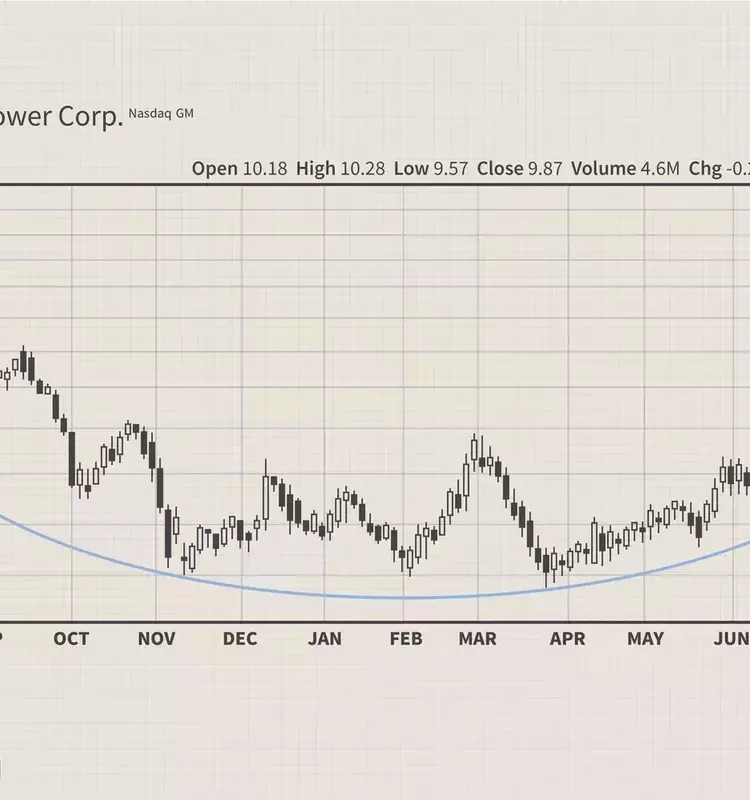
In financial markets, 'basing' describes a period where an asset's price stabilizes within a narrow range, typically after a sharp drop or in the midst of a robust rally. This stabilization suggests a temporary equilibrium between buying and selling pressures, often accompanied by reduced trading activity and volatility. Identifying these consolidation phases is crucial for traders as they frequently precede significant market movements, indicating either a continuation of the previous trend or a potential reversal.
Technical analysis emphasizes the importance of basing periods. For equities, such as stocks, a prolonged basing phase can follow a steep decline, setting the stage for a substantial recovery. Conversely, during an upward trend, basing can act as a 'refresh' period, allowing the asset to gather momentum before continuing its ascent. These periods are characterized by a noticeable decrease in trading volume, signaling that supply and demand are in balance. As assets trade sideways, their volatility diminishes, resulting in a relatively flat price movement. This dynamic creates distinct support and resistance levels as buyers and sellers contend for market control, often leading institutional investors to accumulate positions discreetly.
Traders employ specific strategies when encountering basing patterns. In markets exhibiting a clear trend, establishing a long position is advisable when the price surpasses the consolidated range, ideally supported by above-average trading volume. This volume surge confirms strong market participation. A key indicator of a healthy basing pattern is when the 20-day or 50-day moving average provides support at the pattern's lower boundary, aligning with the asset's price. This approach offers a favorable risk-to-reward outlook, allowing traders to set stop-loss orders below the base's lowest point and target profits several times the stop amount. For short positions, the moving average typically acts as resistance.
Conversely, contrarian traders often utilize basing periods to pinpoint potential market bottoms or tops. If an asset consolidates for an extended duration, a breakout in the direction opposite to the preceding trend can trigger numerous stop-loss orders, attracting new market participants and facilitating a trend reversal. Similar to trend continuation strategies, if the price drops below the lowest point of the basing period, the trade should be exited. Profit targets, in this scenario, are often based on retracement levels of the prior trend.
Technical analysts identify two primary basing patterns: the cup with a handle and the flat base. The 'cup with a handle' pattern typically forms during an uptrend, signifying a correction where the asset's price drops by 30% to 40% from its peak. This pattern usually emerges near 52-week highs, making it particularly potent for assets reaching all-time highs due to the absence of overhead resistance. The 'flat base' pattern, on the other hand, involves a shallower correction and often appears after a significant breakout. Both patterns necessitate an established uptrend to be considered valid signals for further price movement.
Another complex, yet insightful, formation is the 'base-on-base' pattern, which involves the sequential formation of two distinct basing patterns. This typically occurs when an asset's price does not significantly advance beyond its initial buying point, leading to the development of a new base at a higher level than the previous one. These patterns can take various forms, including cup with handle, flat base, or even double bottom formations. Analysts examine several factors to confirm a base-on-base pattern: a clear separation in price levels between the two bases, where the second base does not re-enter the territory of the first; the second base dictating the optimal buying point; and treating the combined formation as a single, overarching pattern rather than two separate ones, unless the stock's price surges more than 20% past its initial buy point before the second base begins to form.
Real-world financial scenarios frequently demonstrate basing patterns. For instance, the S&P 500 exhibited basing behavior following downtrends in both mid-2001 and late 2008. In 2001, after a decline, the index stabilized in early 2002, trading sideways before eventually declining again. Similarly, after the 2008 financial crisis, the S&P 500 plateaued during late 2008 and early 2009, preparing for its subsequent upward trend around July of that year. These examples highlight how basing reflects temporary market indecision and equilibrium before a decisive price movement.
