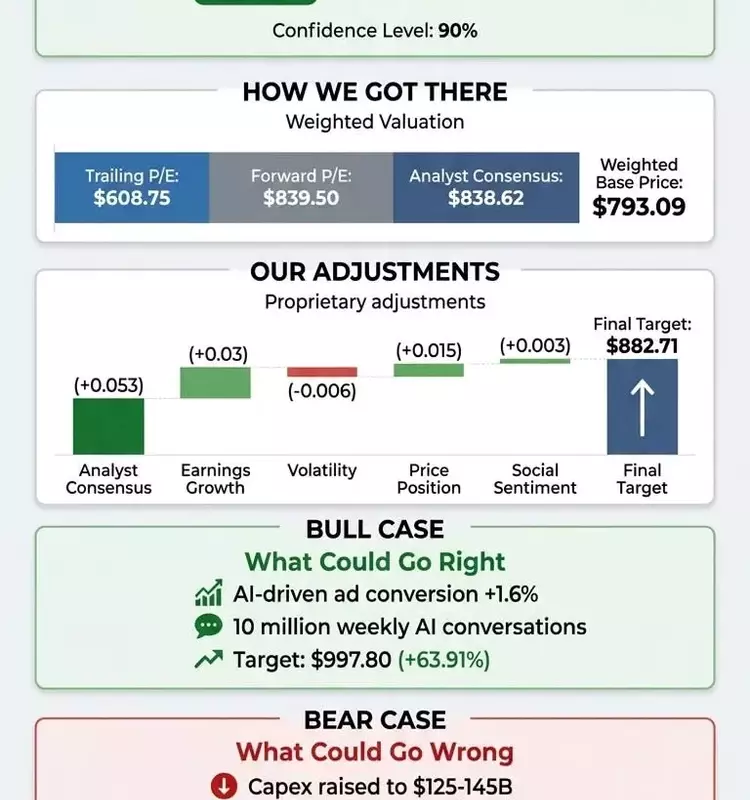
Meta Platforms recently unveiled robust first-quarter results for 2026, showcasing a remarkable 33% surge in revenue and earnings per share that significantly surpassed analyst expectations. This impressive performance is largely attributed to the company's advancements in AI-driven advertising and enhanced user engagement across its platforms, particularly Instagram Reels and Facebook video. However, the market reacted with a sell-off following the announcement of a substantial increase in capital expenditure guidance for 2026, prompting discussions about the balance between aggressive investment in AI infrastructure and short-term financial pressures. Despite this, financial analysts at 24/7 Wall St. maintain a confident 'buy' rating for Meta, projecting a significant price target of $882.71, with the potential for the stock to climb above $1,000 in a bullish scenario, fueled by continued AI innovation and expanding market reach.
Meta's Q1 2026 Performance and Future Outlook
In early May 2026, Meta Platforms (NASDAQ:META) released its first-quarter financial report, revealing a robust 33% year-over-year revenue growth, reaching an impressive $56.31 billion. The company’s earnings per share (EPS) stood at $10.44, comfortably exceeding market consensus by 57%. This strong financial showing was largely propelled by a 19% increase in ad impressions and a 12% rise in the price per advertisement, highlighting the effectiveness of Meta's AI-powered advertising solutions. Despite these stellar figures, the stock experienced a notable dip, falling from $671.77 to $608.745, as management revised its 2026 capital expenditure guidance upwards to a range of $125 billion to $145 billion. This increased spending plan, primarily aimed at AI infrastructure and the Reality Labs division, has raised investor concerns regarding potential near-term margin compression and free cash flow growth. Nevertheless, financial strategists from 24/7 Wall St. have set a 12-month price target of $882.71 for Meta, indicating a substantial 45% upside from its recent trading price, with a strong 'buy' recommendation. They emphasize that the company's continued investment in AI, particularly its adaptive ranking model which boosted ad conversion rates by 1.6%, and the success of its value optimization suite, generating over $20 billion in annual revenue, position Meta for long-term growth. Furthermore, strong engagement gains on Instagram Reels (10% increase in time spent) and Facebook video (over 8% jump in time spent) underscore the platform's expanding user interaction. The bull case scenario, bolstered by 10 million weekly business AI conversations and Mark Zuckerberg's vision for 'personal superintelligence,' anticipates a potential target of $997.80, representing a 63.91% total return. However, risks such as the elevated capital expenditures, the $4.03 billion Q1 loss from Reality Labs, ongoing youth-related litigation, and EU regulatory pressures could present challenges. Despite these concerns, strong internal demand signals for compute resources and constructive insider trading activity suggest confidence in Meta's strategic direction. The analysts project Meta's stock could reach $1,112.87 by 2027, and potentially $1,702.49 by 2030, assuming consistent conversion of AI investments into advertising and engagement gains, though regulatory actions, economic downturns, or faster profitability of Reality Labs could influence these trajectories.
This quarter's events at Meta offer a fascinating study in market dynamics and the evolving landscape of technology investment. It prompts us to consider the delicate balance between aggressive, forward-looking innovation and immediate investor sentiment. While the market's reaction to increased capital expenditure might seem contradictory to stellar earnings, it underscores a deeper tension: the demand for instant gratification versus the patience required for transformative growth. Meta's commitment to AI, despite the short-term financial strain, suggests a strategic long-game aimed at redefining digital interaction and advertising. As observers, we are reminded that true innovation often comes with significant upfront costs and a period of uncertainty. The future success of Meta, and indeed many tech giants, may well hinge on their ability to convince stakeholders that these massive investments are not merely expenses, but foundational pillars for unprecedented future value, a testament to the adage that sometimes, one must spend to earn on a grand scale.
