Navigating Market Volatility with Straddle Options: A Comprehensive Guide
Finance

Navigating Market Volatility with Straddle Options: A Comprehensive Guide

authorBy Morgan Housel
DateJul 21, 2026
Read time2 min

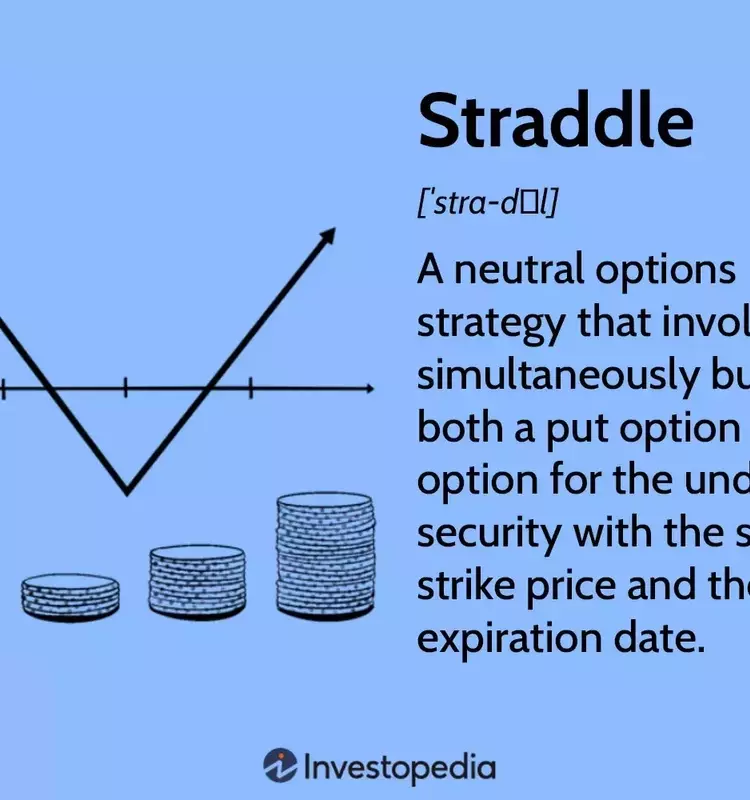
A straddle options strategy involves simultaneously purchasing both a call option and a put option for the same underlying asset, with identical strike prices and expiration dates. This approach is designed for investors who anticipate substantial price fluctuations but are uncertain about the direction of the movement. It allows for potential gains whether the asset's price rises sharply or falls dramatically.

To implement a straddle, investors first identify an underlying security expected to experience significant volatility. Next, they select a strike price and expiration date that align with their market predictions. Then, they acquire both a put and a call option at the chosen strike price and expiration date. The total cost of the straddle is the sum of the premiums paid for both options. Profit is realized if the asset's price moves beyond the combined premium cost in either direction by the expiration date. For example, if a stock trading at $55 has options premiums totaling $5, the stock must move beyond $50 or $60 to be profitable.

While straddles offer the advantage of profiting from volatility in either direction, they come with notable risks. The primary drawback is that the underlying asset's price must move significantly enough to cover the initial cost of both premiums. If the price remains stable or moves only slightly, the investor could incur losses, as one of the options will inevitably expire worthless. This strategy is particularly effective during periods of high anticipated volatility, such as around earnings reports or other major corporate announcements, but it is not suitable for all market conditions or for assets with low price volatility.

The straddle options strategy is a sophisticated tool that can be highly effective in volatile markets. By understanding how to construct and manage straddle positions, investors can position themselves to capitalize on uncertainty. However, it is crucial to carefully assess market conditions and the potential for significant price movements to ensure that the premiums paid are justified by the expected volatility, thereby mitigating the risk of losses if the market remains stagnant.

More Articles
Finance
Mastering the Zig Zag Indicator in Financial Markets
The Zig Zag indicator simplifies price data by filtering out minor fluctuations, making significant trend reversals and underlying market movements more visible. It is a technical analysis tool primarily used to clarify long-term trends and identify potential support and resistance levels. Traders often integrate it with Elliott Wave Theory and adjust its percentage setting for optimal performance across various securities.
By David RubensteinJul 21, 2026
Finance
Understanding Target-Date Funds: A Comprehensive Guide to Retirement Investing
Target-date funds (TDFs) offer a streamlined approach to retirement planning by automatically adjusting investment allocations as the target retirement date approaches. These funds begin with more aggressive growth-oriented assets and gradually transition to conservative fixed-income investments, making them ideal for investors seeking a hands-off strategy. This guide explores the mechanics, benefits, drawbacks, and crucial considerations for investing in TDFs, including fee structures and asset comparisons.
By Lisa JingJul 21, 2026
Finance
Intel's AI Resurgence: A Deep Dive into CPU Demand and Foundry Momentum
Intel Corporation has seen a significant rally in its stock, surpassing previous highs, fueled by renewed investor confidence in the role of CPUs within the evolving AI landscape. The shift from AI training to agentic AI promises increased demand for Intel's data center CPUs. The company's foundry business is also gaining traction, with its CEO, Lip-Bu Tan, being seen as a key asset in navigating industry volatility. Despite recent gains, the author maintains a 'Buy' rating due to the robust demand for data center CPUs and the positive momentum of the foundry operations.
By Nouriel RoubiniJul 21, 2026
Finance
Fidelity Blue Chip Growth Fund Delivers Exceptional Q2 Performance
The Fidelity Blue Chip Growth Fund, focusing on domestic equities with a large-cap bias and sustainable business models, achieved remarkable results in the second quarter. Its Retail Class shares saw a substantial gain of 26.39%, significantly outperforming the Russell 1000 Growth Index's 16.74% advance. This strong performance was primarily attributed to strategic investments in semiconductor-related businesses, particularly those benefiting from the burgeoning AI infrastructure sector, alongside adept security selection within the technology space.
By Nouriel RoubiniJul 21, 2026
Finance
Understanding Material Participation Tests for Tax Purposes
The IRS utilizes a framework of Material Participation Tests to ascertain a taxpayer's engagement level in various income-generating activities. This involvement dictates how losses from these activities can be treated for tax purposes. Meeting at least one of the seven established criteria can enable taxpayers to fully deduct losses, whereas failing to do so may lead to limitations under passive activity rules. These guidelines are crucial for distinguishing between active and passive income and managing tax liabilities effectively.
By Strive MasiyiwaJul 21, 2026