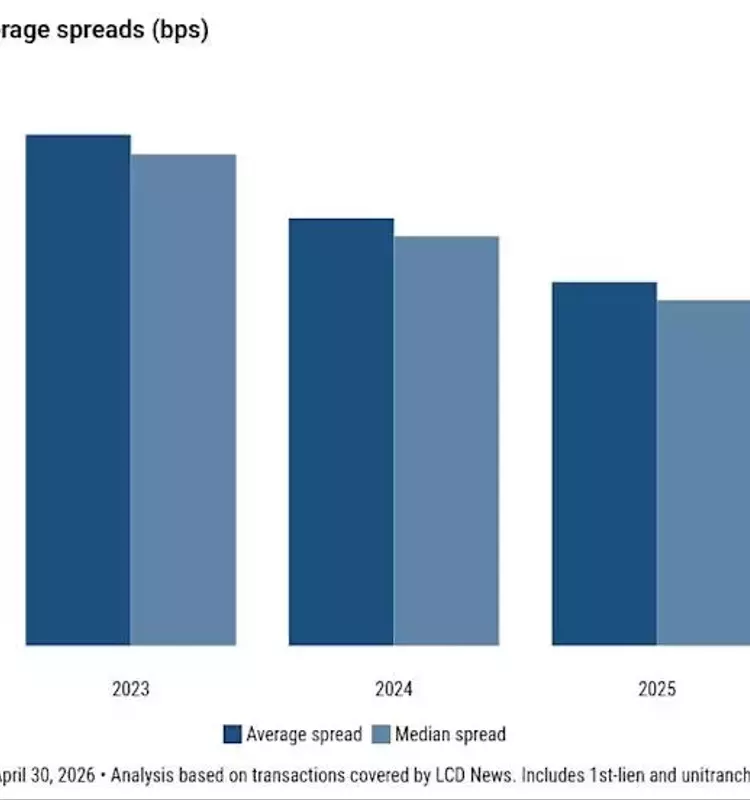
The landscape of private credit is currently undergoing a significant transformation, marked by a growing disparity in loan pricing between the United States and Europe. In the US, market volatility and a retrenchment among lenders have led to a substantial widening of spreads, making loans more expensive for borrowers. Conversely, the European market has maintained more stable spreads, driven by a different set of supply and demand dynamics, including abundant capital and a more competitive lending environment. This evolving situation is compelling market participants on both continents to reassess their strategies and lending practices, highlighting regional differences in how private credit markets are responding to broader economic conditions and investor behavior. The shift also underscores the impact of sector-specific challenges, such as those faced by software companies, which are now experiencing heightened scrutiny and higher borrowing costs.
This divergence is further influenced by the withdrawal of capital from certain US private credit funds, such as non-traded Business Development Companies (BDCs), which are facing redemption requests and a preference for share buybacks over new investments. Meanwhile, European private debt funds have accumulated record levels of 'dry powder,' leading to intense competition for lending opportunities in a quieter M&A market. The interplay of these factors is creating distinct challenges and opportunities for private credit lenders, prompting a re-evaluation of risk appetites and investment strategies on both sides of the Atlantic.
Transatlantic Divide in Private Credit Spreads
The private credit sector is currently observing a notable divergence in lending spreads across the Atlantic. In the United States, there has been a considerable increase in spreads, largely attributed to heightened market volatility and a reduced number of active lenders. This situation has empowered US lenders to command higher returns on their loans. In contrast, the European private credit market has seen spreads remain comparatively consistent, even experiencing some tightening in recent periods. This transatlantic split in pricing dynamics is creating distinct operating environments for private credit providers and borrowers alike, influencing investment decisions and capital allocation strategies globally. The shifting landscape underscores the nuanced interplay of regional economic conditions, investor sentiment, and competitive pressures that define these markets.
Historically, European private credit has often commanded a premium over its American counterpart, but this trend is now reversing. Data indicates that US spreads have widened by 50-100 basis points across most transactions, with typical deals now pricing around 525 basis points. Meanwhile, European direct lending spreads have averaged around 509 basis points over the past year, a slight decrease from the previous year. This change is partly driven by a reduction in liquidity in the US market, as some lenders have become more cautious due to concerns about geopolitical stability and the performance of certain sectors, such as technology. Conversely, Europe's market continues to be characterized by intense competition among lenders, fueled by significant capital raises and a search for deployment opportunities amid a slower M&A environment.
Market Dynamics and Sector-Specific Headwinds
The current market dynamics in private credit are shaped by distinct regional forces and sector-specific challenges. In the US, lenders have become more conservative, partly due to a surge in redemption requests from non-traded Business Development Companies (BDCs) and a broader re-evaluation of risk. This retrenchment has created a less competitive lending environment, leading to wider spreads and more lender-friendly terms. European lenders, however, are grappling with an abundance of capital (dry powder) and a quieter M&A landscape, which intensifies competition for quality deals and keeps spreads tighter. This imbalance compels European institutions to focus on winning deployment opportunities, even if it means accepting more modest margins. This situation is further complicated by varying approaches to sector-specific risks, particularly within the software industry.
The software sector exemplifies the differential approaches taken by US and European lenders. In the US, private credit providers are exercising greater caution with software companies, leading to a substantial increase in spreads for borrowers in this segment, with some reaching up to 1,000 basis points. This reflects a more discerning attitude towards individual credits and a move away from previously aggressive lending practices. European lenders, while not abandoning the software sector, are demonstrating a nuanced approach, carefully assessing individual companies based on their susceptibility or adaptability to trends like artificial intelligence. They are more likely to make a binary assessment of whether a deal is viable, rather than relying solely on increased margins to offset risk. This detailed scrutiny across the software sector highlights how both markets are responding to evolving technological landscapes and associated investment risks.
