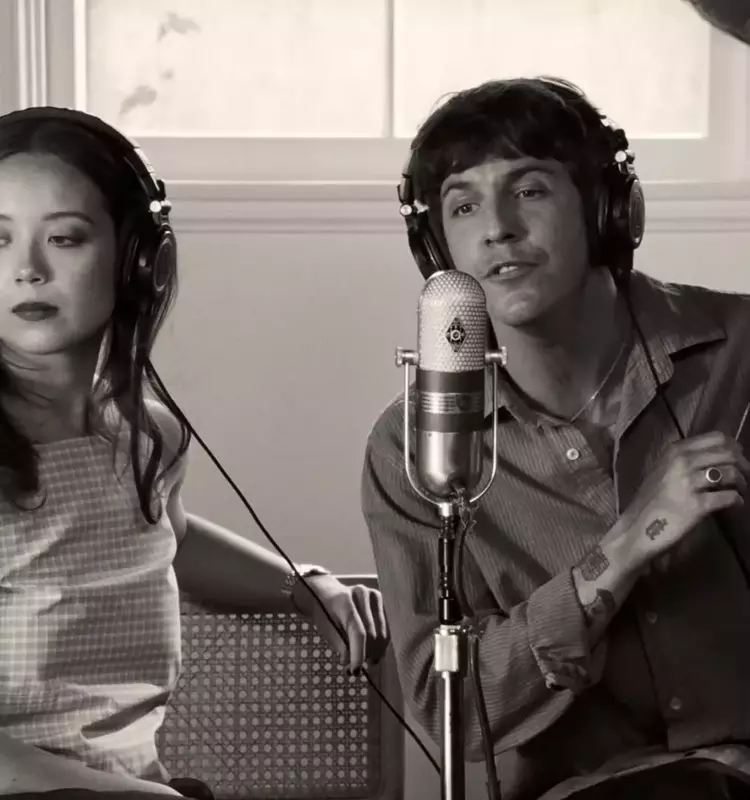
In a compelling demonstration of artistic collaboration, musicians Role Model and Laufey have unveiled the official visual accompaniment for their collaborative track, 'The Longest Goodbye.' This black-and-white cinematic piece captures the raw essence of their duet, presenting an intimate portrayal of emotional resonance. The video eschews conventional music video tropes, instead opting for a stripped-down approach that prioritizes genuine sentiment, reflecting a powerful, unvarnished connection to the song's thematic core.
A Poignant Visual Narrative for 'The Longest Goodbye'
On July 9, 2025, the music world received the much-anticipated official music video for the duet version of 'The Longest Goodbye,' a collaboration between Role Model and Laufey. The visual narrative, presented in a striking black-and-white aesthetic, focuses intensely on the two artists sharing a singular microphone. This intimate setting amplifies the song's profound lyrical content, particularly lines such as Role Model's melancholic realization, \"Now you’re changin’ and movin’, I’ll take my ass to Houston/’Cause I don’t think you love me anymore,\" and Laufey's equally poignant counterpoint, \"Instead of blamin’ and bruisin’ and watching what I’m losin’/I don’t think I love you anymore.\"
This duet originally appeared as a solo track on Role Model's expanded second studio album, Kansas Anymore (The Longest Goodbye). Laufey expressed her enthusiasm for the collaboration on Instagram, noting that the song had \"just got longer,\" referring to its new, extended life as a duet. Role Model further elaborated on the video's authenticity in an Instagram Story, revealing, \"The video is actually us recording the take that we put out. Ain’t no lip-syncing, no match cutting. We put two cameras in there, because we recorded the original version in Noah’s living room with that mic. Miss Laufey was kind enough to come in and do that. Nothing fake about it, because that’s just super vulnerable and raw and honest of us. That’s what music is about.\" This behind-the-scenes detail underscores the artists' commitment to transparency and emotional truth in their work.
The genesis of this collaboration dates back to Role Model's recent headlining tour. During a live performance in Los Angeles, Role Model invited Laufey to join him on stage. He recounted to V Man, \"I asked her to come sing it onstage during my L.A. show, and as soon as I heard her sing the first line of the second verse I was like, ‘Oh, we need to record this.'\" He praised Laufey's contribution, stating, \"I couldn’t think of a better voice to sing that song. Her voice is timeless, and that was kind of the word of the day when I was originally writing that song last year. I wanted to end the album with a very sonically timeless and classic song, and her voice brought it there for me.\"
Regarding his album Kansas Anymore, Role Model recently shared with Rolling Stone his intentions: \"the one thing I wanted to prove when I first put it out was my growth — my songwriting and my taste in music had matured, and I had also matured as a person. It felt like a big shift in the way I would talk about things and write about them, and a big part of that was just me getting to a place on guitar where I could play well enough that I could write songs by myself on it.\" This reflects a continuous artistic evolution, perfectly encapsulated by his collaboration with Laufey.
From a journalistic perspective, the release of 'The Longest Goodbye' music video highlights a compelling trend in contemporary music: the embrace of raw, unpolished authenticity. In an era often dominated by highly produced visuals, Role Model and Laufey's decision to present a video that essentially captures a live, unadulterated recording session is both refreshing and impactful. This choice not only deepens the emotional connection to the song but also serves as a powerful reminder that true artistry often lies in vulnerability and sincerity, rather than elaborate spectacle. It inspires a re-evaluation of what constitutes a 'music video' in the digital age, suggesting that perhaps the most resonant visuals are those that strip away the artifice and simply allow the music, and the artists, to speak for themselves.