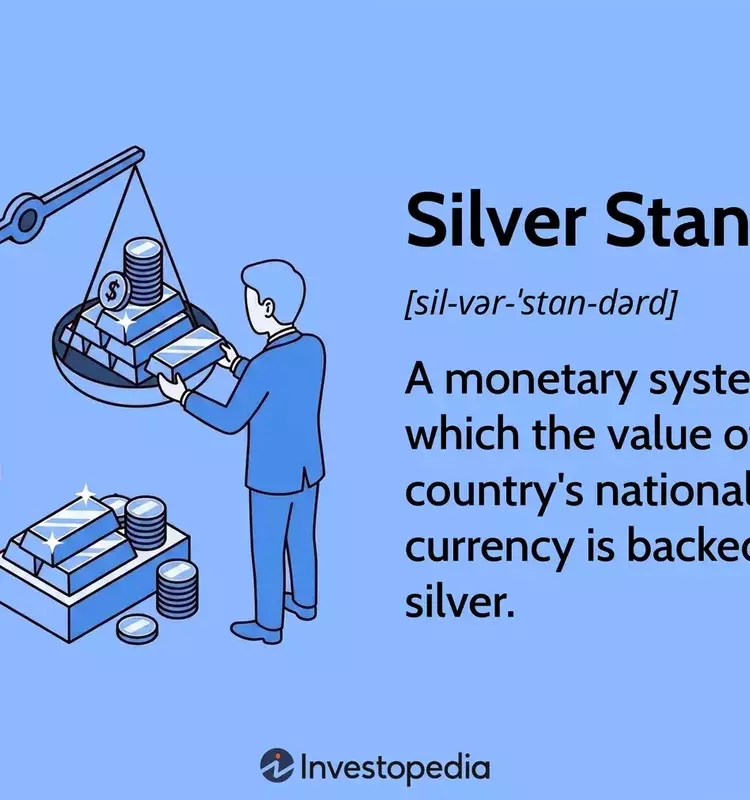
The silver standard, a monetary framework tying a nation's currency value to a specified amount of physical silver, functioned similarly to the gold standard. This system enabled individuals to exchange their currency for a predetermined quantity of silver, serving as a safeguard against governmental practices that could diminish currency value through excessive money creation.
Throughout history, the silver standard was widely adopted, influencing economic stability across various civilizations. However, its prevalence declined significantly during the 20th century as countries transitioned to fiat money systems, where currency value is not backed by a physical commodity. Today, no country operates under a silver or gold standard, reflecting a global shift towards flexible monetary policies.
Understanding the Silver Standard's Mechanism
The silver standard represents a monetary policy where the intrinsic value of a country's currency is directly linked to a fixed weight of silver. This framework, akin to the historical gold standard, aims to provide stability and maintain the purchasing power of the national currency. Under this system, individuals holding currency are granted the right to convert their money into a specific quantity of silver, thereby limiting the government's ability to arbitrarily increase the money supply. This convertibility was intended to act as a natural check against inflationary pressures and the debasement of currency, as the creation of new currency would necessitate a corresponding increase in silver reserves.
Historically, the implementation of the silver standard involved establishing a fixed exchange rate between the national currency and silver. This mechanism ensured that the value of money was consistently tethered to a tangible asset, providing a sense of economic security. The finite nature of silver, requiring physical extraction and minting, inherently restricted the government's capacity to produce new currency without sufficient backing. This constraint was a core principle for proponents of the silver standard, who believed it was essential for preserving the long-term integrity and value of a nation's monetary unit against political manipulation.
Historical Evolution and Global Abandonment
The silver standard boasts a rich history, with its origins tracing back to ancient Greece, where silver was among the earliest metals utilized as a medium of exchange. Following the collapse of the Roman Empire, its adoption became widespread, influencing monetary systems in diverse regions such as China, India, Bohemia, Great Britain, and the burgeoning United States. Early in American history, the national currency operated on a bimetallic system, valuing both silver and gold, though silver coins often predominated in circulation.
A pivotal shift occurred in the United States in 1834 when Congress altered the silver-to-gold ratio, inadvertently prompting a surge in silver exports and a subsequent scarcity of silver coinage. This development led to gold emerging as the primary currency. Further evolution in 1862 saw the introduction of fiat money, a revolutionary concept at the time, which detached currency from any metallic backing. Despite initial resistance, this trend gained momentum globally. By 1971, the U.S., under President Nixon, fully severed the dollar's convertibility to precious metals, marking a definitive move away from commodity-backed currencies. This global transition meant that by today, no nation adheres to either a silver or gold standard, with the last vestiges of the silver standard officially ending when countries like China and Hong Kong abandoned it in 1935, solidifying the worldwide embrace of fiat money systems.
