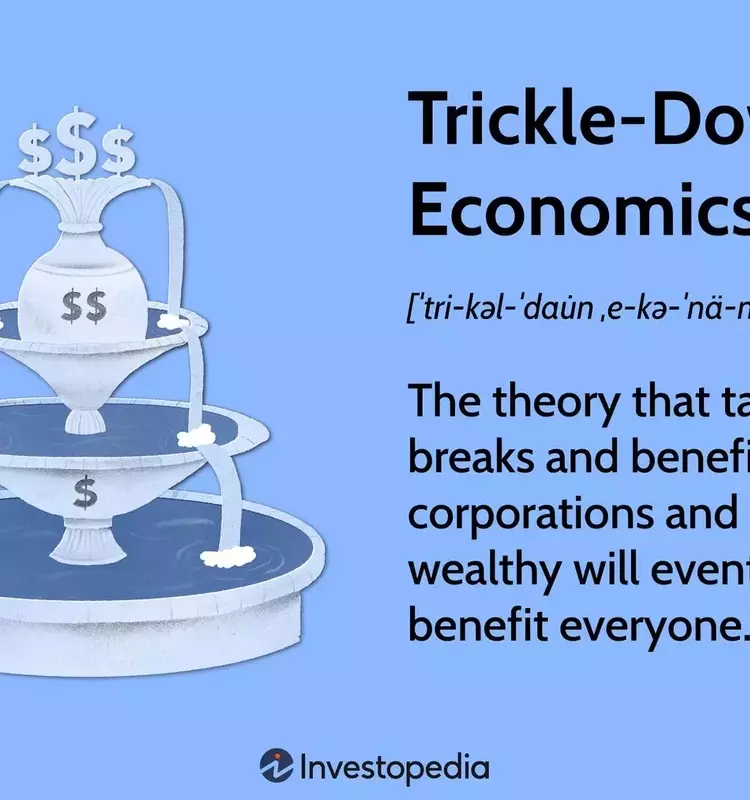
Trickle-down economics is an economic theory that suggests that benefits for the wealthy and businesses will ultimately benefit everyone in society. This concept, often associated with supply-side economics, proposes that reducing taxes for corporations and high-income earners will stimulate investment, foster job creation, and lead to overall economic growth. However, this theory has faced significant criticism, with many economists arguing that it tends to widen income inequality and offers limited direct advantages to lower and middle-income households.
At its core, trickle-down economics is a debated political concept rooted in the broader framework of supply-side economics. There isn't a single, universally defined set of policies explicitly labeled as "trickle-down." Instead, any policy that primarily benefits affluent individuals and corporations in the short term, with the stated goal of improving the living standards of all citizens in the long run, falls under this umbrella. Historical examples include economic stimulus measures implemented during President Herbert Hoover's administration and the income tax reductions enacted under President Ronald Reagan.
Proponents of supply-side economics believe that easing regulations and cutting taxes for businesses and high-income individuals incentivize companies to invest more, leading to business expansion and increased employment. These policies often begin with corporate income tax reductions and deregulation. The idea is that with more capital retained within the corporate sector, businesses will invest in new facilities, upgrade technology, purchase equipment, and expand their workforce. Simultaneously, wealthier individuals are expected to increase their spending, thereby boosting demand for various goods and services across the economy. This surge in economic activity, fueled by increased employment and consumer spending, is predicted to drive growth in sectors such as housing, automotive, consumer goods, and retail. According to trickle-down economic theory, this economic expansion would ultimately generate higher tax revenues, effectively offsetting the initial tax cuts for the wealthy and corporations.
A key concept influencing trickle-down economics is the Laffer Curve, developed by American economist Arthur Laffer, who served in the Reagan administration. This bell-shaped curve illustrates the theoretical relationship between government tax rates and tax revenue. Laffer's analysis suggests that both extremely low (0%) and extremely high (100%) tax rates would result in zero government revenue. At 0%, no taxes are collected, while at 100%, there is no incentive for individuals to earn income. The curve posits that there is an optimal tax rate that maximizes government revenue, and reducing tax rates below this point could actually increase taxable income and boost overall revenue. During Reagan's presidency, the top tax rate was significantly lowered from 70% to 28%, and federal receipts subsequently increased from $599 billion to $991 billion. While these figures appeared to support some aspects of the Laffer Curve, they did not definitively establish a causal link between reduced top tax rates and improved economic conditions for low- and middle-income earners.
Despite arguments from trickle-down proponents that funneling more money to the wealthy and corporations stimulates spending and free-market capitalism, critics contend that these policies often require government intervention and can distort the economy. A major point of contention is the potential for these benefits to exacerbate income inequality, as tax cuts disproportionately favor the wealthy, leaving lower-income individuals with minimal direct advantages. Many economists argue that stimulating the economy is more effectively achieved by providing tax cuts to poor and working-class families, who are more likely to spend their additional income on goods and services, thereby increasing demand. In contrast, tax cuts for corporations might be used for stock buybacks or retained as increased savings by the wealthy, with less immediate impact on broader economic activity. Economic growth is influenced by a multitude of factors, including monetary policies from central banks like the Federal Reserve, interest rates, international trade, exports, and foreign direct investment. A London School of Economics report from December 2020, which analyzed five decades of tax cuts across 18 affluent nations, concluded that such policies consistently benefited the wealthy but had no significant impact on unemployment rates or overall economic growth.
Trickle-down economics is an economic principle based on the belief that giving tax breaks and financial advantages to large corporations and wealthy individuals will stimulate the economy and improve living standards for all. This theory has guided the policies of several U.S. presidents, including Hoover, Reagan, and Trump, with prominent examples such as Reaganomics and the Tax Cuts and Jobs Act. However, critics argue that these policies contribute to increased income inequality and fail to deliver on their promise of widespread economic benefits. Numerous studies also raise doubts about their effectiveness in genuinely fostering economic growth and reducing unemployment.
