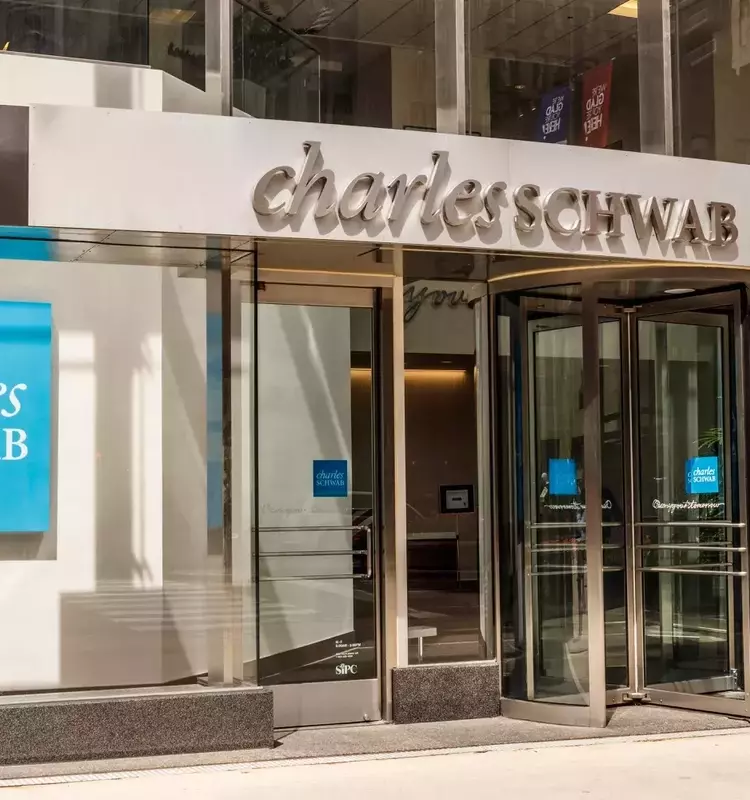
Charles Schwab is a major player in the financial services sector, renowned for its diverse offerings that span asset management, discount brokerage, banking, and advisory services. The firm's strategic move to eliminate trading commissions for stocks and ETFs in 2019 significantly reshaped the industry. With a vast array of services, including banking solutions, mutual funds, and exchange-traded funds, Schwab continues to serve a wide client base.
Initially recognized as a pioneer in discount brokerage, Charles Schwab's core business still heavily relies on this segment, facilitated by its subsidiary, Charles Schwab & Co. The company also operates Schwab Bank, a federal savings bank established in Reno, Nevada, in 2003, further diversifying its financial offerings. Beyond traditional banking, Schwab provides an extensive selection of mutual funds and ETFs accessible through various account types, including brokerage, individual retirement accounts (IRAs), and 529 college savings plans. Clients can engage with Schwab's services through multiple channels, including phone, online platforms, and physical branch offices.
Schwab has aggressively expanded its footprint in asset management and investment advisory, notably through its 2020 acquisition of TD Ameritrade. This acquisition brought in approximately 12 million new client accounts, an additional $1.3 trillion in client assets, and an annual revenue boost of $5 billion. By February 2026, Schwab's assets under management (AUM) had reached an impressive $12.22 trillion. The company also boasts 38.9 million active brokerage accounts, 5.8 million workplace plan participant accounts, and 2.3 million banking accounts.
A pivotal moment for Schwab and the broader financial industry was its decision in 2019 to cease charging trading commissions for stocks and ETFs in the U.S. This move prompted several major competitors to follow suit, fundamentally altering the competitive landscape for investors. Schwab's dominance in asset management is evident in its $12.22 trillion AUM, placing it ahead of major competitors like Fidelity ($7.1 trillion), Goldman Sachs (over $3.5 trillion), Vanguard ($12 trillion), and Morgan Stanley ($1.9 trillion). While some of these firms do not directly compete in discount brokerage, they are strong rivals in banking and advisory services.
Schwab's product offerings include over 3,000 ETFs and thousands of OneSource mutual funds, which are notable for their absence of loads or transaction fees. In comparison, Fidelity offers more than 400 ETFs and over 10,000 mutual funds, while Interactive Brokers provides access to more than 50,000 mutual funds. The company also offers extensive research services, providing clients with free stock reports from experts like Morningstar and Argus. This comprehensive suite of research tools is a key differentiator, though competitors such as Fidelity and Interactive Brokers also offer robust research capabilities.
Charles Schwab is a global financial powerhouse, offering a wide array of services including retail and commercial banking, wealth management, investment, and advisory services. With a network of over 350 offices across the United States, it provides retirement, brokerage, and checking/savings accounts. The firm's substantial assets under management and diverse service portfolio solidify its position as a highly competitive and influential entity in the financial market.
