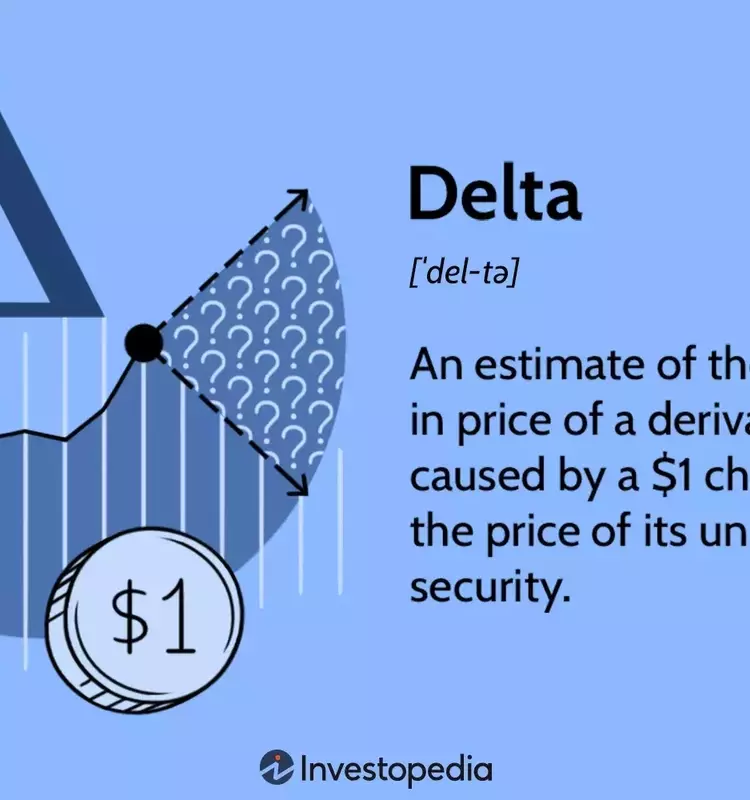
Delta serves as a vital indicator in the realm of options trading, offering a quantifiable measure of how susceptible a derivative's price is to shifts in the value of its foundational asset. This metric is instrumental for market participants seeking to gauge potential gains or losses and to strategically manage the inherent risks of their portfolios. The behavior of delta is distinct for various option types, providing predictable patterns that are leveraged by a diverse group of investors, from individual traders to large-scale hedge fund managers.
The Core Role of Delta in Options Trading
Delta, symbolized as Δ, is a risk measure integral to options trading, indicating the expected change in an option's value for every dollar movement in its underlying security. This metric empowers traders to grasp an option's sensitivity to market fluctuations, aiding in the estimation of potential profits or losses. Furthermore, delta is a cornerstone for constructing hedging strategies and effectively managing portfolio risk.
Originating from sophisticated pricing models, such as the widely recognized Black-Scholes model, delta is continuously calculated and disseminated by trading algorithms to assist market participants. Its value, which can be positive or negative depending on the option type, is particularly predictable for both call and put options. For instance, a call option's delta typically ranges from 0 to 1, signifying its price increase as the underlying asset appreciates. Conversely, a put option's delta falls between -1 and 0, reflecting its price decrease as the underlying asset gains value.
Delta spreading, a common options strategy, involves establishing a delta-neutral position where positive and negative deltas balance out. This is often achieved through a calendar spread, which entails simultaneously buying and selling options with differing expiration dates. The aim is to generate modest profits when the underlying asset's price remains stable. For example, if shares of 'BigCorp' are trading at $20 and a call option has a delta of 0.35, a $1 increase in BigCorp's stock price would lead to a 35-cent increase in the call option's price. Conversely, a put option with a delta of -0.65 would see its price decrease by 65 cents if BigCorp's stock price rises by $1. Traders also consider an option's gamma, which measures the rate of change of delta, to further refine their risk management.
Practical Applications of Delta
Options traders utilize delta in multiple ways. Firstly, it provides a clear understanding of directional risk, indicating how an option's price will react to changes in the underlying asset's price. Secondly, delta is crucial for achieving a delta-neutral position, which aims to mitigate risk by balancing the sensitivities of various options or underlying assets. For example, if a trader holds 100 call options, each with a delta of +0.40, they would sell 4,000 shares of stock to neutralize the position. Similarly, if they bought 100 put options with a delta of -0.30, they would purchase 3,000 shares to achieve delta neutrality.
For traders managing multiple option positions, assessing the 'portfolio delta' is essential. This involves summing the deltas of all positions to understand the overall directional exposure of the portfolio. A portfolio with a delta of +0.70 (e.g., from one call with +0.10 delta and two calls with +0.30 delta) could be made delta-neutral by adding a put with a -0.70 delta. Importantly, holding a single share of stock always represents a +1.0 delta position, while shorting a stock equates to a -1.0 delta.
Understanding delta is not merely an academic exercise; it is a practical necessity for anyone involved in derivatives trading. Derivatives are financial contracts whose value is derived from an underlying asset, and they inherently carry risks. By comprehending how delta functions, traders can make more informed decisions, manage their exposure, and potentially navigate the complexities of the market more effectively, transforming theoretical knowledge into tangible financial outcomes.
