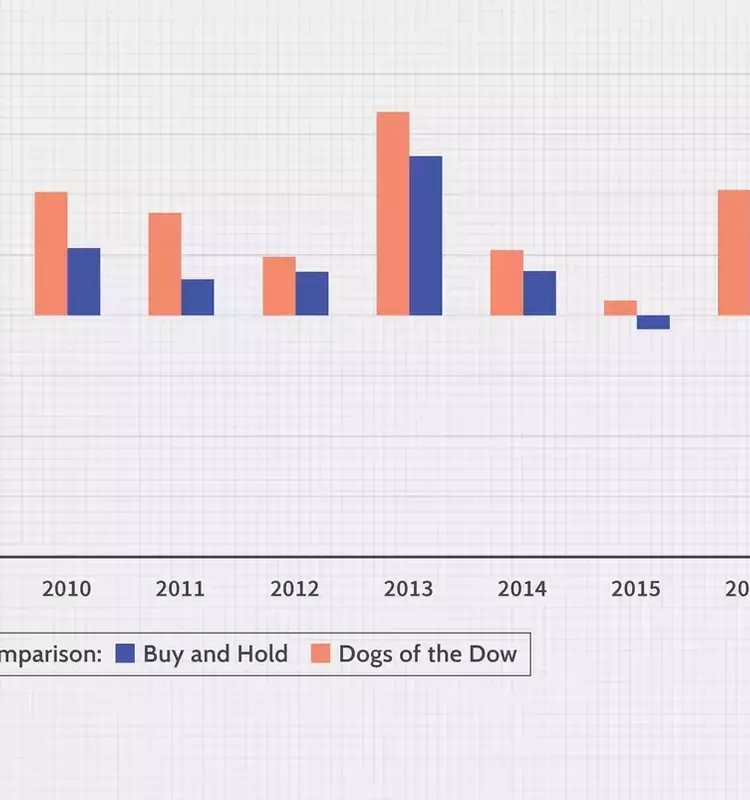
The "Dogs of the Dow" is an investment strategy centered on picking the ten highest dividend-yielding stocks from the Dow Jones Industrial Average (DJIA) annually. This approach, widely popularized by Michael O'Higgins' 1991 book 'Beating the Dow,' seeks to achieve superior returns compared to the broader market index. The core principle posits that blue-chip companies with high dividend yields are likely undervalued and poised for future growth, as their stock prices tend to fluctuate more than their stable dividend payouts. By reinvesting in these select companies each year, investors aim to capitalize on potential rebounds and generate competitive returns. While not always outperforming the DJIA in every single year, the strategy has historically demonstrated comparable or slightly better long-term performance, making it an appealing option for those seeking a disciplined, low-maintenance investment plan.
The methodology behind the Dogs of the Dow strategy is refreshingly simple, making it accessible to individual investors. At the close of trading on the final day of each calendar year, investors identify the ten stocks within the DJIA that boast the highest dividend yields. On the first trading day of the new year, an equal dollar amount is then invested in each of these ten companies. This portfolio is held for the entire year, after which the process is repeated, requiring an annual rebalancing of the holdings based on the new year's highest dividend payers. This systematic approach leverages the belief that blue-chip companies with high dividend yields are often temporarily out of favor, and their stock prices are likely to appreciate as they revert to their mean. The strategy relies on the inherent stability of dividends from well-established companies, which typically do not adjust their payouts as frequently as their stock prices react to market conditions.
The "Dogs of the Dow" Strategy: Simplicity Meets Potential Outperformance
The "Dogs of the Dow" investment strategy offers a clear-cut approach for investors looking to potentially surpass the performance of the Dow Jones Industrial Average (DJIA). This method, brought to prominence by Michael O'Higgins, involves annually selecting the ten companies from the DJIA that exhibit the highest dividend yields. The underlying assumption is that these high-yield, blue-chip stocks are often undervalued and are therefore positioned for future price appreciation. Investors allocate an equal amount of capital to each of these selected stocks at the start of the year, holding them for twelve months before repeating the selection process. This straightforward, rules-based system aims to leverage the tendency of established companies to maintain their dividend payments even when their stock prices might be temporarily depressed, suggesting a potential rebound. Historical analyses indicate that while the strategy's performance relative to the DJIA can vary year-to-year, it has shown a respectable track record over the long term, offering a disciplined way to participate in the market.
Understanding the core mechanics of the Dogs of the Dow strategy reveals its appeal, particularly for non-professional investors. The emphasis on high-dividend-yielding blue-chip stocks is rooted in the belief that such companies are fundamentally sound but may be experiencing temporary market disfavor, leading to a higher yield relative to their stock price. This dip in price is seen as an opportunity, as the stable dividend indicates underlying financial health. The annual rebalancing mechanism ensures that the portfolio consistently holds those companies deemed to be the most undervalued among the Dow components. This low-maintenance aspect, combined with its consistent application, makes the strategy attractive to those who prefer a less hands-on approach to investing. While the strategy has faced periods of underperformance, such as during the 2008 financial crisis, its cumulative returns over extended periods, like the decade following 2016, suggest its potential to deliver competitive, if not superior, results when compared to the broader index.
Performance and Practical Application of the Dogs of the Dow
Examining the performance of the Dogs of the Dow strategy highlights its historical efficacy, albeit with some fluctuations. While the strategy experienced larger losses during significant downturns like the 2008 financial crisis, it has often recovered and delivered strong returns in subsequent periods. Over the decade from 2016 to 2026, the Dogs of the Dow demonstrated a respectable trailing total return of 12.13%, closely trailing the DJIA's 13.74%. More recently, between 2021 and 2026, the strategy's total returns of 10.5% remained competitive with the DJIA's 10.95%, showcasing its consistent performance. Investors can implement this strategy by directly purchasing the individual stocks, which currently include companies like Verizon, Chevron, and Johnson & Johnson, or by investing in exchange-traded funds (ETFs) that track similar dividend-focused strategies within the Dow, such as the FT Vest DJIA Dogs 10 Target Income ETF (DOGG) or the Invesco Dow Jones Industrial Average Dividend ETF (DJD).
For those interested in implementing the Dogs of the Dow strategy, the process is quite accessible. Each year, typically on the last trading day, investors identify the ten companies within the Dow Jones Industrial Average that boast the highest dividend yields. These stocks are then purchased in equal dollar amounts on the first trading day of the new year. The portfolio is held for the entire year, and the process is repeated annually. This simple, rules-based approach aims to mitigate the complexities of active stock picking while still seeking to outperform the market. The strategy's long-term appeal lies in its emphasis on blue-chip companies with established dividend histories, which tend to be more resilient during market volatility. While investors can manage this strategy manually, the emergence of specialized ETFs provides a convenient avenue for gaining exposure to the Dogs of the Dow, further simplifying its adoption for a wider range of investors seeking a blend of income and capital appreciation.
