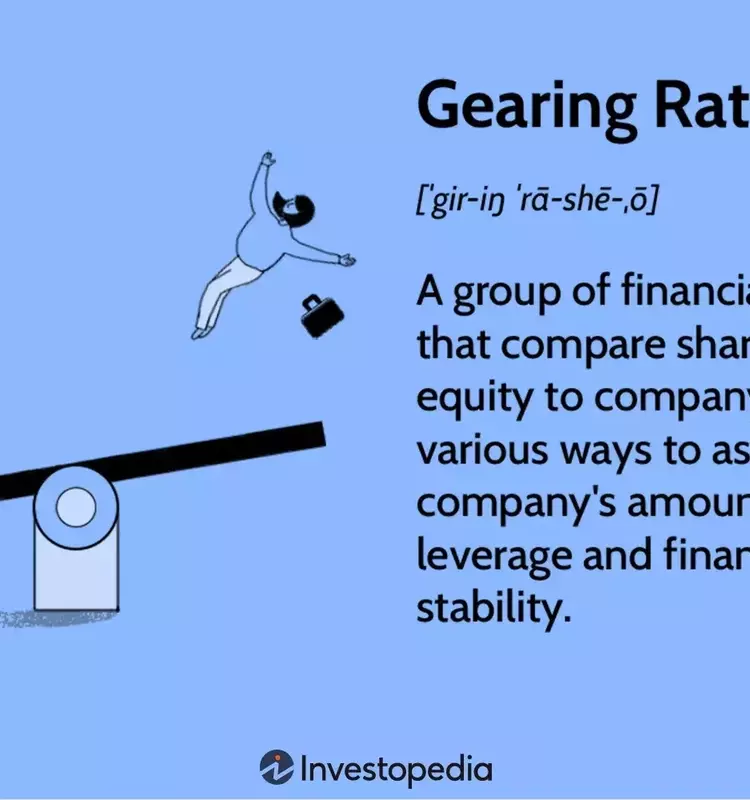
Understanding Gearing Ratios: A Key to Financial Health
Finance

Understanding Gearing Ratios: A Key to Financial Health

authorBy Suze Orman
DateApr 29, 2026
Read time3 min

Gearing ratios serve as essential financial indicators, shedding light on a company's capital structure by comparing its reliance on borrowed funds (debt) against its owner's investment (equity). These ratios are fundamental for evaluating a business's financial health and its susceptibility to financial risks. A company's gearing ratio is particularly insightful when benchmarked against industry peers, providing context for its financial stability.

Several types of gearing ratios exist, each offering a unique perspective on a company's leverage. Prominent examples include the debt-to-equity ratio, which contrasts total debt with total equity; the times interest earned ratio, measuring a company's ability to cover interest payments; the equity ratio, comparing equity to total assets; and the debt ratio, which relates total debt to total assets. A higher gearing ratio typically signifies greater financial leverage, indicating an increased reliance on debt financing. Conversely, a lower ratio suggests a stronger equity base and potentially less financial risk. These metrics are instrumental for both internal strategic planning and external evaluations by financial institutions considering loan applications.

The interpretation of gearing ratios requires careful consideration of various factors. While a high ratio often points to elevated leverage and a riskier financial structure, it doesn't automatically equate to poor financial health. For instance, companies operating in regulated sectors or those with monopolistic advantages might exhibit higher gearing ratios due to their stable market positions and predictable cash flows. Industries that necessitate substantial investment in fixed assets, such as manufacturing or infrastructure, commonly rely on debt financing, leading to inherently higher gearing ratios. Therefore, it is imperative to analyze these ratios within the broader context of economic conditions, industry norms, and the specific operational characteristics of the company.

To effectively utilize gearing ratios, comparative analysis is key. Consider a company with a debt ratio of 0.6. While this figure provides some initial information about its financial framework, its true significance emerges when compared to competitors and industry averages. If the industry average debt ratio stands at 0.8 and a major rival's ratio is 0.9, then a company with a 0.6 ratio is performing favorably, suggesting a more conservative and potentially stable financing approach relative to its peers. This comparative insight allows stakeholders to make more informed judgments about the company's financial resilience and its capacity to withstand economic fluctuations.

Ultimately, gearing ratios are indispensable tools for understanding a company's financial dynamics. They provide a comprehensive view of how a company finances its operations, its level of financial risk, and its ability to meet its obligations. By examining these ratios in conjunction with industry standards and economic trends, investors, creditors, and management can gain valuable perspectives on a company's long-term viability and strategic direction.

More Articles
Finance
Active REIT ETF: Outperforming its Passive Counterparts
Cohen & Steers Real Estate Active ETF (CSRE) has demonstrated superior performance compared to passive REIT ETFs since its launch in early 2025. This success is attributed to its active management strategy, which includes deep sector knowledge, focused high-conviction investments, and a specific emphasis on technology-driven real estate. While offering diversification and historical outperformance, CSRE comes with higher fees and lower yields, making it suitable for total-return investors but less appealing for income-focused or cost-sensitive individuals.
By Lisa JingApr 29, 2026
Finance
Understanding Claims Reserves in the Insurance Industry
Claims reserves are funds set aside by insurance companies to cover future payments for policyholder claims that have not yet been settled. These reserves are a crucial component of an insurer's financial stability, ensuring they can meet their financial obligations. Actuarial methods are used to estimate these reserves, which are then recorded as liabilities on the company's balance sheet. Accurate estimation is vital for maintaining investor confidence and ensuring the long-term solvency of the insurance provider.
By David RubensteinApr 29, 2026
Finance
GOAU: Navigating the Gold Market with a Focus on Precious Metals Miners
The U.S. Global GO GOLD and Precious Metal Miners ETF (GOAU) provides investors with an actively managed avenue to invest in companies deriving at least half of their revenue from precious metals. This ETF has demonstrated strong performance over the past decade, outpacing the S&P 500, primarily due to the upward trajectory of precious metals prices and the robust profit margins of its constituent companies. Despite a modest dividend yield of 0.94%, GOAU is strategically positioned for continued growth, as gold prices are anticipated to rise further amidst ongoing global monetary expansion and persistent inflationary pressures. While a strong U.S. dollar and elevated oil prices present near-term challenges, the fundamental long-term investment case for gold and precious metals miners remains compelling.
By Lisa JingApr 29, 2026
Finance
Understanding Petty Cash in Business Operations
Petty cash refers to a small fund maintained by businesses for minor, immediate expenses where traditional payment methods like checks or credit cards are impractical. This article delves into the definition, management, recording, and reconciliation processes of petty cash, highlighting its role in streamlining small-scale transactions while addressing the inherent risks and controls necessary for its effective use in a modern financial landscape.
By Fareed ZakariaApr 29, 2026
Finance
Understanding Logistics in Business Management
Logistics is crucial for managing the flow and storage of resources and information within a supply chain, ensuring timely and accurate delivery to meet demand. This concept, originally a military term, has evolved significantly in the business sector. Effective logistics enhance efficiency, reduce costs, and provide a competitive advantage, directly impacting a company's financial success and customer satisfaction.
By Fareed ZakariaApr 29, 2026