Understanding Gross Sales: Definition, Calculation, and Significance
Finance

Understanding Gross Sales: Definition, Calculation, and Significance

authorBy Michele Ferrero
DateAug 26, 2026
Read time3 min

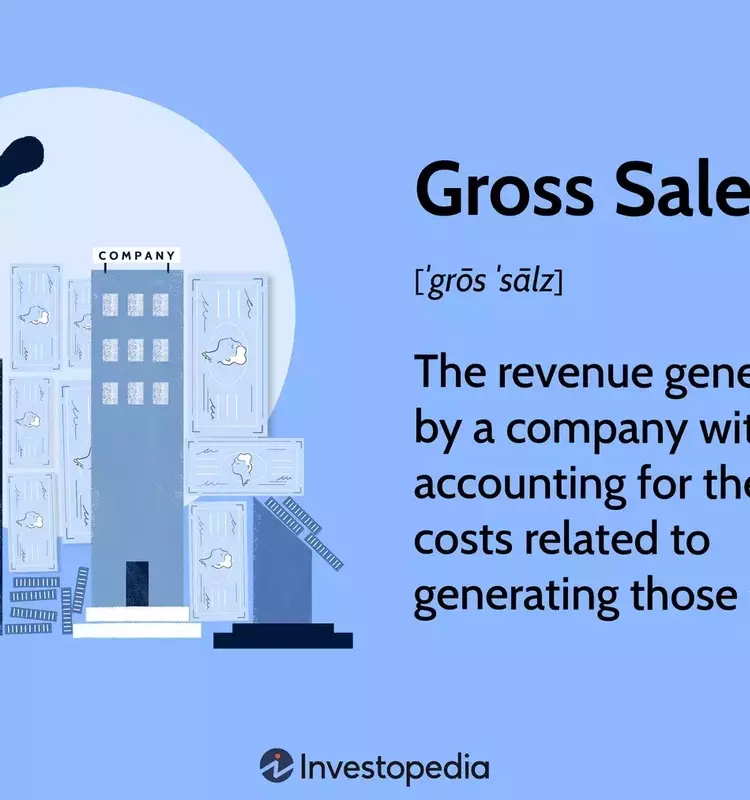
Gross sales, a fundamental financial metric, signifies a company's entire revenue generated from product or service transactions, prior to factoring in any deductions such as customer returns, offered discounts, or various allowances. Although this figure offers preliminary insights into a firm's market activity and sales volume, it doesn't present a full and accurate representation of its overall financial health. The true profitability and operational efficiency are not captured by gross sales alone.

The Essence and Computation of Gross Sales

Gross sales quantifies the collective value of all sales made over a specified period, without any adjustments. It's a foundational number that can indicate a company's market reach and its ability to move products or services. However, it’s crucial to understand that this figure is distinct from net revenue, as it consciously omits deductions that significantly impact a company's actual earnings.

To determine gross sales, a straightforward calculation is applied: multiply the total number of units sold by their respective selling price per unit. For instance, consider a fictional technology enterprise, Tech Innovations Inc. During a particular quarter, they successfully market 10,000 units of their flagship device, each priced at $200. Applying the formula, their gross sales for that quarter would be:

Gross Sales = 10,000 units × $200/unit = $2,000,000

This $2,000,000 represents the company's unadjusted revenue, before any considerations for operational costs, discounts, returns, or other allowances. This raw figure offers a glimpse into the company’s sales capabilities and market demand for its offerings.

While gross sales provides a direct measure of a company's sales prowess, particularly relevant for entities in the retail sector, it doesn't fully encapsulate the financial narrative. Unlike net sales, which factor in deductions like customer returns, sales allowances, and discounts, gross sales stand as a preliminary metric. Analysts often find it insightful to track both gross and net sales, along with the variance between them. A growing disparity could signal underlying issues, such as product quality concerns leading to increased returns, thereby offering a more nuanced understanding of a company's performance. However, because gross sales can present an inflated view of revenue, many companies opt to publicly report only net sales on their financial statements, which offers a more realistic portrayal of their top-line performance after all reductions have been applied.

From a journalist's perspective, the concept of gross sales serves as a compelling starting point for financial reporting. It allows for the initial, impactful announcement of a company’s market success or challenge, capturing immediate attention with large revenue figures. However, the true journalistic responsibility lies in delving deeper, beyond the superficiality of gross sales, to uncover the underlying story told by net sales and other financial indicators. The contrast between gross and net sales provides a critical lens through which to examine a company’s operational integrity and customer satisfaction. A significant gap might not just indicate financial adjustments but also reveal a broader narrative of product quality, competitive pressures, or strategic pricing decisions. Therefore, reporting on gross sales demands not just a statement of numbers, but an inquisitive exploration into what those numbers truly signify for a company’s long-term viability and public perception.

More Articles
Finance
Understanding Option Greeks: Key Metrics for Risk Assessment in Trading
Option Greeks are vital risk management tools for traders, each representing how different factors affect an option's price. Delta measures price sensitivity to the underlying asset, theta quantifies time decay, gamma assesses delta's stability, vega indicates volatility sensitivity, and rho gauges interest rate impact. These metrics enable traders to estimate potential payouts and manage their portfolios effectively in the dynamic options market.
By Michele FerreroAug 26, 2026
Finance
Understanding Month-to-Month Tenancy: Flexibility in Rental Agreements
A month-to-month tenancy is a rental agreement that renews automatically each month, offering both tenants and landlords greater flexibility compared to a fixed-term lease. This arrangement allows either party to terminate the agreement with appropriate notice, typically 30 days. While providing adaptability, it may also lead to less stability, higher rents, and potential for frequent changes in living or rental situations. This article explores the mechanics, advantages, disadvantages, and different types of tenancy agreements.
By David RubensteinAug 26, 2026
Finance
Mastering the Supertrend Indicator for Enhanced Trading
The Supertrend indicator is a valuable technical analysis tool for identifying market trends and generating trading signals. By combining Average True Range (ATR) with a multiplier, it provides dynamic support and resistance levels. While effective in trending markets, its limitations in sideways markets highlight the importance of integrating it with other technical indicators for comprehensive trading strategies.
By Strive MasiyiwaAug 26, 2026
Finance
David Tepper's Appaloosa Management Q2 2026 Portfolio Analysis
This analysis details the significant changes within David Tepper's Appaloosa Management's Q2 2026 portfolio, which expanded to approximately $7.73 billion. The portfolio's core consists of 27 holdings, with a strong concentration in its top five: Amazon, Micron Technology, Taiwan Semiconductor Manufacturing, Alphabet, and Uber. Key movements include substantial new investments in Apple, Boeing, American Airlines, and CrowdStrike, indicating fresh strategic convictions. Conversely, the firm fully divested from SanDisk, Microsoft, PDD Holdings, and KraneShares CSI China Internet ETF. Furthermore, significant increases were observed in holdings like Amazon, Taiwan Semiconductor Manufacturing, Alphabet, Uber, Meta Platforms, and the iShares MSCI South Korea ETF, highlighting a pronounced focus on technology and growth sectors. In contrast, positions in Micron Technology and Alibaba Group Holding were aggressively reduced, showcasing a dynamic and opportunistic approach to managing investment risks and opportunities.
By Michele FerreroAug 26, 2026
Finance
Understanding Green Marketing: Principles and Pitfalls
Green marketing involves promoting products based on their environmental benefits and sustainability. This approach has become increasingly vital as consumers prioritize eco-consciousness. While it offers advantages such as enhanced brand image and consumer loyalty, challenges like greenwashing and higher costs persist. Companies must genuinely commit to environmental initiatives to avoid misleading claims and potential penalties.
By Lisa JingAug 26, 2026