Understanding the Hundredweight (CWT) Measurement
Finance

Understanding the Hundredweight (CWT) Measurement

authorBy Michele Ferrero
DateJul 22, 2026
Read time2 min

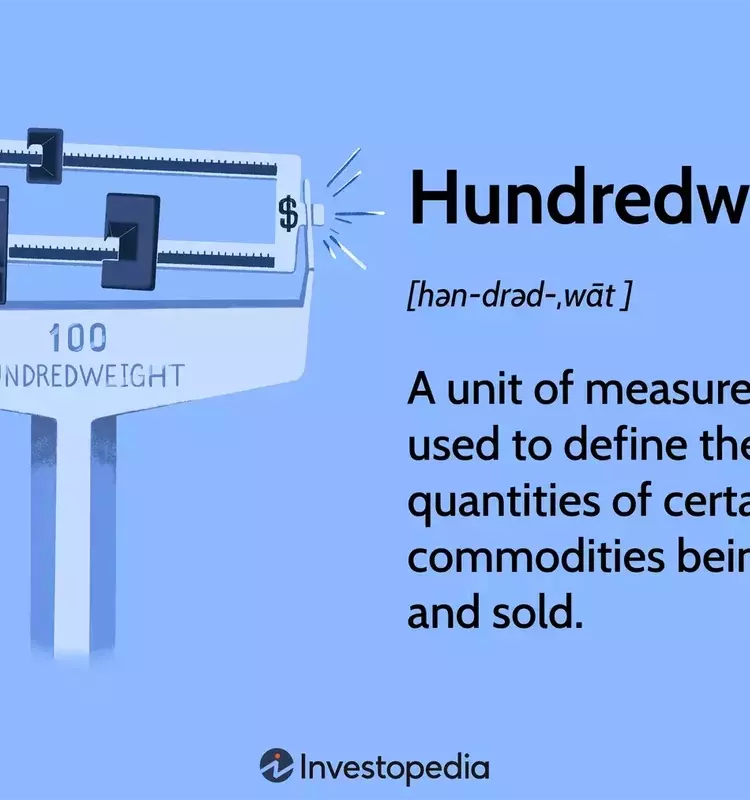
The hundredweight (CWT) is a traditional unit of weight, primarily used in agricultural sectors and for trading specific commodities. This measurement represents 100 pounds in the United States and Canada, while in the United Kingdom, it historically denotes 112 pounds. Although modern commerce increasingly favors the metric system, the hundredweight maintains its significance in certain industries and historical data.

Tracing its origins to the late Medieval European era, the hundredweight, derived from the French “avoirdupois” system, served as a crucial mass measurement for various goods like wax, sugar, and pepper. Initially, its exact value varied between 100 and 108 pounds. However, a standardized definition emerged in 1340 when King Edward III established one stone as 14 pounds, thereby setting one hundredweight at 112 pounds (equivalent to eight stones). This became legally codified in the U.K. through the Weights and Measures Act of 1878. In contrast, North America adopted a simpler definition of 100 pounds for the hundredweight, a practice that continues to this day. This dual definition has historically posed challenges for international trade. In the U.K., legal distinctions were even drawn between a 100-pound unit (referred to as a “cental” after 1879) and the 112-pound hundredweight to avoid confusion and prevent fraudulent activities.

In practical applications, the hundredweight is still prevalent in specific areas. For instance, in commodities markets, livestock such as cattle are often priced in hundredweights, and certain futures contracts for goods like rice are also denominated in this unit. Beyond agriculture, it’s also used for exceptionally heavy materials, such as steel, and for bulk products including paper and various chemicals. In the transportation industry, the hundredweight plays a role in shipping logistics. Businesses sending smaller loads to multiple destinations often opt for hundredweight pricing, especially for lighter items traveling shorter distances. This contrasts with less-than-truckload (LTL) shipping, which is more suitable for larger, heavier, or irregularly shaped items transported over longer distances, typically to a single destination like a warehouse.

While the metric system's global adoption has diminished the overall use of the hundredweight, it endures as a specialized unit in particular sectors. Its continued presence in agricultural markets and certain shipping contexts highlights its enduring utility for specific economic activities. This persistence underscores the practical adaptability and historical roots of various measurement systems in global commerce.

More Articles
Finance
Navigating Market Dynamics: Q2 Investment Insights and Macroeconomic Outlook
This report offers an in-depth analysis of Q2 investment performance, highlighting significant gains from key holdings like Uniqure and Gitlab. It also explores pressing macroeconomic concerns, particularly the overheated AI sector and potential global risks such as the Strait of Hormuz. The author expresses confidence in the portfolio's resilience amidst economic uncertainties, emphasizing value-oriented strategies and a balanced approach to market volatility.
By David RubensteinJul 22, 2026
Finance
The J. M. Smucker Company: A "Soft Buy" for Stable Growth and Value
The J. M. Smucker Company (SJM) receives a 'soft buy' rating due to its robust core business, improving financial leverage, and attractive valuation. The U.S. Retail Coffee segment is a key growth driver, benefiting from strong consumer demand and pricing power. Management projects 3-4% revenue growth and $9.75-$10.25 adjusted EPS, with a continued focus on debt reduction and operational efficiency, enhancing its investment appeal.
By Fareed ZakariaJul 22, 2026
Finance
Analyzing the Nuveen Core Plus Impact Fund (NPCT): A Deep Dive
This article offers an in-depth analysis of the Nuveen Core Plus Impact Fund (NPCT), highlighting its strategy of high current income and capital appreciation through a multi-sector, investment-grade portfolio with significant leverage. It examines the fund's long-duration profile, exposure to interest rate risks, and its active management approach. The discussion also covers NPCT's distribution rate, the substantial return of capital, and its historical total returns, emphasizing how its performance correlates with investment-grade spreads and interest rate fluctuations.
By David RubensteinJul 22, 2026
Finance
Ibotta: Navigating a Pivotal Business Transformation
Ibotta, Inc. (IBTA) receives a Hold rating with a target price of $32, reflecting a balanced view of its risks and opportunities during a significant business shift. The direct-to-consumer (D2C) app, a former high-margin segment, is experiencing a downturn, with first-quarter D2C revenue dropping by 25% and margins shrinking considerably. Growth within the Ibotta Performance Network (IPN), which operates on lower margins, has yet to offset these D2C losses, leading to an overall decline in revenue and profitability. However, new collaborations with major players like Uber Eats, Giant Eagle, and DoorDash present promising avenues for growth, though tangible evidence of a sustained financial recovery is still pending.
By Michele FerreroJul 22, 2026
Finance
Unlocking Market Secrets with the Money Flow Index: A Comprehensive Guide
The Money Flow Index (MFI) is a powerful technical analysis tool that combines price and volume data to gauge the strength of money flowing into or out of a security. This guide explores its calculation, interpretation, and how it differs from the Relative Strength Index (RSI), offering insights for traders to identify potential market reversals and make informed decisions.
By Michele FerreroJul 22, 2026