Unlocking Market Secrets: Navigating Inside Days for Smarter Trading
Defining Inside Days: A Signal of Market Pause
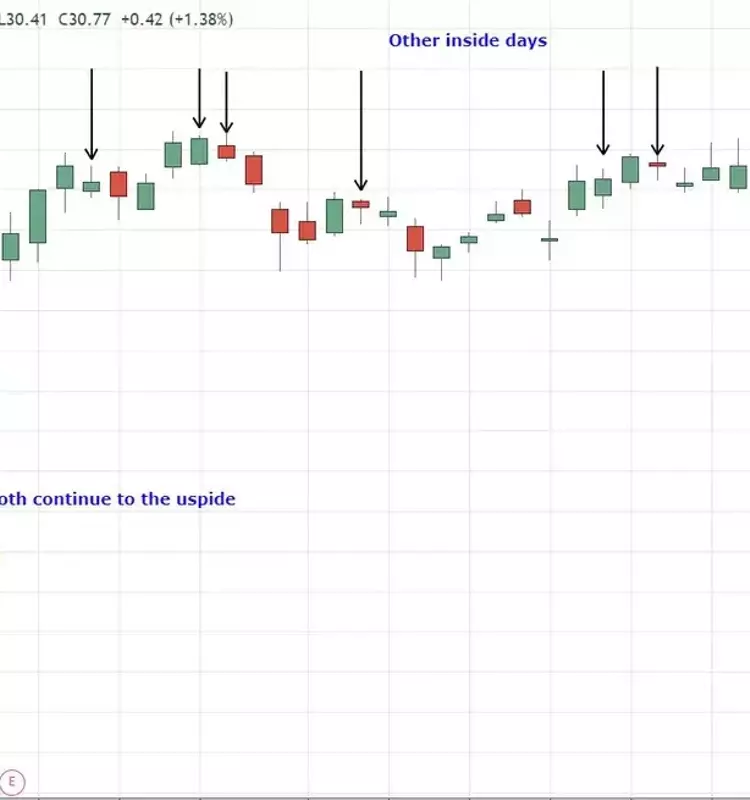
In the realm of technical analysis, an "inside day" is a visual cue on a price chart that suggests a period of market calm and potential consolidation. This pattern emerges when a security's daily price fluctuations, both its highest and lowest points, remain entirely within the boundaries set by the previous day's trading range. Such an occurrence hints at a temporary reduction in price movement, often preceding a more significant shift.
Visualizing Inside Day Formations on Candlestick Charts
Candlestick charts offer a clear representation of an asset's price movements throughout a trading day. The "wick" illustrates the day's extreme high and low, while the "body" indicates the opening and closing prices. An inside day is characterized by its candlestick being enveloped by the prior day's (or days') candlestick, signifying a tightening of the trading range. This confinement of price action often reflects a pause in market direction, which, if prolonged, can lead to a decisive breakout.
Practical Illustrations of Inside Day Patterns in Trading
Consider a stock's performance over two days. If Day 1 sees the stock open at $50, reach a high of $55, dip to $48, and close at $52, and Day 2's activity (an inside day) involves opening at $51, peaking at $54, dropping to $49, and closing at $53, then Day 2's entire price range is contained within Day 1's. This scenario exemplifies market indecision or consolidation. Such patterns are often paired with other technical analysis tools like the Relative Strength Index (RSI) or Moving Average Convergence Divergence (MACD) to gain deeper insights into potential market movements.
Strategic Approaches to Trading Inside Day Patterns
Engaging with the inside day pattern requires a precise strategy centered on identifying market dynamics and positioning for subsequent price movements. This involves careful consideration of the overarching market trend and the specific security's behavior.
Leveraging Inside Days in Bullish Market Environments
In a bullish market, recognizing an inside day involves confirming an upward trend through longer-term charts. Traders then await a price breakout above the inside day's high, often setting entry points at this threshold and using stop-loss orders below the inside day's low to mitigate risk. Integrating tools like moving averages or RSI helps refine these entry and exit strategies, ensuring a more comprehensive approach to trading decisions.
Adapting to Inside Days in Bearish Market Conditions
Conversely, in a bearish market, the initial step remains pattern identification, followed by confirmation of a downward trend. Traders pause until the price breaks below the inside day's low, signaling a potential continuation of the bearish trend. A short position is typically entered at this point, with stop-loss orders placed above the inside day's high to manage downside risk. Profit targets are established based on support levels or specific risk-reward ratios, emphasizing the need for a holistic trading strategy beyond a single pattern.
Other Complementary Patterns to Inside Days
Beyond the inside day, several other candlestick patterns offer additional insights into market sentiment and potential price shifts. These include the engulfing pattern, piercing line, dark cloud cover, morning stars, evening stars, three white soldiers, and three black crows. Each provides a unique perspective on market dynamics, but their efficacy is significantly enhanced when used in conjunction with other analytical tools.
Relevance of Inside Days Across Diverse Markets and Securities
Inside days hold significance across various markets and securities, though their interpretation is context-dependent. In individual stocks, they can indicate a pause in a trend, especially after sharp price movements, with external factors like earnings reports playing a crucial role. For highly volatile commodity markets, an inside day might signal a brief consolidation before a trend resumes or reverses, influenced by broader market conditions. In the perpetually liquid forex market, inside days primarily highlight periods of reduced volatility, hinting at impending breakouts in either direction.
Inherent Limitations of Relying Solely on the Inside Day Pattern
Despite its utility, the inside day pattern, like any technical indicator, has limitations. Over-reliance can lead to false breakouts, and its predictive power is low in isolation. Potential drawbacks include delayed entry, market sensitivity, the risk of overtrading, and a lack of a precise pattern-based risk-reward ratio. Therefore, it is crucial to integrate this pattern with other analytical methods and a robust risk management framework for more informed trading decisions.
